

132
C. Winograd
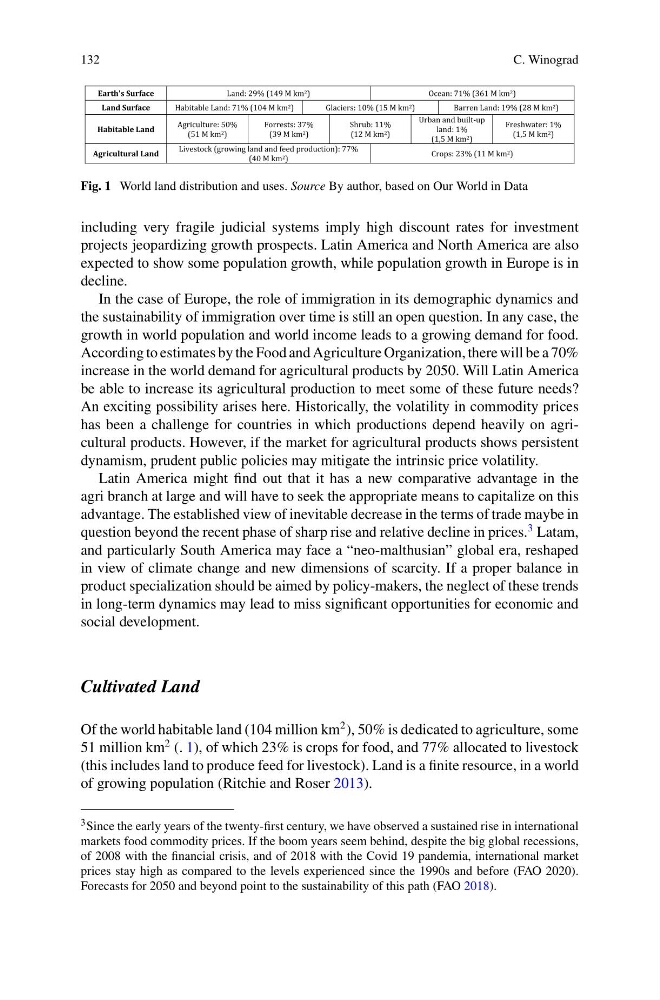
Fig. 1 World land distribution and uses. Source By author, based on Our World in Data
including very fragile judicial systems imply high discount rates for investment
projects jeopardizing growth prospects. Latin America and North America are also
expected to show some population growth, while population growth in Europe is in
decline.
In the case of Europe, the role of immigration in its demographic dynamics and
the sustainability of immigration over time is still an open question. In any case, the
growth in world population and world income leads to a growing demand for food.
According to estimates by the Food and Agriculture Organization, there will be a 70%
increase in the world demand for agricultural products by 2050. Will Latin America
be able to increase its agricultural production to meet some of these future needs?
An exciting possibility arises here. Historically, the volatility in commodity prices
has been a challenge for countries in which productions depend heavily on agricultural products. However, if the market for agricultural products shows persistent
dynamism, prudent public policies may mitigate the intrinsic price volatility.
Latin America might find out that it has a new comparative advantage in the
agri branch at large and will have to seek the appropriate means to capitalize on this
advantage. The established view of inevitable decrease in the terms of trade maybe in
question beyond the recent phase of sharp rise and relative decline in prices.
3 Latam,
and particularly South America may face a “neo-malthusian” global era, reshaped
in view of climate change and new dimensions of scarcity. If a proper balance in
product specialization should be aimed by policy-makers, the neglect of these trends
in long-term dynamics may lead to miss significant opportunities for economic and
social development.
Cultivated Land
Of the world habitable land (104 million km
2 ), 50% is dedicated to agriculture, some
51 million km
2 (. 1), of which 23% is crops for food, and 77% allocated to livestock
(this includes land to produce feed for livestock). Land is a finite resource, in a world
of growing population (Ritchie and Roser 2013).
3 Since the early years of the twenty-first century, we have observed a sustained rise in international
markets food commodity prices. If the boom years seem behind, despite the big global recessions,
of 2008 with the financial crisis, and of 2018 with the Covid 19 pandemia, international market
prices stay high as compared to the levels experienced since the 1990s and before (FAO 2020).
Forecasts for 2050 and beyond point to the sustainability of this path (FAO 2018).
C. Winograd
Fig. 1 World land distribution and uses. Source By author, based on Our World in Data
including very fragile judicial systems imply high discount rates for investment
projects jeopardizing growth prospects. Latin America and North America are also
expected to show some population growth, while population growth in Europe is in
decline.
In the case of Europe, the role of immigration in its demographic dynamics and
the sustainability of immigration over time is still an open question. In any case, the
growth in world population and world income leads to a growing demand for food.
According to estimates by the Food and Agriculture Organization, there will be a 70%
increase in the world demand for agricultural products by 2050. Will Latin America
be able to increase its agricultural production to meet some of these future needs?
An exciting possibility arises here. Historically, the volatility in commodity prices
has been a challenge for countries in which productions depend heavily on agricultural products. However, if the market for agricultural products shows persistent
dynamism, prudent public policies may mitigate the intrinsic price volatility.
Latin America might find out that it has a new comparative advantage in the
agri branch at large and will have to seek the appropriate means to capitalize on this
advantage. The established view of inevitable decrease in the terms of trade maybe in
question beyond the recent phase of sharp rise and relative decline in prices.
3 Latam,
and particularly South America may face a “neo-malthusian” global era, reshaped
in view of climate change and new dimensions of scarcity. If a proper balance in
product specialization should be aimed by policy-makers, the neglect of these trends
in long-term dynamics may lead to miss significant opportunities for economic and
social development.
Cultivated Land
Of the world habitable land (104 million km
2 ), 50% is dedicated to agriculture, some
51 million km
2 (. 1), of which 23% is crops for food, and 77% allocated to livestock
(this includes land to produce feed for livestock). Land is a finite resource, in a world
of growing population (Ritchie and Roser 2013).
3 Since the early years of the twenty-first century, we have observed a sustained rise in international
markets food commodity prices. If the boom years seem behind, despite the big global recessions,
of 2008 with the financial crisis, and of 2018 with the Covid 19 pandemia, international market
prices stay high as compared to the levels experienced since the 1990s and before (FAO 2020).
Forecasts for 2050 and beyond point to the sustainability of this path (FAO 2018).