

Carbon Taxes and Renewable Energy Subsidies: A Discussion About . . .
123
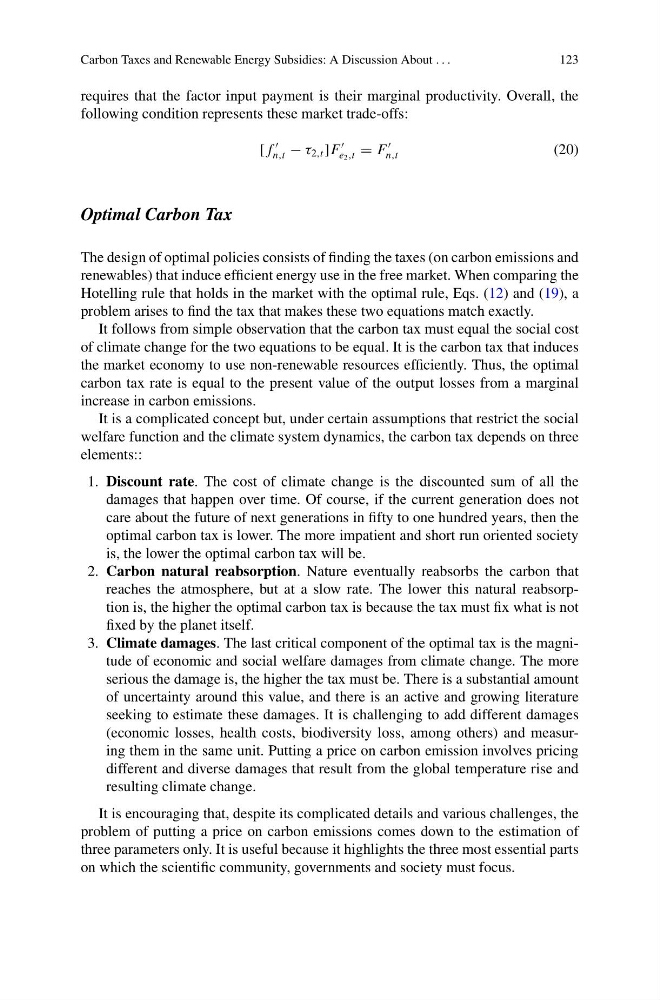
requires that the factor input payment is their marginal productivity. Overall, the
following condition represents these market trade-offs:
[ f
n,t − τ 2,t ]F
e 2 ,t = F
n,t
(20)
Optimal Carbon Tax
The design of optimal policies consists of finding the taxes (on carbon emissions and
renewables) that induce efficient energy use in the free market. When comparing the
Hotelling rule that holds in the market with the optimal rule, Eqs. (12) and (19), a
problem arises to find the tax that makes these two equations match exactly.
It follows from simple observation that the carbon tax must equal the social cost
of climate change for the two equations to be equal. It is the carbon tax that induces
the market economy to use non-renewable resources efficiently. Thus, the optimal
carbon tax rate is equal to the present value of the output losses from a marginal
increase in carbon emissions.
It is a complicated concept but, under certain assumptions that restrict the social
welfare function and the climate system dynamics, the carbon tax depends on three
elements::
1. Discount rate. The cost of climate change is the discounted sum of all the
damages that happen over time. Of course, if the current generation does not
care about the future of next generations in fifty to one hundred years, then the
optimal carbon tax is lower. The more impatient and short run oriented society
is, the lower the optimal carbon tax will be.
2. Carbon natural reabsorption. Nature eventually reabsorbs the carbon that
reaches the atmosphere, but at a slow rate. The lower this natural reabsorption is, the higher the optimal carbon tax is because the tax must fix what is not
fixed by the planet itself.
3. Climate damages. The last critical component of the optimal tax is the magnitude of economic and social welfare damages from climate change. The more
serious the damage is, the higher the tax must be. There is a substantial amount
of uncertainty around this value, and there is an active and growing literature
seeking to estimate these damages. It is challenging to add different damages
(economic losses, health costs, biodiversity loss, among others) and measuring them in the same unit. Putting a price on carbon emission involves pricing
different and diverse damages that result from the global temperature rise and
resulting climate change.
It is encouraging that, despite its complicated details and various challenges, the
problem of putting a price on carbon emissions comes down to the estimation of
three parameters only. It is useful because it highlights the three most essential parts
on which the scientific community, governments and society must focus.
123
requires that the factor input payment is their marginal productivity. Overall, the
following condition represents these market trade-offs:
[ f
n,t − τ 2,t ]F
e 2 ,t = F
n,t
(20)
Optimal Carbon Tax
The design of optimal policies consists of finding the taxes (on carbon emissions and
renewables) that induce efficient energy use in the free market. When comparing the
Hotelling rule that holds in the market with the optimal rule, Eqs. (12) and (19), a
problem arises to find the tax that makes these two equations match exactly.
It follows from simple observation that the carbon tax must equal the social cost
of climate change for the two equations to be equal. It is the carbon tax that induces
the market economy to use non-renewable resources efficiently. Thus, the optimal
carbon tax rate is equal to the present value of the output losses from a marginal
increase in carbon emissions.
It is a complicated concept but, under certain assumptions that restrict the social
welfare function and the climate system dynamics, the carbon tax depends on three
elements::
1. Discount rate. The cost of climate change is the discounted sum of all the
damages that happen over time. Of course, if the current generation does not
care about the future of next generations in fifty to one hundred years, then the
optimal carbon tax is lower. The more impatient and short run oriented society
is, the lower the optimal carbon tax will be.
2. Carbon natural reabsorption. Nature eventually reabsorbs the carbon that
reaches the atmosphere, but at a slow rate. The lower this natural reabsorption is, the higher the optimal carbon tax is because the tax must fix what is not
fixed by the planet itself.
3. Climate damages. The last critical component of the optimal tax is the magnitude of economic and social welfare damages from climate change. The more
serious the damage is, the higher the tax must be. There is a substantial amount
of uncertainty around this value, and there is an active and growing literature
seeking to estimate these damages. It is challenging to add different damages
(economic losses, health costs, biodiversity loss, among others) and measuring them in the same unit. Putting a price on carbon emission involves pricing
different and diverse damages that result from the global temperature rise and
resulting climate change.
It is encouraging that, despite its complicated details and various challenges, the
problem of putting a price on carbon emissions comes down to the estimation of
three parameters only. It is useful because it highlights the three most essential parts
on which the scientific community, governments and society must focus.