

122
M. E. Belfiori
1 =
∞
t=0
q
0
t [( p 1t − τ 1t )(R t − R t+1 )]
(15)
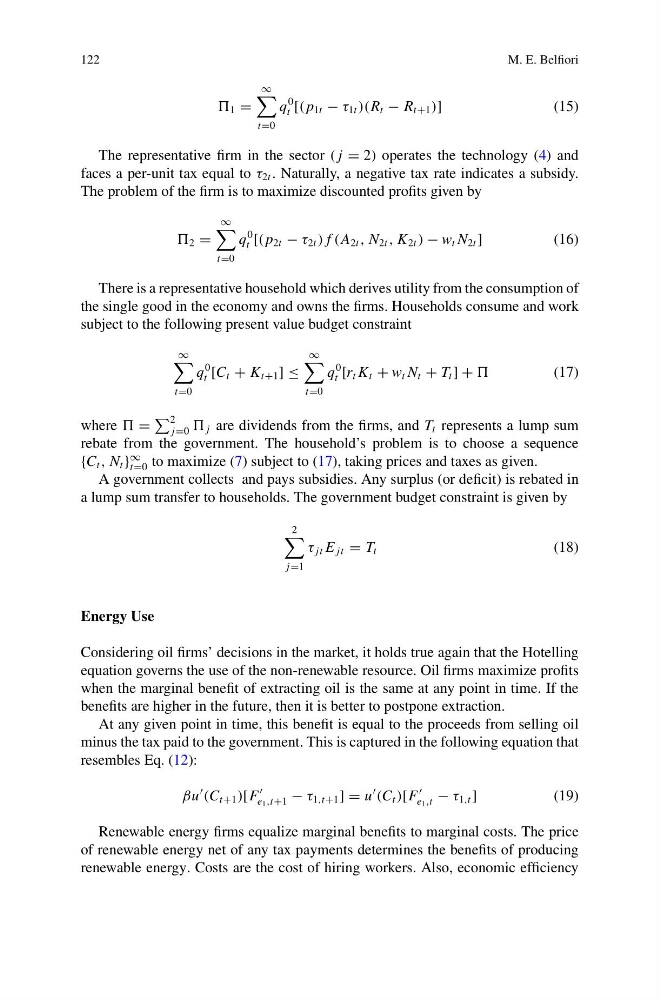
The representative firm in the sector ( j = 2) operates the technology (4) and
faces a per-unit tax equal to τ 2t . Naturally, a negative tax rate indicates a subsidy.
The problem of the firm is to maximize discounted profits given by
2 =
∞
t=0
q
0
t [( p 2t − τ 2t ) f (A 2t , N 2t , K 2t ) − w t N 2t ]
(16)
There is a representative household which derives utility from the consumption of
the single good in the economy and owns the firms. Households consume and work
subject to the following present value budget constraint
∞
t=0
q
0
t [C t + K t+1 ] ≤
∞
t=0
q
0
t [r t K t + w t N t + T t ] +
(17)
where =
2
j=0 j are dividends from the firms, and T t represents a lump sum
rebate from the government. The household’s problem is to choose a sequence
{C t , N t }
∞
t=0 to maximize (7) subject to (17), taking prices and taxes as given.
A government collects and pays subsidies. Any surplus (or deficit) is rebated in
a lump sum transfer to households. The government budget constraint is given by
2
j=1
τ jt E jt = T t
(18)
Energy Use
Considering oil firms’ decisions in the market, it holds true again that the Hotelling
equation governs the use of the non-renewable resource. Oil firms maximize profits
when the marginal benefit of extracting oil is the same at any point in time. If the
benefits are higher in the future, then it is better to postpone extraction.
At any given point in time, this benefit is equal to the proceeds from selling oil
minus the tax paid to the government. This is captured in the following equation that
resembles Eq. (12):
βu
(C t+1 )[F
e 1 ,t+1 − τ 1,t+1 ] = u
(C t )[F
e 1 ,t − τ 1,t ]
(19)
Renewable energy firms equalize marginal benefits to marginal costs. The price
of renewable energy net of any tax payments determines the benefits of producing
renewable energy. Costs are the cost of hiring workers. Also, economic efficiency
M. E. Belfiori
1 =
∞
t=0
q
0
t [( p 1t − τ 1t )(R t − R t+1 )]
(15)
The representative firm in the sector ( j = 2) operates the technology (4) and
faces a per-unit tax equal to τ 2t . Naturally, a negative tax rate indicates a subsidy.
The problem of the firm is to maximize discounted profits given by
2 =
∞
t=0
q
0
t [( p 2t − τ 2t ) f (A 2t , N 2t , K 2t ) − w t N 2t ]
(16)
There is a representative household which derives utility from the consumption of
the single good in the economy and owns the firms. Households consume and work
subject to the following present value budget constraint
∞
t=0
q
0
t [C t + K t+1 ] ≤
∞
t=0
q
0
t [r t K t + w t N t + T t ] +
(17)
where =
2
j=0 j are dividends from the firms, and T t represents a lump sum
rebate from the government. The household’s problem is to choose a sequence
{C t , N t }
∞
t=0 to maximize (7) subject to (17), taking prices and taxes as given.
A government collects and pays subsidies. Any surplus (or deficit) is rebated in
a lump sum transfer to households. The government budget constraint is given by
2
j=1
τ jt E jt = T t
(18)
Energy Use
Considering oil firms’ decisions in the market, it holds true again that the Hotelling
equation governs the use of the non-renewable resource. Oil firms maximize profits
when the marginal benefit of extracting oil is the same at any point in time. If the
benefits are higher in the future, then it is better to postpone extraction.
At any given point in time, this benefit is equal to the proceeds from selling oil
minus the tax paid to the government. This is captured in the following equation that
resembles Eq. (12):
βu
(C t+1 )[F
e 1 ,t+1 − τ 1,t+1 ] = u
(C t )[F
e 1 ,t − τ 1,t ]
(19)
Renewable energy firms equalize marginal benefits to marginal costs. The price
of renewable energy net of any tax payments determines the benefits of producing
renewable energy. Costs are the cost of hiring workers. Also, economic efficiency