

108
M. P. Ramos and O. O. Chisari
and higher than estimated in simulation models that assume full employment and
limited mobility of capital. If the problem were cheap to solve, it would have already
been solved.
This chapter has summarized the estimated costs when two main alternatives are
considered: taxes on carbon emissions or relatively higher tariffs on trade that are
not environmentally friendly, and we have seen that the costs are much greater under
unemployment, high mobility of capital across countries and the adoption of costly
technology.
Moreover, we have seen that some critical dimensions have to be taken into account
when the special characteristics of less developed economies are considered. This
creates a multi-dimensional problem with possibly critical associated thresholds. For
instance, a policy aimed at reducing emissions that significantly increases unemployment will not be feasible, or a technological substitution that is very demanding in
terms of foreign resources could be blocked by financial needs and trade balance
results.
Annexes A
A simplified CGE model to estimate the costs and dividends
of an ETR
In this annex based on Chisari and Miller (2015), we present the basic assumptions
of the general equilibrium model used for simulations of the ETRs to Argentina.
Changes in relative prices for goods (domestic and foreign) and factors (labour
and capital) due to the implementation of an ETR, would lead to possible multiple
dividends depending on the markets’ behaviour constraints.
Even if the CGE model assumes more than one household (at least poor and rich),
for simplification in notation let us assume that we have only one representative
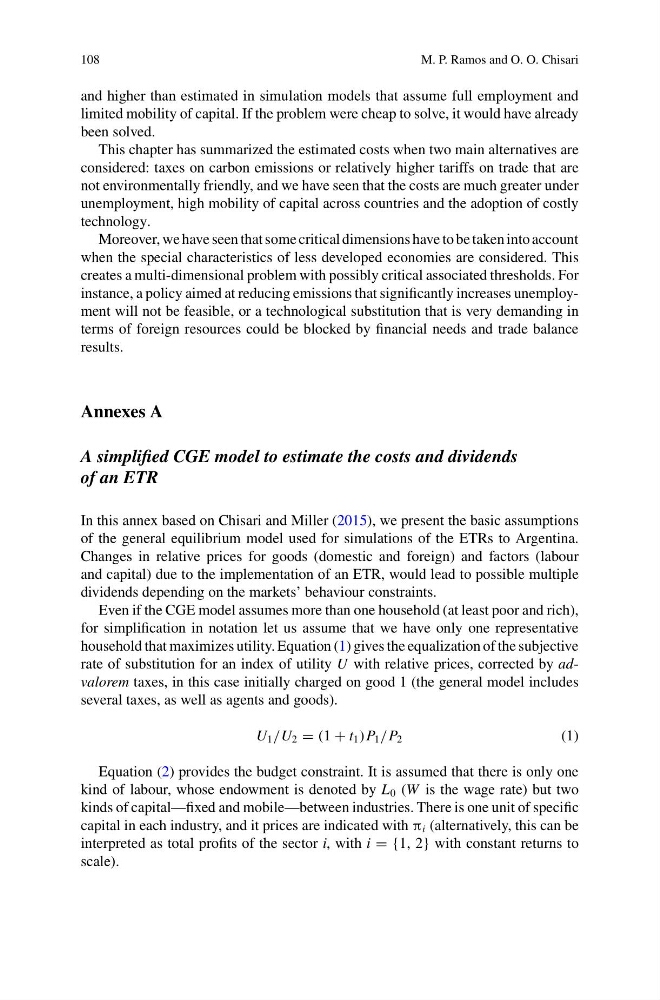
household that maximizes utility. Equation (1) gives the equalization of the subjective
rate of substitution for an index of utility U with relative prices, corrected by advalorem taxes, in this case initially charged on good 1 (the general model includes
several taxes, as well as agents and goods).
U 1 /U 2 = (1 + t 1 )P 1 /P 2
(1)
Equation (2) provides the budget constraint. It is assumed that there is only one
kind of labour, whose endowment is denoted by L 0 (W is the wage rate) but two
kinds of capital—fixed and mobile—between industries. There is one unit of specific
capital in each industry, and it prices are indicated with π i (alternatively, this can be
interpreted as total profits of the sector i, with i = {1, 2} with constant returns to
scale).
M. P. Ramos and O. O. Chisari
and higher than estimated in simulation models that assume full employment and
limited mobility of capital. If the problem were cheap to solve, it would have already
been solved.
This chapter has summarized the estimated costs when two main alternatives are
considered: taxes on carbon emissions or relatively higher tariffs on trade that are
not environmentally friendly, and we have seen that the costs are much greater under
unemployment, high mobility of capital across countries and the adoption of costly
technology.
Moreover, we have seen that some critical dimensions have to be taken into account
when the special characteristics of less developed economies are considered. This
creates a multi-dimensional problem with possibly critical associated thresholds. For
instance, a policy aimed at reducing emissions that significantly increases unemployment will not be feasible, or a technological substitution that is very demanding in
terms of foreign resources could be blocked by financial needs and trade balance
results.
Annexes A
A simplified CGE model to estimate the costs and dividends
of an ETR
In this annex based on Chisari and Miller (2015), we present the basic assumptions
of the general equilibrium model used for simulations of the ETRs to Argentina.
Changes in relative prices for goods (domestic and foreign) and factors (labour
and capital) due to the implementation of an ETR, would lead to possible multiple
dividends depending on the markets’ behaviour constraints.
Even if the CGE model assumes more than one household (at least poor and rich),
for simplification in notation let us assume that we have only one representative
household that maximizes utility. Equation (1) gives the equalization of the subjective
rate of substitution for an index of utility U with relative prices, corrected by advalorem taxes, in this case initially charged on good 1 (the general model includes
several taxes, as well as agents and goods).
U 1 /U 2 = (1 + t 1 )P 1 /P 2
(1)
Equation (2) provides the budget constraint. It is assumed that there is only one
kind of labour, whose endowment is denoted by L 0 (W is the wage rate) but two
kinds of capital—fixed and mobile—between industries. There is one unit of specific
capital in each industry, and it prices are indicated with π i (alternatively, this can be
interpreted as total profits of the sector i, with i = {1, 2} with constant returns to
scale).