

“Multiple Dividends with Climate Change Policies: Evidence …
103
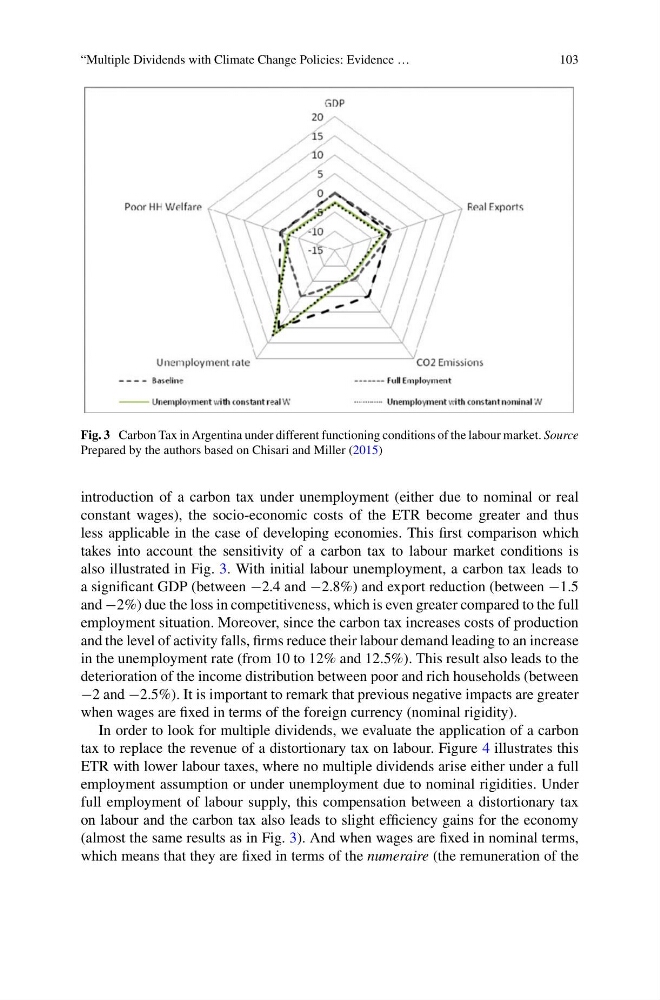
Fig. 3 Carbon Tax in Argentina under different functioning conditions of the labour market. Source
Prepared by the authors based on Chisari and Miller (2015)
introduction of a carbon tax under unemployment (either due to nominal or real
constant wages), the socio-economic costs of the ETR become greater and thus
less applicable in the case of developing economies. This first comparison which
takes into account the sensitivity of a carbon tax to labour market conditions is
also illustrated in Fig. 3. With initial labour unemployment, a carbon tax leads to
a significant GDP (between −2.4 and −2.8%) and export reduction (between −1.5
and −2%) due the loss in competitiveness, which is even greater compared to the full
employment situation. Moreover, since the carbon tax increases costs of production
and the level of activity falls, firms reduce their labour demand leading to an increase
in the unemployment rate (from 10 to 12% and 12.5%). This result also leads to the
deterioration of the income distribution between poor and rich households (between
−2 and −2.5%). It is important to remark that previous negative impacts are greater
when wages are fixed in terms of the foreign currency (nominal rigidity).
In order to look for multiple dividends, we evaluate the application of a carbon
tax to replace the revenue of a distortionary tax on labour. Figure 4 illustrates this
ETR with lower labour taxes, where no multiple dividends arise either under a full
employment assumption or under unemployment due to nominal rigidities. Under
full employment of labour supply, this compensation between a distortionary tax
on labour and the carbon tax also leads to slight efficiency gains for the economy
(almost the same results as in Fig. 3). And when wages are fixed in nominal terms,
which means that they are fixed in terms of the numeraire (the remuneration of the
103
Fig. 3 Carbon Tax in Argentina under different functioning conditions of the labour market. Source
Prepared by the authors based on Chisari and Miller (2015)
introduction of a carbon tax under unemployment (either due to nominal or real
constant wages), the socio-economic costs of the ETR become greater and thus
less applicable in the case of developing economies. This first comparison which
takes into account the sensitivity of a carbon tax to labour market conditions is
also illustrated in Fig. 3. With initial labour unemployment, a carbon tax leads to
a significant GDP (between −2.4 and −2.8%) and export reduction (between −1.5
and −2%) due the loss in competitiveness, which is even greater compared to the full
employment situation. Moreover, since the carbon tax increases costs of production
and the level of activity falls, firms reduce their labour demand leading to an increase
in the unemployment rate (from 10 to 12% and 12.5%). This result also leads to the
deterioration of the income distribution between poor and rich households (between
−2 and −2.5%). It is important to remark that previous negative impacts are greater
when wages are fixed in terms of the foreign currency (nominal rigidity).
In order to look for multiple dividends, we evaluate the application of a carbon
tax to replace the revenue of a distortionary tax on labour. Figure 4 illustrates this
ETR with lower labour taxes, where no multiple dividends arise either under a full
employment assumption or under unemployment due to nominal rigidities. Under
full employment of labour supply, this compensation between a distortionary tax
on labour and the carbon tax also leads to slight efficiency gains for the economy
(almost the same results as in Fig. 3). And when wages are fixed in nominal terms,
which means that they are fixed in terms of the numeraire (the remuneration of the