

48
EIA evaluates both beneficial and adverse environmental impacts of a proposed
development/project, along with interrelated socio-economic, human-health and
cultural impacts. The EIA documentation submitted by the originator (project proponent) should contain as a minimum the following information to help decisionmaker take appropriate decisions, for example,
1. Description of the proposed activity and its purpose
2. Statement of the alternatives that include a no-action alternative
3. Information on the environment that is likely to get affected
4. Prediction of significant environmental impact of the upcoming activity besides
its alternatives
5. Outline for environmental monitoring as well as management programs
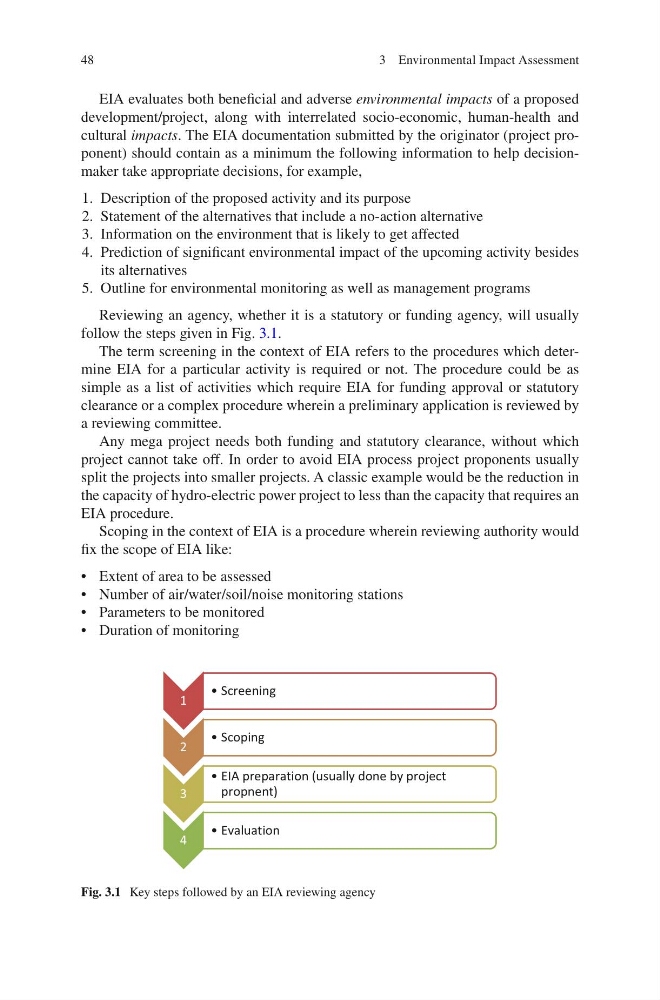
Reviewing an agency, whether it is a statutory or funding agency, will usually
follow the steps given in Fig. 3.1.
The term screening in the context of EIA refers to the procedures which determine EIA for a particular activity is required or not. The procedure could be as
simple as a list of activities which require EIA for funding approval or statutory
clearance or a complex procedure wherein a preliminary application is reviewed by
a reviewing committee.
Any mega project needs both funding and statutory clearance, without which
project cannot take off. In order to avoid EIA process project proponents usually
split the projects into smaller projects. A classic example would be the reduction in
the capacity of hydro-electric power project to less than the capacity that requires an
EIA procedure.
Scoping in the context of EIA is a procedure wherein reviewing authority would
fix the scope of EIA like:
• Extent of area to be assessed
• Number of air/water/soil/noise monitoring stations
• Parameters to be monitored
• Duration of monitoring
1
• Screening
2
• Scoping
3
• EIA preparation (usually done by project
propnent)
4
• Evaluation
Fig. 3.1 Key steps followed by an EIA reviewing agency
3 Environmental Impact Assessment
EIA evaluates both beneficial and adverse environmental impacts of a proposed
development/project, along with interrelated socio-economic, human-health and
cultural impacts. The EIA documentation submitted by the originator (project proponent) should contain as a minimum the following information to help decisionmaker take appropriate decisions, for example,
1. Description of the proposed activity and its purpose
2. Statement of the alternatives that include a no-action alternative
3. Information on the environment that is likely to get affected
4. Prediction of significant environmental impact of the upcoming activity besides
its alternatives
5. Outline for environmental monitoring as well as management programs
Reviewing an agency, whether it is a statutory or funding agency, will usually
follow the steps given in Fig. 3.1.
The term screening in the context of EIA refers to the procedures which determine EIA for a particular activity is required or not. The procedure could be as
simple as a list of activities which require EIA for funding approval or statutory
clearance or a complex procedure wherein a preliminary application is reviewed by
a reviewing committee.
Any mega project needs both funding and statutory clearance, without which
project cannot take off. In order to avoid EIA process project proponents usually
split the projects into smaller projects. A classic example would be the reduction in
the capacity of hydro-electric power project to less than the capacity that requires an
EIA procedure.
Scoping in the context of EIA is a procedure wherein reviewing authority would
fix the scope of EIA like:
• Extent of area to be assessed
• Number of air/water/soil/noise monitoring stations
• Parameters to be monitored
• Duration of monitoring
1
• Screening
2
• Scoping
3
• EIA preparation (usually done by project
propnent)
4
• Evaluation
Fig. 3.1 Key steps followed by an EIA reviewing agency
3 Environmental Impact Assessment