

23
• Social welfare
• Tourism
• Transportation
• Waste
• Water
HIA assists decision-makers to make decisions regarding alternatives (no project, take up partial project, take up different project and modify the existing project)
as well as improvements to prevent disease/injury besides promoting health. The
environment being the sum total of physical, chemical and biological components
in a given region, the temperature and wind humidity may affect concentration of air
pollutants due to temperature inversion (warmer air held above cooler air).
Project-related activities may indirectly, directly or cumulatively alter community exposures to health risks like communicable/non-communicable diseases,
accidents as well as exposure to hazardous conditions/materials (IFC 2018).
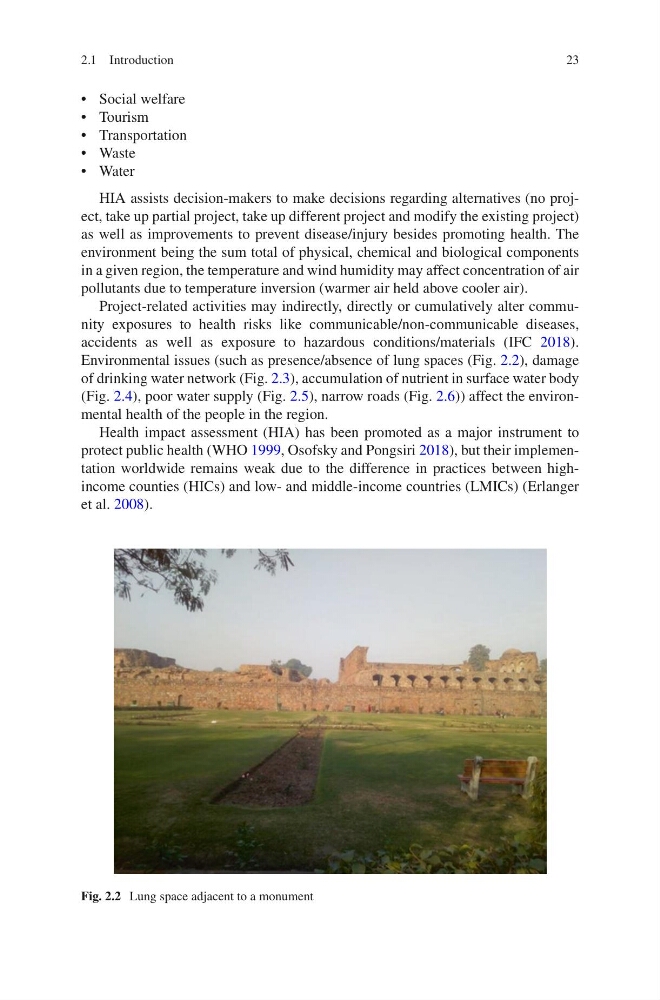
Environmental issues (such as presence/absence of lung spaces (Fig. 2.2), damage
of drinking water network (Fig. 2.3), accumulation of nutrient in surface water body
(Fig. 2.4), poor water supply (Fig. 2.5), narrow roads (Fig. 2.6)) affect the environmental health of the people in the region.
Health impact assessment (HIA) has been promoted as a major instrument to
protect public health (WHO 1999, Osofsky and Pongsiri 2018), but their implementation worldwide remains weak due to the difference in practices between highincome counties (HICs) and low- and middle-income countries (LMICs) (Erlanger
et al. 2008).
Fig. 2.2 Lung space adjacent to a monument
2.1 Introduction
• Social welfare
• Tourism
• Transportation
• Waste
• Water
HIA assists decision-makers to make decisions regarding alternatives (no project, take up partial project, take up different project and modify the existing project)
as well as improvements to prevent disease/injury besides promoting health. The
environment being the sum total of physical, chemical and biological components
in a given region, the temperature and wind humidity may affect concentration of air
pollutants due to temperature inversion (warmer air held above cooler air).
Project-related activities may indirectly, directly or cumulatively alter community exposures to health risks like communicable/non-communicable diseases,
accidents as well as exposure to hazardous conditions/materials (IFC 2018).
Environmental issues (such as presence/absence of lung spaces (Fig. 2.2), damage
of drinking water network (Fig. 2.3), accumulation of nutrient in surface water body
(Fig. 2.4), poor water supply (Fig. 2.5), narrow roads (Fig. 2.6)) affect the environmental health of the people in the region.
Health impact assessment (HIA) has been promoted as a major instrument to
protect public health (WHO 1999, Osofsky and Pongsiri 2018), but their implementation worldwide remains weak due to the difference in practices between highincome counties (HICs) and low- and middle-income countries (LMICs) (Erlanger
et al. 2008).
Fig. 2.2 Lung space adjacent to a monument
2.1 Introduction