

9
According to Article 198 of United Nations Convention on the Law of the Sea:
When a State becomes aware of cases in which the marine environment is in imminent
danger of being damaged or has been damaged by pollution, it shall immediately notify
other States it deems likely to be affected by such damage, as well as the competent international organization.
H. Information and Consultation in Cross-Boundary Relations: Besides emergency situations, a country that plans to take up or authorize activities likely to
impact environment of other country must inform the latter. Furthermore, it
must convey the relevant details of the project to the other country.
I. The Rights of Individuals: If the activities in the jurisdiction or control of one
state impact environment of other country, the individuals who are at risk must
have the right to judicial or administrative procedures in the country causing the
harm to environment.
1.3.1 Economic Instruments
Economic incentives in the context of environmental law can provide incentives,
pressurize or apply disincentives, and/or permit participants to negotiate the benefits
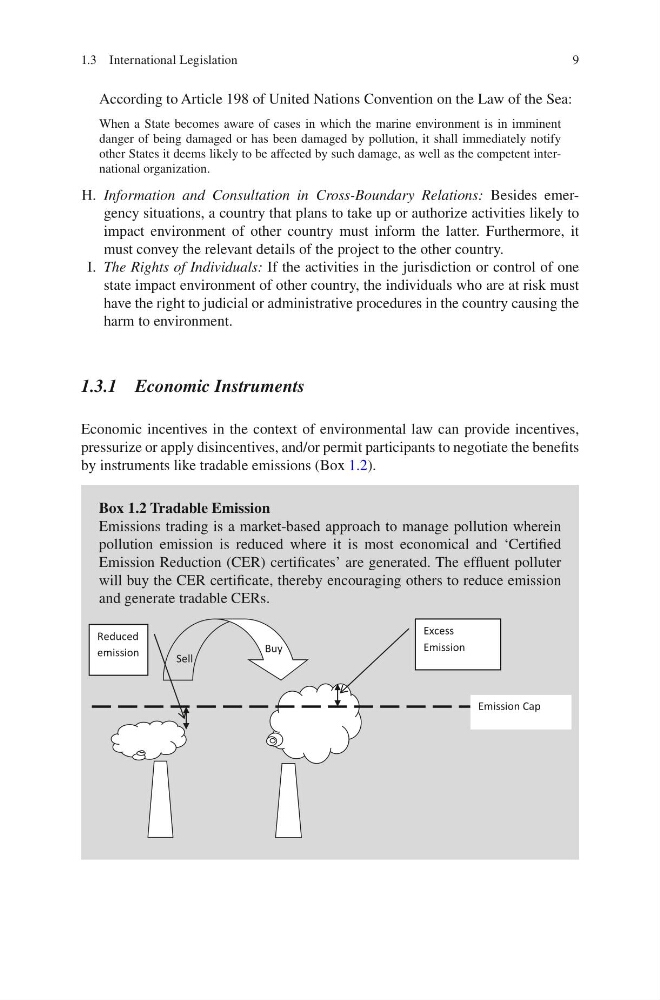
by instruments like tradable emissions (Box 1.2).
Box 1.2 Tradable Emission
Emissions trading is a market-based approach to manage pollution wherein
pollution emission is reduced where it is most economical and ‘Certified
Emission Reduction (CER) certificates’ are generated. The effluent polluter
will buy the CER certificate, thereby encouraging others to reduce emission
and generate tradable CERs.
Sell
Buy
Emission Cap
Excess
Emission
Reduced
emission
1.3 International Legislation
According to Article 198 of United Nations Convention on the Law of the Sea:
When a State becomes aware of cases in which the marine environment is in imminent
danger of being damaged or has been damaged by pollution, it shall immediately notify
other States it deems likely to be affected by such damage, as well as the competent international organization.
H. Information and Consultation in Cross-Boundary Relations: Besides emergency situations, a country that plans to take up or authorize activities likely to
impact environment of other country must inform the latter. Furthermore, it
must convey the relevant details of the project to the other country.
I. The Rights of Individuals: If the activities in the jurisdiction or control of one
state impact environment of other country, the individuals who are at risk must
have the right to judicial or administrative procedures in the country causing the
harm to environment.
1.3.1 Economic Instruments
Economic incentives in the context of environmental law can provide incentives,
pressurize or apply disincentives, and/or permit participants to negotiate the benefits
by instruments like tradable emissions (Box 1.2).
Box 1.2 Tradable Emission
Emissions trading is a market-based approach to manage pollution wherein
pollution emission is reduced where it is most economical and ‘Certified
Emission Reduction (CER) certificates’ are generated. The effluent polluter
will buy the CER certificate, thereby encouraging others to reduce emission
and generate tradable CERs.
Sell
Buy
Emission Cap
Excess
Emission
Reduced
emission
1.3 International Legislation