

232
• Ear muffs or plugs for ear protection
11.5 Social Distancing, Lockdown and Change in Lifestyle
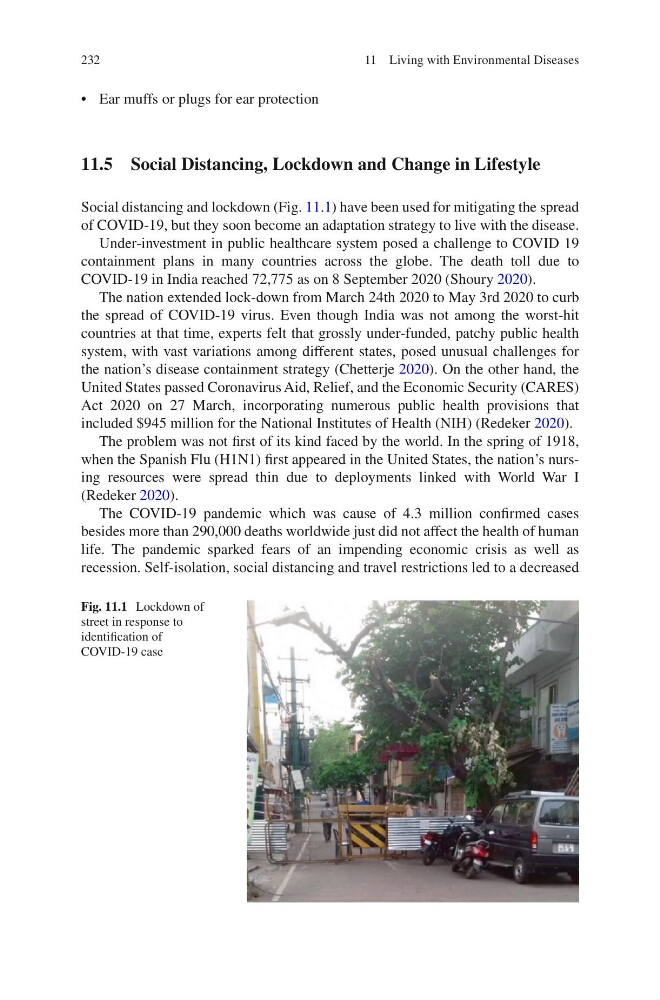
Social distancing and lockdown (Fig. 11.1) have been used for mitigating the spread
of COVID-19, but they soon become an adaptation strategy to live with the disease.
Under-investment in public healthcare system posed a challenge to COVID 19
containment plans in many countries across the globe. The death toll due to
COVID-19 in India reached 72,775 as on 8 September 2020 (Shoury 2020).
The nation extended lock-down from March 24th 2020 to May 3rd 2020 to curb
the spread of COVID-19 virus. Even though India was not among the worst-hit
countries at that time, experts felt that grossly under-funded, patchy public health
system, with vast variations among different states, posed unusual challenges for
the nation’s disease containment strategy (Chetterje 2020). On the other hand, the
United States passed Coronavirus Aid, Relief, and the Economic Security (CARES)
Act 2020 on 27 March, incorporating numerous public health provisions that
included $945 million for the National Institutes of Health (NIH) (Redeker 2020).
The problem was not first of its kind faced by the world. In the spring of 1918,
when the Spanish Flu (H1N1) first appeared in the United States, the nation’s nursing resources were spread thin due to deployments linked with World War I
(Redeker 2020).
The COVID-19 pandemic which was cause of 4.3 million confirmed cases
besides more than 290,000 deaths worldwide just did not affect the health of human
life. The pandemic sparked fears of an impending economic crisis as well as
recession. Self-isolation, social distancing and travel restrictions led to a decreased
Fig. 11.1 Lockdown of
street in response to
identification of
COVID- 19 case
11 Living with Environmental Diseases
• Ear muffs or plugs for ear protection
11.5 Social Distancing, Lockdown and Change in Lifestyle
Social distancing and lockdown (Fig. 11.1) have been used for mitigating the spread
of COVID-19, but they soon become an adaptation strategy to live with the disease.
Under-investment in public healthcare system posed a challenge to COVID 19
containment plans in many countries across the globe. The death toll due to
COVID-19 in India reached 72,775 as on 8 September 2020 (Shoury 2020).
The nation extended lock-down from March 24th 2020 to May 3rd 2020 to curb
the spread of COVID-19 virus. Even though India was not among the worst-hit
countries at that time, experts felt that grossly under-funded, patchy public health
system, with vast variations among different states, posed unusual challenges for
the nation’s disease containment strategy (Chetterje 2020). On the other hand, the
United States passed Coronavirus Aid, Relief, and the Economic Security (CARES)
Act 2020 on 27 March, incorporating numerous public health provisions that
included $945 million for the National Institutes of Health (NIH) (Redeker 2020).
The problem was not first of its kind faced by the world. In the spring of 1918,
when the Spanish Flu (H1N1) first appeared in the United States, the nation’s nursing resources were spread thin due to deployments linked with World War I
(Redeker 2020).
The COVID-19 pandemic which was cause of 4.3 million confirmed cases
besides more than 290,000 deaths worldwide just did not affect the health of human
life. The pandemic sparked fears of an impending economic crisis as well as
recession. Self-isolation, social distancing and travel restrictions led to a decreased
Fig. 11.1 Lockdown of
street in response to
identification of
COVID- 19 case
11 Living with Environmental Diseases