

214
10.3 Preparedness
An emergency is an unplanned event that may result in the risks to human property,
health or the environment, within a facility or in the local community.
There is no uniform recommendation regarding the suitable behaviour during an
earthquake. Two different behavioural strategies are suggested across the globe to
the people inside buildings during earthquake: (a) evacuate the building and move
to an open area or (b) stay inside the building and “drop, cover and hold” (Fig. 10.3).
The reasons for such deviations are due to the disparity in the vulnerability of
building to earthquake and threats to occupants. In places where the buildings can
withstand earthquakes, the main hazard to inhabitant is due to falling objects
(Miranda et al. 2012; Ramirez and Peek-Asa 2005; Inel et al. 2013). In such situation, the “drop, cover and hold” strategy (Fig. 10.2) is preferable as it gives protection from hazard. If the buildings are not reinforced to comply with seismic codes,
the key threat to occupants is due to the possible collapse of the building (Inel
et al. 2013).
Projects/facility and community should have an Emergency Preparedness and
Response Plan that is compatible with the risks of the project/facility/community
and that includes the following fundamental elements:
• Administration
• Business continuity in addition to contingency
• Checklists (role, action, equipment etc.)
• Communication systems
• Emergency resources
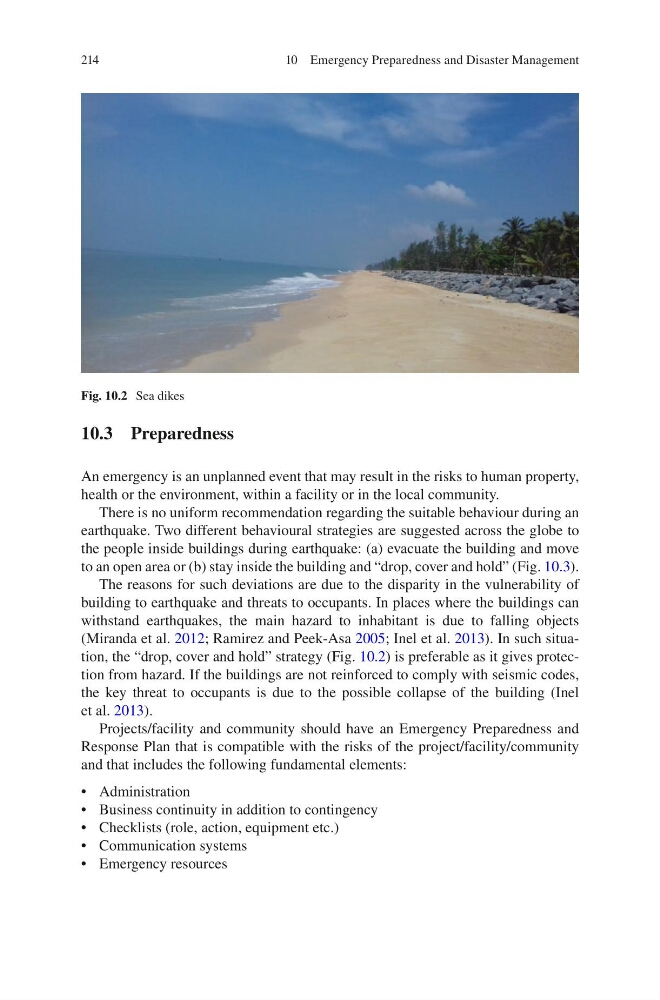
Fig. 10.2 Sea dikes
10 Emergency Preparedness and Disaster Management
10.3 Preparedness
An emergency is an unplanned event that may result in the risks to human property,
health or the environment, within a facility or in the local community.
There is no uniform recommendation regarding the suitable behaviour during an
earthquake. Two different behavioural strategies are suggested across the globe to
the people inside buildings during earthquake: (a) evacuate the building and move
to an open area or (b) stay inside the building and “drop, cover and hold” (Fig. 10.3).
The reasons for such deviations are due to the disparity in the vulnerability of
building to earthquake and threats to occupants. In places where the buildings can
withstand earthquakes, the main hazard to inhabitant is due to falling objects
(Miranda et al. 2012; Ramirez and Peek-Asa 2005; Inel et al. 2013). In such situation, the “drop, cover and hold” strategy (Fig. 10.2) is preferable as it gives protection from hazard. If the buildings are not reinforced to comply with seismic codes,
the key threat to occupants is due to the possible collapse of the building (Inel
et al. 2013).
Projects/facility and community should have an Emergency Preparedness and
Response Plan that is compatible with the risks of the project/facility/community
and that includes the following fundamental elements:
• Administration
• Business continuity in addition to contingency
• Checklists (role, action, equipment etc.)
• Communication systems
• Emergency resources
Fig. 10.2 Sea dikes
10 Emergency Preparedness and Disaster Management