

191
9.4 Housing
The quality of housing plays a major role in people’s health. A good house will
provide optimum living conditions. To provide proper housing, strategies need to be
developed and implemented to reduce and prevent household crowding (WHO 2018).
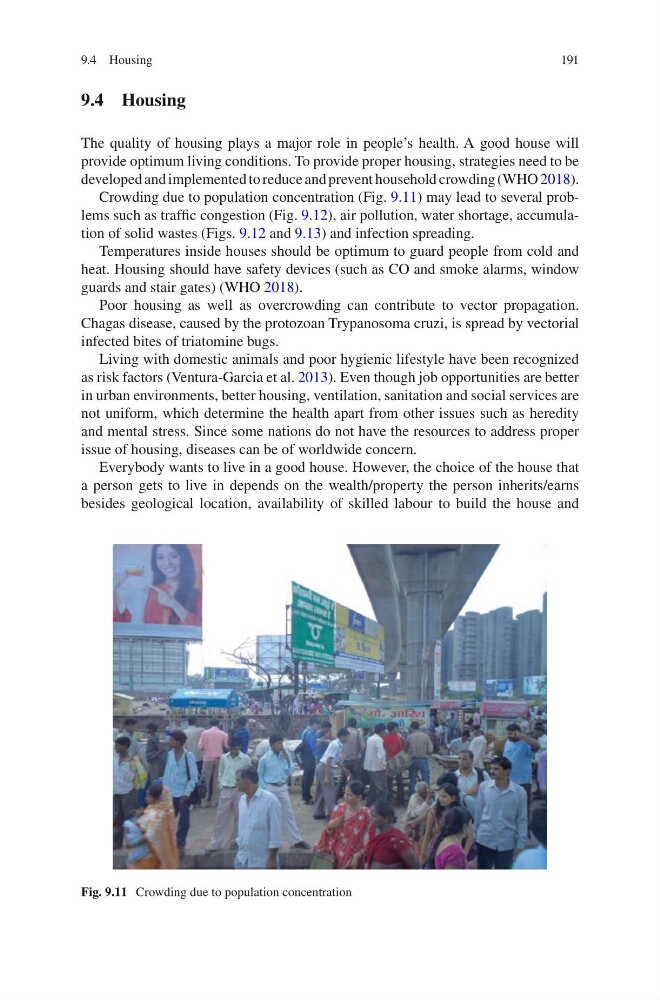
Crowding due to population concentration (Fig. 9.11) may lead to several problems such as traffic congestion (Fig. 9.12), air pollution, water shortage, accumulation of solid wastes (Figs. 9.12 and 9.13) and infection spreading.
Temperatures inside houses should be optimum to guard people from cold and
heat. Housing should have safety devices (such as CO and smoke alarms, window
guards and stair gates) (WHO 2018).
Poor housing as well as overcrowding can contribute to vector propagation.
Chagas disease, caused by the protozoan Trypanosoma cruzi, is spread by vectorial
infected bites of triatomine bugs.
Living with domestic animals and poor hygienic lifestyle have been recognized
as risk factors (Ventura-Garcia et al. 2013). Even though job opportunities are better
in urban environments, better housing, ventilation, sanitation and social services are
not uniform, which determine the health apart from other issues such as heredity
and mental stress. Since some nations do not have the resources to address proper
issue of housing, diseases can be of worldwide concern.
Everybody wants to live in a good house. However, the choice of the house that
a person gets to live in depends on the wealth/property the person inherits/earns
besides geological location, availability of skilled labour to build the house and
Fig. 9.11 Crowding due to population concentration
9.4 Housing
9.4 Housing
The quality of housing plays a major role in people’s health. A good house will
provide optimum living conditions. To provide proper housing, strategies need to be
developed and implemented to reduce and prevent household crowding (WHO 2018).
Crowding due to population concentration (Fig. 9.11) may lead to several problems such as traffic congestion (Fig. 9.12), air pollution, water shortage, accumulation of solid wastes (Figs. 9.12 and 9.13) and infection spreading.
Temperatures inside houses should be optimum to guard people from cold and
heat. Housing should have safety devices (such as CO and smoke alarms, window
guards and stair gates) (WHO 2018).
Poor housing as well as overcrowding can contribute to vector propagation.
Chagas disease, caused by the protozoan Trypanosoma cruzi, is spread by vectorial
infected bites of triatomine bugs.
Living with domestic animals and poor hygienic lifestyle have been recognized
as risk factors (Ventura-Garcia et al. 2013). Even though job opportunities are better
in urban environments, better housing, ventilation, sanitation and social services are
not uniform, which determine the health apart from other issues such as heredity
and mental stress. Since some nations do not have the resources to address proper
issue of housing, diseases can be of worldwide concern.
Everybody wants to live in a good house. However, the choice of the house that
a person gets to live in depends on the wealth/property the person inherits/earns
besides geological location, availability of skilled labour to build the house and
Fig. 9.11 Crowding due to population concentration
9.4 Housing