

174
where in gases from first chamber gets into second chamber wherein temperature is
maintained to disintegrate POPs.
The flue gases have to be fitted with air pollution control equipment in order to
avoid impact of air pollution on human health and environment.
Radioactive wastes are generated by the nuclear power industry, universities,
hospitals, as well as non-nuclear industries. Radioactive waste emits radiation, and
hence, they are hazardous to human health and the environment. Therefore, it must
be managed with special care. Finding appropriate waste disposal solutions is a
main challenge for all stakeholders (Institut de Radioprotection et de Sûreté
Nucléaire (IRSN) 2013). Radioactive wastes in health care establishments are produced due to procedures in various investigative, as well as therapeutic practices.
Radioactive wastes are divided into very low, low, intermediate and high-level
waste (Table 8.4).
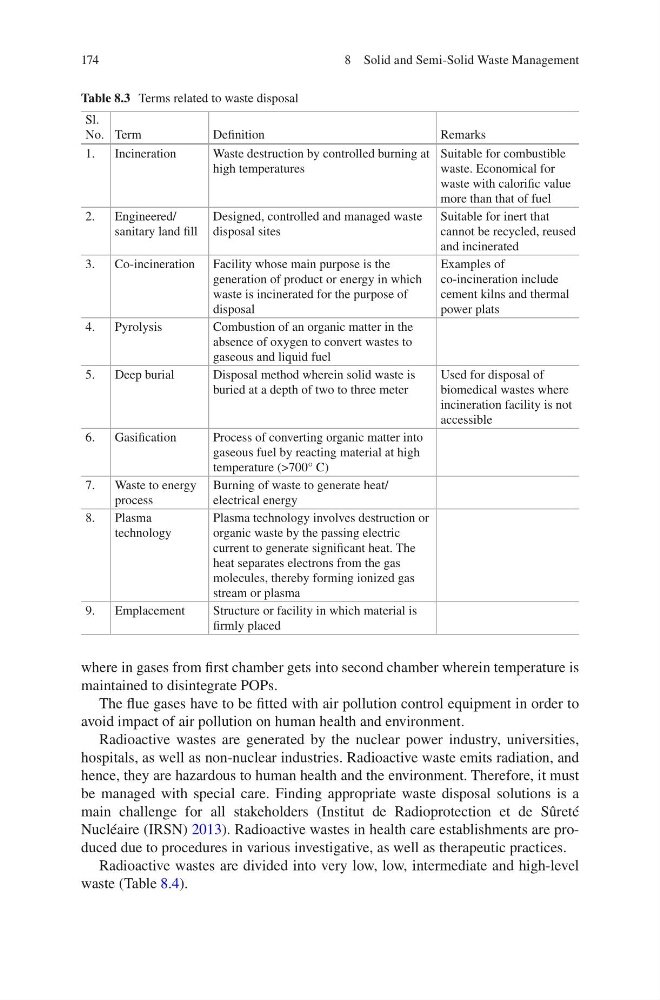
Table 8.3 Terms related to waste disposal
Sl.
No. Term
Definition
Remarks
1.
Incineration
Waste destruction by controlled burning at
high temperatures
Suitable for combustible
waste. Economical for
waste with calorific value
more than that of fuel
2.
Engineered/
sanitary land fill
Designed, controlled and managed waste
disposal sites
Suitable for inert that
cannot be recycled, reused
and incinerated
3.
Co-incineration Facility whose main purpose is the
generation of product or energy in which
waste is incinerated for the purpose of
disposal
Examples of
co-incineration include
cement kilns and thermal
power plats
4.
Pyrolysis
Combustion of an organic matter in the
absence of oxygen to convert wastes to
gaseous and liquid fuel
5.
Deep burial
Disposal method wherein solid waste is
buried at a depth of two to three meter
Used for disposal of
biomedical wastes where
incineration facility is not
accessible
6.
Gasification
Process of converting organic matter into
gaseous fuel by reacting material at high
temperature (>700° C)
7.
Waste to energy
process
Burning of waste to generate heat/
electrical energy
8.
Plasma
technology
Plasma technology involves destruction or
organic waste by the passing electric
current to generate significant heat. The
heat separates electrons from the gas
molecules, thereby forming ionized gas
stream or plasma
9.
Emplacement
Structure or facility in which material is
firmly placed
8 Solid and Semi-Solid Waste Management
where in gases from first chamber gets into second chamber wherein temperature is
maintained to disintegrate POPs.
The flue gases have to be fitted with air pollution control equipment in order to
avoid impact of air pollution on human health and environment.
Radioactive wastes are generated by the nuclear power industry, universities,
hospitals, as well as non-nuclear industries. Radioactive waste emits radiation, and
hence, they are hazardous to human health and the environment. Therefore, it must
be managed with special care. Finding appropriate waste disposal solutions is a
main challenge for all stakeholders (Institut de Radioprotection et de Sûreté
Nucléaire (IRSN) 2013). Radioactive wastes in health care establishments are produced due to procedures in various investigative, as well as therapeutic practices.
Radioactive wastes are divided into very low, low, intermediate and high-level
waste (Table 8.4).
Table 8.3 Terms related to waste disposal
Sl.
No. Term
Definition
Remarks
1.
Incineration
Waste destruction by controlled burning at
high temperatures
Suitable for combustible
waste. Economical for
waste with calorific value
more than that of fuel
2.
Engineered/
sanitary land fill
Designed, controlled and managed waste
disposal sites
Suitable for inert that
cannot be recycled, reused
and incinerated
3.
Co-incineration Facility whose main purpose is the
generation of product or energy in which
waste is incinerated for the purpose of
disposal
Examples of
co-incineration include
cement kilns and thermal
power plats
4.
Pyrolysis
Combustion of an organic matter in the
absence of oxygen to convert wastes to
gaseous and liquid fuel
5.
Deep burial
Disposal method wherein solid waste is
buried at a depth of two to three meter
Used for disposal of
biomedical wastes where
incineration facility is not
accessible
6.
Gasification
Process of converting organic matter into
gaseous fuel by reacting material at high
temperature (>700° C)
7.
Waste to energy
process
Burning of waste to generate heat/
electrical energy
8.
Plasma
technology
Plasma technology involves destruction or
organic waste by the passing electric
current to generate significant heat. The
heat separates electrons from the gas
molecules, thereby forming ionized gas
stream or plasma
9.
Emplacement
Structure or facility in which material is
firmly placed
8 Solid and Semi-Solid Waste Management