

173
– Deep burial.
– Gasification.
– Waste to energy process.
– Plasma technology.
– Emplacement.
The terms with respect to disposal are briefly explained in Table 8.3.
Management of mercury-containing waste should include:
1. Proper disposal/handling of mercury as well as mercury contaminated waste.
2. Recycling mercury-containing goods.
3. Separation of reusable and non-reusable mercury-containing products.
4. Using alternatives for products that contain mercury.
In order to protect public health, waste transportation should have proper vehicles with good tracking system operated by trained personnel. The community
should have emergency management plan and system to respond to emergencies in
case of emergencies.
Incineration is one of the most extensively used methods adopted to dispose
combustible waste. But the process results in air pollution and needs to be controlled. While the incineration is being phased out or used as source of energy in
some countries, the process is less practiced in the developing nations due to high
operating/capital costs.
Incineration (Fig.8.29) is a waste disposal/treatment wherein waste is burnt in
specialized engineered set up. The gas generated is likely to have dioxins and furans,
which are persistent organic pollutants (POP) and known carcinogens. POPs remain
in environment for long period without getting altered into innocuous compounds/
elements. POPs can also enter into food chain through water/air. Hence, it is desirable to maintain high temperature in incinerator or use dual chamber incinerators
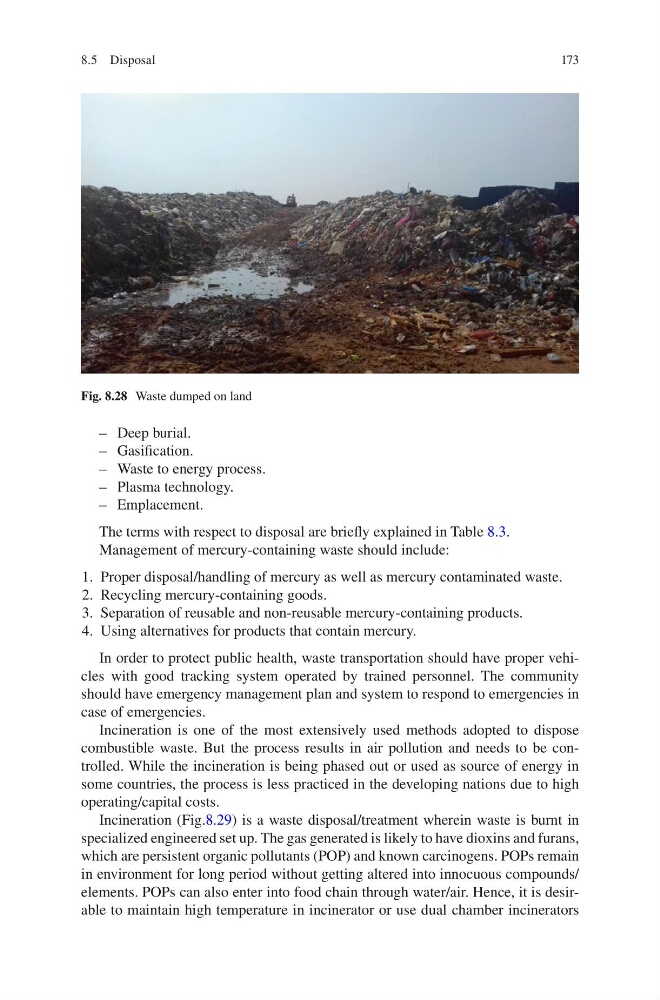
Fig. 8.28 Waste dumped on land
8.5 Disposal
– Deep burial.
– Gasification.
– Waste to energy process.
– Plasma technology.
– Emplacement.
The terms with respect to disposal are briefly explained in Table 8.3.
Management of mercury-containing waste should include:
1. Proper disposal/handling of mercury as well as mercury contaminated waste.
2. Recycling mercury-containing goods.
3. Separation of reusable and non-reusable mercury-containing products.
4. Using alternatives for products that contain mercury.
In order to protect public health, waste transportation should have proper vehicles with good tracking system operated by trained personnel. The community
should have emergency management plan and system to respond to emergencies in
case of emergencies.
Incineration is one of the most extensively used methods adopted to dispose
combustible waste. But the process results in air pollution and needs to be controlled. While the incineration is being phased out or used as source of energy in
some countries, the process is less practiced in the developing nations due to high
operating/capital costs.
Incineration (Fig.8.29) is a waste disposal/treatment wherein waste is burnt in
specialized engineered set up. The gas generated is likely to have dioxins and furans,
which are persistent organic pollutants (POP) and known carcinogens. POPs remain
in environment for long period without getting altered into innocuous compounds/
elements. POPs can also enter into food chain through water/air. Hence, it is desirable to maintain high temperature in incinerator or use dual chamber incinerators
Fig. 8.28 Waste dumped on land
8.5 Disposal