

112
3. Country and private user have to invest huge amount to get rid of higher pollution
concentration in natural water resources.
4. There would be decrease in crop production due to contamination as all the contaminants need not be plant nutrients.
5. In its complexity, the deterioration of health of medical and paramedical staff
due to pollution may just destroy fragile health system in any country.
6. The impact of pollution on military and police may also pose threat to national
security and law and order.
But in the reality, many developing countries where only a fraction of wastewater
is treated, the economic burden of the treatment is borne by the country and in some
cases international agencies that are providing financial assistance to treat
unhealthy people.
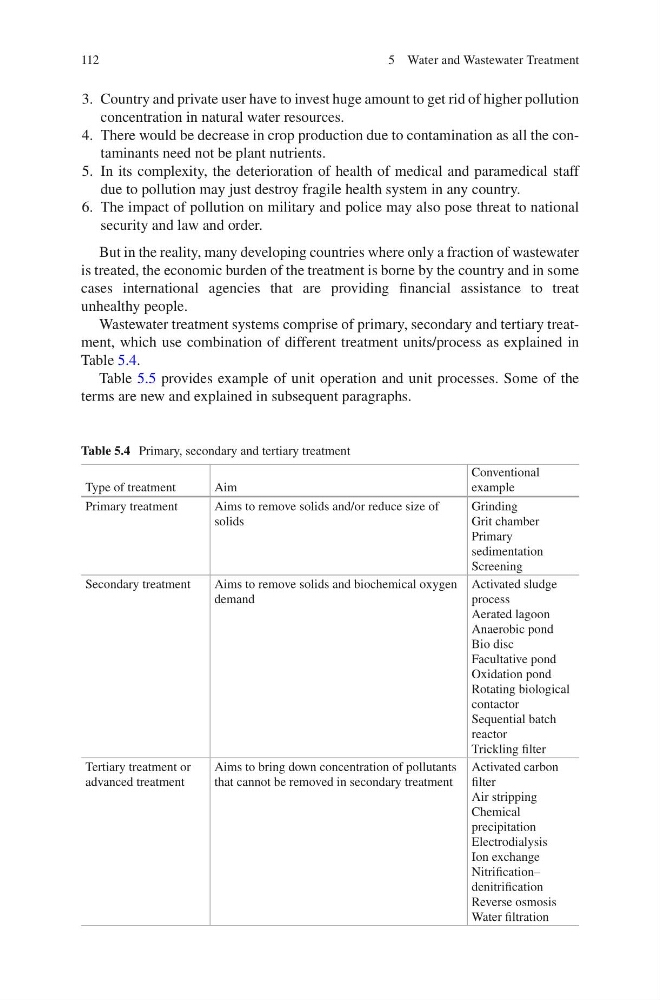
Wastewater treatment systems comprise of primary, secondary and tertiary treatment, which use combination of different treatment units/process as explained in
Table 5.4.
Table 5.5 provides example of unit operation and unit processes. Some of the
terms are new and explained in subsequent paragraphs.
Type of treatment
Aim
Conventional
example
Primary treatment
Aims to remove solids and/or reduce size of
solids
Grinding
Grit chamber
Primary
sedimentation
Screening
Secondary treatment
Aims to remove solids and biochemical oxygen
demand
Activated sludge
process
Aerated lagoon
Anaerobic pond
Bio disc
Facultative pond
Oxidation pond
Rotating biological
contactor
Sequential batch
reactor
Trickling filter
Tertiary treatment or
advanced treatment
Aims to bring down concentration of pollutants
that cannot be removed in secondary treatment
Activated carbon
filter
Air stripping
Chemical
precipitation
Electrodialysis
Ion exchange
Nitrification–
denitrification
Reverse osmosis
Water filtration
Table 5.4 Primary, secondary and tertiary treatment
5 Water and Wastewater Treatment
3. Country and private user have to invest huge amount to get rid of higher pollution
concentration in natural water resources.
4. There would be decrease in crop production due to contamination as all the contaminants need not be plant nutrients.
5. In its complexity, the deterioration of health of medical and paramedical staff
due to pollution may just destroy fragile health system in any country.
6. The impact of pollution on military and police may also pose threat to national
security and law and order.
But in the reality, many developing countries where only a fraction of wastewater
is treated, the economic burden of the treatment is borne by the country and in some
cases international agencies that are providing financial assistance to treat
unhealthy people.
Wastewater treatment systems comprise of primary, secondary and tertiary treatment, which use combination of different treatment units/process as explained in
Table 5.4.
Table 5.5 provides example of unit operation and unit processes. Some of the
terms are new and explained in subsequent paragraphs.
Type of treatment
Aim
Conventional
example
Primary treatment
Aims to remove solids and/or reduce size of
solids
Grinding
Grit chamber
Primary
sedimentation
Screening
Secondary treatment
Aims to remove solids and biochemical oxygen
demand
Activated sludge
process
Aerated lagoon
Anaerobic pond
Bio disc
Facultative pond
Oxidation pond
Rotating biological
contactor
Sequential batch
reactor
Trickling filter
Tertiary treatment or
advanced treatment
Aims to bring down concentration of pollutants
that cannot be removed in secondary treatment
Activated carbon
filter
Air stripping
Chemical
precipitation
Electrodialysis
Ion exchange
Nitrification–
denitrification
Reverse osmosis
Water filtration
Table 5.4 Primary, secondary and tertiary treatment
5 Water and Wastewater Treatment