

46
L. Nurhidayah
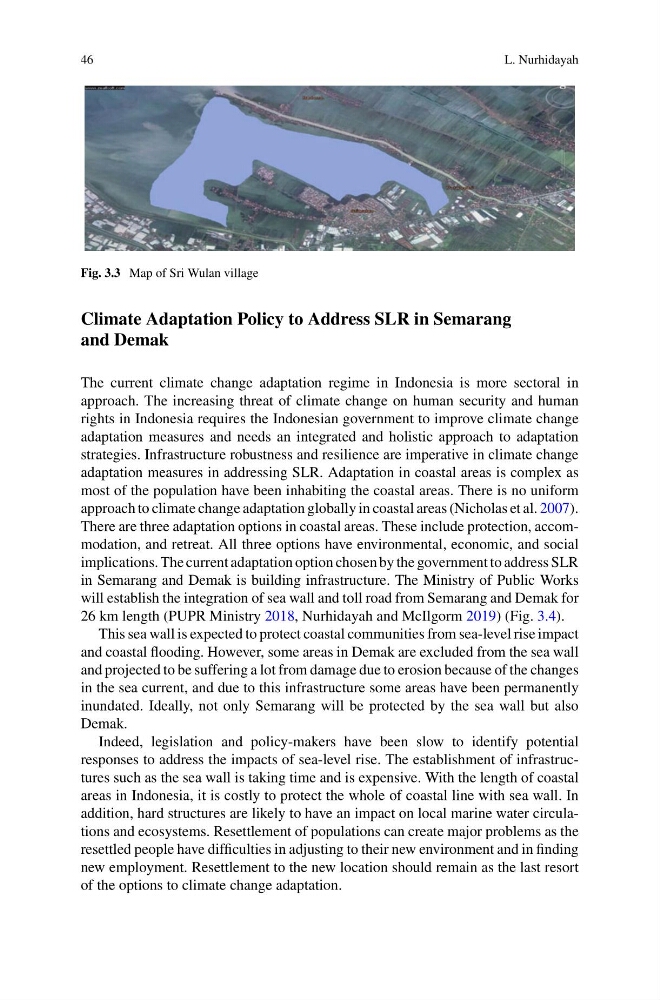
Fig. 3.3 Map of Sri Wulan village
Climate Adaptation Policy to Address SLR in Semarang
and Demak
The current climate change adaptation regime in Indonesia is more sectoral in
approach. The increasing threat of climate change on human security and human
rights in Indonesia requires the Indonesian government to improve climate change
adaptation measures and needs an integrated and holistic approach to adaptation
strategies. Infrastructure robustness and resilience are imperative in climate change
adaptation measures in addressing SLR. Adaptation in coastal areas is complex as
most of the population have been inhabiting the coastal areas. There is no uniform
approach to climate change adaptation globally in coastal areas (Nicholas et al. 2007).
There are three adaptation options in coastal areas. These include protection, accommodation, and retreat. All three options have environmental, economic, and social
implications. The current adaptation option chosen by the government to address SLR
in Semarang and Demak is building infrastructure. The Ministry of Public Works
will establish the integration of sea wall and toll road from Semarang and Demak for
26 km length (PUPR Ministry 2018, Nurhidayah and McIlgorm 2019) (Fig. 3.4).
This sea wall is expected to protect coastal communities from sea-level rise impact
and coastal flooding. However, some areas in Demak are excluded from the sea wall
and projected to be suffering a lot from damage due to erosion because of the changes
in the sea current, and due to this infrastructure some areas have been permanently
inundated. Ideally, not only Semarang will be protected by the sea wall but also
Demak.
Indeed, legislation and policy-makers have been slow to identify potential
responses to address the impacts of sea-level rise. The establishment of infrastructures such as the sea wall is taking time and is expensive. With the length of coastal
areas in Indonesia, it is costly to protect the whole of coastal line with sea wall. In
addition, hard structures are likely to have an impact on local marine water circulations and ecosystems. Resettlement of populations can create major problems as the
resettled people have difficulties in adjusting to their new environment and in finding
new employment. Resettlement to the new location should remain as the last resort
of the options to climate change adaptation.
L. Nurhidayah
Fig. 3.3 Map of Sri Wulan village
Climate Adaptation Policy to Address SLR in Semarang
and Demak
The current climate change adaptation regime in Indonesia is more sectoral in
approach. The increasing threat of climate change on human security and human
rights in Indonesia requires the Indonesian government to improve climate change
adaptation measures and needs an integrated and holistic approach to adaptation
strategies. Infrastructure robustness and resilience are imperative in climate change
adaptation measures in addressing SLR. Adaptation in coastal areas is complex as
most of the population have been inhabiting the coastal areas. There is no uniform
approach to climate change adaptation globally in coastal areas (Nicholas et al. 2007).
There are three adaptation options in coastal areas. These include protection, accommodation, and retreat. All three options have environmental, economic, and social
implications. The current adaptation option chosen by the government to address SLR
in Semarang and Demak is building infrastructure. The Ministry of Public Works
will establish the integration of sea wall and toll road from Semarang and Demak for
26 km length (PUPR Ministry 2018, Nurhidayah and McIlgorm 2019) (Fig. 3.4).
This sea wall is expected to protect coastal communities from sea-level rise impact
and coastal flooding. However, some areas in Demak are excluded from the sea wall
and projected to be suffering a lot from damage due to erosion because of the changes
in the sea current, and due to this infrastructure some areas have been permanently
inundated. Ideally, not only Semarang will be protected by the sea wall but also
Demak.
Indeed, legislation and policy-makers have been slow to identify potential
responses to address the impacts of sea-level rise. The establishment of infrastructures such as the sea wall is taking time and is expensive. With the length of coastal
areas in Indonesia, it is costly to protect the whole of coastal line with sea wall. In
addition, hard structures are likely to have an impact on local marine water circulations and ecosystems. Resettlement of populations can create major problems as the
resettled people have difficulties in adjusting to their new environment and in finding
new employment. Resettlement to the new location should remain as the last resort
of the options to climate change adaptation.