

15 Peatland Protection in Indonesia: Toward the Right Direction?
307
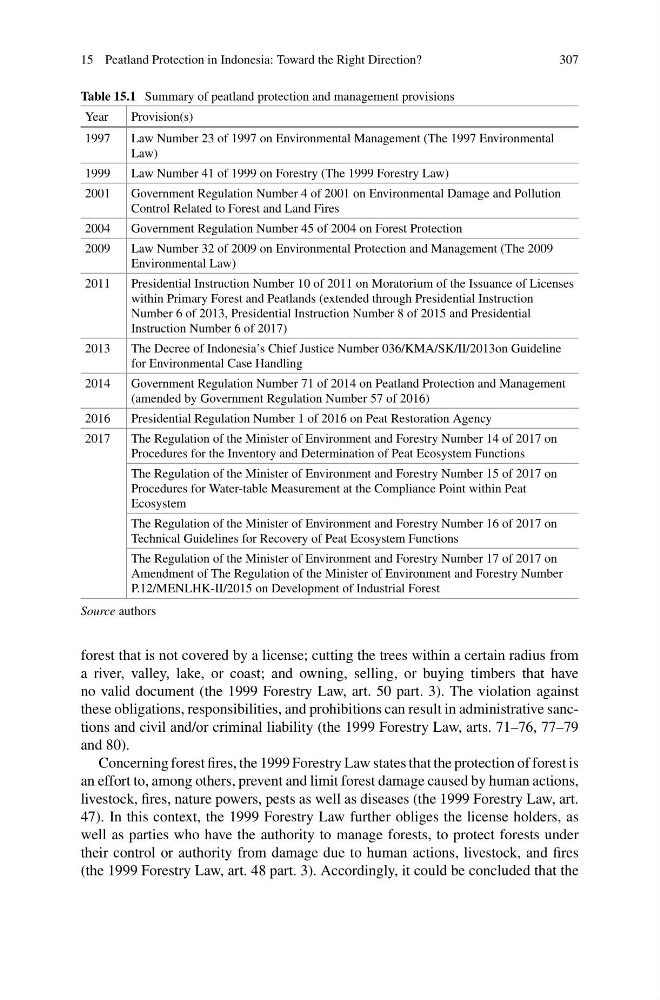
Table 15.1 Summary of peatland protection and management provisions
Year
Provision(s)
1997
Law Number 23 of 1997 on Environmental Management (The 1997 Environmental
Law)
1999
Law Number 41 of 1999 on Forestry (The 1999 Forestry Law)
2001
Government Regulation Number 4 of 2001 on Environmental Damage and Pollution
Control Related to Forest and Land Fires
2004
Government Regulation Number 45 of 2004 on Forest Protection
2009
Law Number 32 of 2009 on Environmental Protection and Management (The 2009
Environmental Law)
2011
Presidential Instruction Number 10 of 2011 on Moratorium of the Issuance of Licenses
within Primary Forest and Peatlands (extended through Presidential Instruction
Number 6 of 2013, Presidential Instruction Number 8 of 2015 and Presidential
Instruction Number 6 of 2017)
2013
The Decree of Indonesia’s Chief Justice Number 036/KMA/SK/II/2013on Guideline
for Environmental Case Handling
2014
Government Regulation Number 71 of 2014 on Peatland Protection and Management
(amended by Government Regulation Number 57 of 2016)
2016
Presidential Regulation Number 1 of 2016 on Peat Restoration Agency
2017
The Regulation of the Minister of Environment and Forestry Number 14 of 2017 on
Procedures for the Inventory and Determination of Peat Ecosystem Functions
The Regulation of the Minister of Environment and Forestry Number 15 of 2017 on
Procedures for Water-table Measurement at the Compliance Point within Peat
Ecosystem
The Regulation of the Minister of Environment and Forestry Number 16 of 2017 on
Technical Guidelines for Recovery of Peat Ecosystem Functions
The Regulation of the Minister of Environment and Forestry Number 17 of 2017 on
Amendment of The Regulation of the Minister of Environment and Forestry Number
P.12/MENLHK-II/2015 on Development of Industrial Forest
Source authors
forest that is not covered by a license; cutting the trees within a certain radius from
a river, valley, lake, or coast; and owning, selling, or buying timbers that have
no valid document (the 1999 Forestry Law, art. 50 part. 3). The violation against
these obligations, responsibilities, and prohibitions can result in administrative sanctions and civil and/or criminal liability (the 1999 Forestry Law, arts. 71–76, 77–79
and 80).
Concerning forest fires, the 1999 Forestry Law states that the protection of forest is
an effort to, among others, prevent and limit forest damage caused by human actions,
livestock, fires, nature powers, pests as well as diseases (the 1999 Forestry Law, art.
47). In this context, the 1999 Forestry Law further obliges the license holders, as
well as parties who have the authority to manage forests, to protect forests under
their control or authority from damage due to human actions, livestock, and fires
(the 1999 Forestry Law, art. 48 part. 3). Accordingly, it could be concluded that the
307
Table 15.1 Summary of peatland protection and management provisions
Year
Provision(s)
1997
Law Number 23 of 1997 on Environmental Management (The 1997 Environmental
Law)
1999
Law Number 41 of 1999 on Forestry (The 1999 Forestry Law)
2001
Government Regulation Number 4 of 2001 on Environmental Damage and Pollution
Control Related to Forest and Land Fires
2004
Government Regulation Number 45 of 2004 on Forest Protection
2009
Law Number 32 of 2009 on Environmental Protection and Management (The 2009
Environmental Law)
2011
Presidential Instruction Number 10 of 2011 on Moratorium of the Issuance of Licenses
within Primary Forest and Peatlands (extended through Presidential Instruction
Number 6 of 2013, Presidential Instruction Number 8 of 2015 and Presidential
Instruction Number 6 of 2017)
2013
The Decree of Indonesia’s Chief Justice Number 036/KMA/SK/II/2013on Guideline
for Environmental Case Handling
2014
Government Regulation Number 71 of 2014 on Peatland Protection and Management
(amended by Government Regulation Number 57 of 2016)
2016
Presidential Regulation Number 1 of 2016 on Peat Restoration Agency
2017
The Regulation of the Minister of Environment and Forestry Number 14 of 2017 on
Procedures for the Inventory and Determination of Peat Ecosystem Functions
The Regulation of the Minister of Environment and Forestry Number 15 of 2017 on
Procedures for Water-table Measurement at the Compliance Point within Peat
Ecosystem
The Regulation of the Minister of Environment and Forestry Number 16 of 2017 on
Technical Guidelines for Recovery of Peat Ecosystem Functions
The Regulation of the Minister of Environment and Forestry Number 17 of 2017 on
Amendment of The Regulation of the Minister of Environment and Forestry Number
P.12/MENLHK-II/2015 on Development of Industrial Forest
Source authors
forest that is not covered by a license; cutting the trees within a certain radius from
a river, valley, lake, or coast; and owning, selling, or buying timbers that have
no valid document (the 1999 Forestry Law, art. 50 part. 3). The violation against
these obligations, responsibilities, and prohibitions can result in administrative sanctions and civil and/or criminal liability (the 1999 Forestry Law, arts. 71–76, 77–79
and 80).
Concerning forest fires, the 1999 Forestry Law states that the protection of forest is
an effort to, among others, prevent and limit forest damage caused by human actions,
livestock, fires, nature powers, pests as well as diseases (the 1999 Forestry Law, art.
47). In this context, the 1999 Forestry Law further obliges the license holders, as
well as parties who have the authority to manage forests, to protect forests under
their control or authority from damage due to human actions, livestock, and fires
(the 1999 Forestry Law, art. 48 part. 3). Accordingly, it could be concluded that the