

10 Carbon Stocks from Peat Swamp Forest and Oil Palm Plantation …
205
peatlands. This data can be used to enrich global and national forest inventory data
to revise second forest reference emissions level document.
A preliminary carbon stock inventory in peat swamp forest over shallow peats
(<3 m) in Tanjung Puting reported stocks to range from 863 to 1048 Mg C/ha (Murdiyarso et al. 2009). We expanded our measurements to slightly deeper peat forests
and oil palm plantations located in close proximity to the peat swamp forest sites.
The objectives of this study were to quantify the carbon stocks of intact peat swamp
forests, secondary forests, and oil palm plantations and estimate potential emissions
from vegetation carbon change due to forest to oil palm conversion. To accomplish
these objectives, we (1) quantified the structure and composition of primary forest,
secondary forest, and oil palm plantation and (2) measured the total ecosystem C
stocks in each ecosystem.
Materials and Methods
Study Site
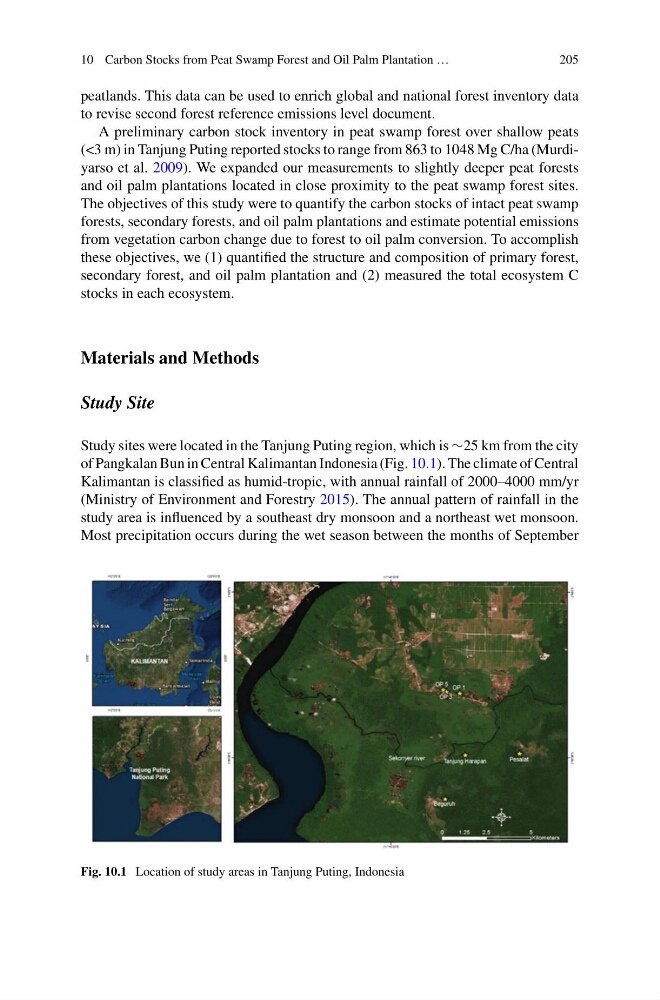
Study sites were located in the Tanjung Puting region, which is ∼25 km from the city
of Pangkalan Bun in Central Kalimantan Indonesia (Fig. 10.1). The climate of Central
Kalimantan is classified as humid-tropic, with annual rainfall of 2000–4000 mm/yr
(Ministry of Environment and Forestry 2015). The annual pattern of rainfall in the
study area is influenced by a southeast dry monsoon and a northeast wet monsoon.
Most precipitation occurs during the wet season between the months of September
Fig. 10.1 Location of study areas in Tanjung Puting, Indonesia
205
peatlands. This data can be used to enrich global and national forest inventory data
to revise second forest reference emissions level document.
A preliminary carbon stock inventory in peat swamp forest over shallow peats
(<3 m) in Tanjung Puting reported stocks to range from 863 to 1048 Mg C/ha (Murdiyarso et al. 2009). We expanded our measurements to slightly deeper peat forests
and oil palm plantations located in close proximity to the peat swamp forest sites.
The objectives of this study were to quantify the carbon stocks of intact peat swamp
forests, secondary forests, and oil palm plantations and estimate potential emissions
from vegetation carbon change due to forest to oil palm conversion. To accomplish
these objectives, we (1) quantified the structure and composition of primary forest,
secondary forest, and oil palm plantation and (2) measured the total ecosystem C
stocks in each ecosystem.
Materials and Methods
Study Site
Study sites were located in the Tanjung Puting region, which is ∼25 km from the city
of Pangkalan Bun in Central Kalimantan Indonesia (Fig. 10.1). The climate of Central
Kalimantan is classified as humid-tropic, with annual rainfall of 2000–4000 mm/yr
(Ministry of Environment and Forestry 2015). The annual pattern of rainfall in the
study area is influenced by a southeast dry monsoon and a northeast wet monsoon.
Most precipitation occurs during the wet season between the months of September
Fig. 10.1 Location of study areas in Tanjung Puting, Indonesia