

96
A. Pratiwi et al.
Table 5.5 (continued)
Variables
(1)
(2)
(3)
(4)
(5)
Log of farm
income
Adopting
water and soil
conservation
technique
Adopting
grafting
technique
Planting
spices crop
(=1 if yes)
Planting
hardwood
trees (=1 if
yes)
Second-generation
migrant to
Lampung
−0.112
−0.00541
−0.0131
0.0692
0.0719
(=1 if yes)
(0.117)
(0.0446)
(0.0200)
(0.0635)
(0.0481)
Constant
16.15 ***
0.619 ***
0.921 ***
1.021 ***
0.0614
(0.471)
(0.140)
(0.0875)
(0.242)
(0.204)
Observations
618
646
655
655
655
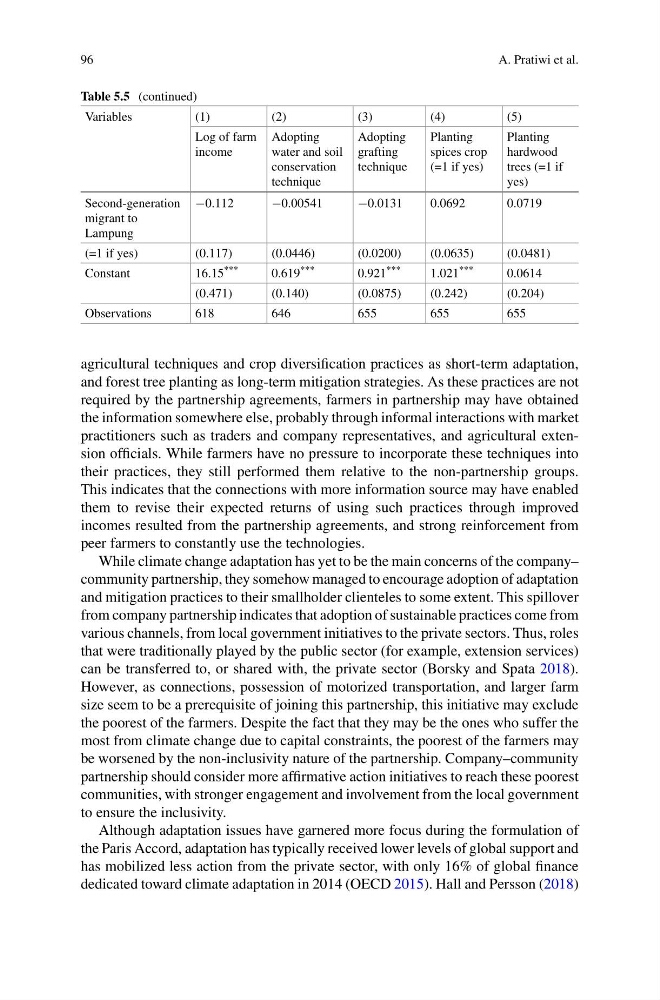
agricultural techniques and crop diversification practices as short-term adaptation,
and forest tree planting as long-term mitigation strategies. As these practices are not
required by the partnership agreements, farmers in partnership may have obtained
the information somewhere else, probably through informal interactions with market
practitioners such as traders and company representatives, and agricultural extension officials. While farmers have no pressure to incorporate these techniques into
their practices, they still performed them relative to the non-partnership groups.
This indicates that the connections with more information source may have enabled
them to revise their expected returns of using such practices through improved
incomes resulted from the partnership agreements, and strong reinforcement from
peer farmers to constantly use the technologies.
While climate change adaptation has yet to be the main concerns of the company–
community partnership, they somehow managed to encourage adoption of adaptation
and mitigation practices to their smallholder clienteles to some extent. This spillover
from company partnership indicates that adoption of sustainable practices come from
various channels, from local government initiatives to the private sectors. Thus, roles
that were traditionally played by the public sector (for example, extension services)
can be transferred to, or shared with, the private sector (Borsky and Spata 2018).
However, as connections, possession of motorized transportation, and larger farm
size seem to be a prerequisite of joining this partnership, this initiative may exclude
the poorest of the farmers. Despite the fact that they may be the ones who suffer the
most from climate change due to capital constraints, the poorest of the farmers may
be worsened by the non-inclusivity nature of the partnership. Company–community
partnership should consider more affirmative action initiatives to reach these poorest
communities, with stronger engagement and involvement from the local government
to ensure the inclusivity.
Although adaptation issues have garnered more focus during the formulation of
the Paris Accord, adaptation has typically received lower levels of global support and
has mobilized less action from the private sector, with only 16% of global finance
dedicated toward climate adaptation in 2014 (OECD 2015). Hall and Persson (2018)
A. Pratiwi et al.
Table 5.5 (continued)
Variables
(1)
(2)
(3)
(4)
(5)
Log of farm
income
Adopting
water and soil
conservation
technique
Adopting
grafting
technique
Planting
spices crop
(=1 if yes)
Planting
hardwood
trees (=1 if
yes)
Second-generation
migrant to
Lampung
−0.112
−0.00541
−0.0131
0.0692
0.0719
(=1 if yes)
(0.117)
(0.0446)
(0.0200)
(0.0635)
(0.0481)
Constant
16.15 ***
0.619 ***
0.921 ***
1.021 ***
0.0614
(0.471)
(0.140)
(0.0875)
(0.242)
(0.204)
Observations
618
646
655
655
655
agricultural techniques and crop diversification practices as short-term adaptation,
and forest tree planting as long-term mitigation strategies. As these practices are not
required by the partnership agreements, farmers in partnership may have obtained
the information somewhere else, probably through informal interactions with market
practitioners such as traders and company representatives, and agricultural extension officials. While farmers have no pressure to incorporate these techniques into
their practices, they still performed them relative to the non-partnership groups.
This indicates that the connections with more information source may have enabled
them to revise their expected returns of using such practices through improved
incomes resulted from the partnership agreements, and strong reinforcement from
peer farmers to constantly use the technologies.
While climate change adaptation has yet to be the main concerns of the company–
community partnership, they somehow managed to encourage adoption of adaptation
and mitigation practices to their smallholder clienteles to some extent. This spillover
from company partnership indicates that adoption of sustainable practices come from
various channels, from local government initiatives to the private sectors. Thus, roles
that were traditionally played by the public sector (for example, extension services)
can be transferred to, or shared with, the private sector (Borsky and Spata 2018).
However, as connections, possession of motorized transportation, and larger farm
size seem to be a prerequisite of joining this partnership, this initiative may exclude
the poorest of the farmers. Despite the fact that they may be the ones who suffer the
most from climate change due to capital constraints, the poorest of the farmers may
be worsened by the non-inclusivity nature of the partnership. Company–community
partnership should consider more affirmative action initiatives to reach these poorest
communities, with stronger engagement and involvement from the local government
to ensure the inclusivity.
Although adaptation issues have garnered more focus during the formulation of
the Paris Accord, adaptation has typically received lower levels of global support and
has mobilized less action from the private sector, with only 16% of global finance
dedicated toward climate adaptation in 2014 (OECD 2015). Hall and Persson (2018)