

Respondents from the pilot survey complained that the questions on choice
modelling were too complicated and too lengthy. The questionnaires used in the
final full survey were thus modified for easier completion. Modifications include a
question on annual income and adding a map with administrative boundaries of
the Liuqiu Island to facilitate respondents to link their marine activities to the
platform. Both local residents and tourists were approached randomly in the full
survey.
The full survey was carried out in a face-to-face manner between 8 and
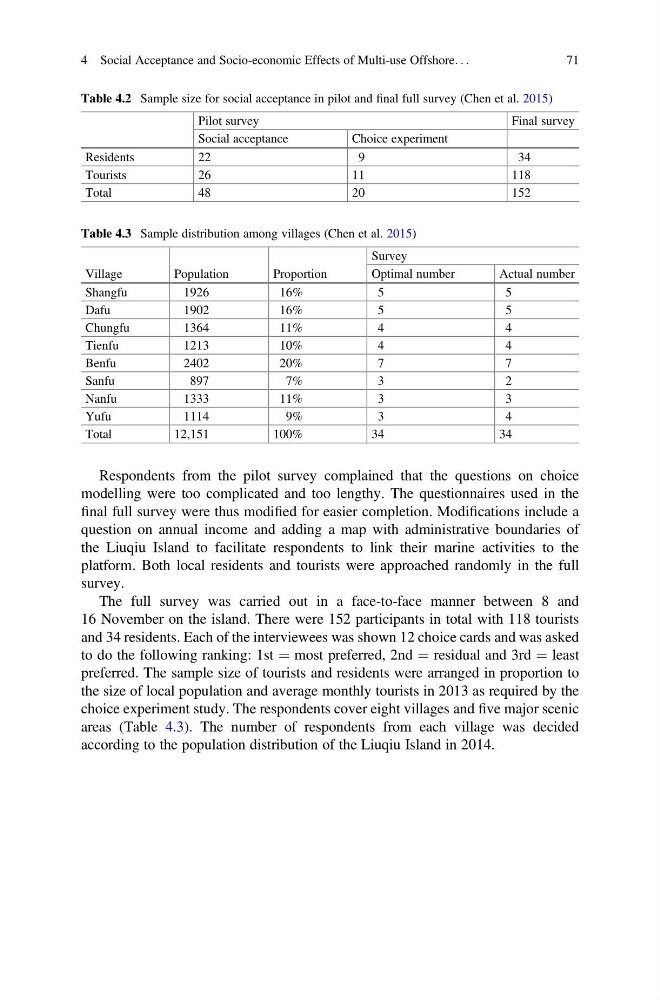
16 November on the island. There were 152 participants in total with 118 tourists
and 34 residents. Each of the interviewees was shown 12 choice cards and was asked
to do the following ranking: 1st ¼ most preferred, 2nd ¼ residual and 3rd ¼ least
preferred. The sample size of tourists and residents were arranged in proportion to
the size of local population and average monthly tourists in 2013 as required by the
choice experiment study. The respondents cover eight villages and five major scenic
areas (Table 4.3). The number of respondents from each village was decided
according to the population distribution of the Liuqiu Island in 2014.
Table 4.2 Sample size for social acceptance in pilot and final full survey (Chen et al. 2015)
Pilot survey
Final survey
Social acceptance
Choice experiment
Residents
22
9
34
Tourists
26
11
118
Total
48
20
152
Table 4.3 Sample distribution among villages (Chen et al. 2015)
Village
Population
Proportion
Survey
Optimal number
Actual number
Shangfu
1926
16%
5
5
Dafu
1902
16%
5
5
Chungfu
1364
11%
4
4
Tienfu
1213
10%
4
4
Benfu
2402
20%
7
7
Sanfu
897
7%
3
2
Nanfu
1333
11%
3
3
Yufu
1114
9%
3
4
Total
12,151
100%
34
34
4 Social Acceptance and Socio-economic Effects of Multi-use Offshore. . .
71
modelling were too complicated and too lengthy. The questionnaires used in the
final full survey were thus modified for easier completion. Modifications include a
question on annual income and adding a map with administrative boundaries of
the Liuqiu Island to facilitate respondents to link their marine activities to the
platform. Both local residents and tourists were approached randomly in the full
survey.
The full survey was carried out in a face-to-face manner between 8 and
16 November on the island. There were 152 participants in total with 118 tourists
and 34 residents. Each of the interviewees was shown 12 choice cards and was asked
to do the following ranking: 1st ¼ most preferred, 2nd ¼ residual and 3rd ¼ least
preferred. The sample size of tourists and residents were arranged in proportion to
the size of local population and average monthly tourists in 2013 as required by the
choice experiment study. The respondents cover eight villages and five major scenic
areas (Table 4.3). The number of respondents from each village was decided
according to the population distribution of the Liuqiu Island in 2014.
Table 4.2 Sample size for social acceptance in pilot and final full survey (Chen et al. 2015)
Pilot survey
Final survey
Social acceptance
Choice experiment
Residents
22
9
34
Tourists
26
11
118
Total
48
20
152
Table 4.3 Sample distribution among villages (Chen et al. 2015)
Village
Population
Proportion
Survey
Optimal number
Actual number
Shangfu
1926
16%
5
5
Dafu
1902
16%
5
5
Chungfu
1364
11%
4
4
Tienfu
1213
10%
4
4
Benfu
2402
20%
7
7
Sanfu
897
7%
3
2
Nanfu
1333
11%
3
3
Yufu
1114
9%
3
4
Total
12,151
100%
34
34
4 Social Acceptance and Socio-economic Effects of Multi-use Offshore. . .
71