

owner and the operator are not the same entity, a consolidated financial analysis,
which excludes the cash flows between the owner and the operator, should be
carried out to assess the actual profitability of the investment, independent of the
internal payments.
• An appropriate financial discount rate (FDR) is adopted in order to calculate the
present value of the future cash flows. The financial discount rate reflects the
opportunity cost of capital from the public point of view.
• Project cash flow forecasts should cover a period appropriate to the project’s
economically useful life and its likely long-term impacts. The number of years for
which forecasts are provided should correspond to the project’s time horizon
(or reference period). The choice of time horizon affects the appraisal results.
• The financial analysis should usually be carried out in constant (real) prices,
i.e. with prices fixed at a base year.
• The analysis should be carried out net of VAT.
Project profitability and financial viability are measured by two indicators:
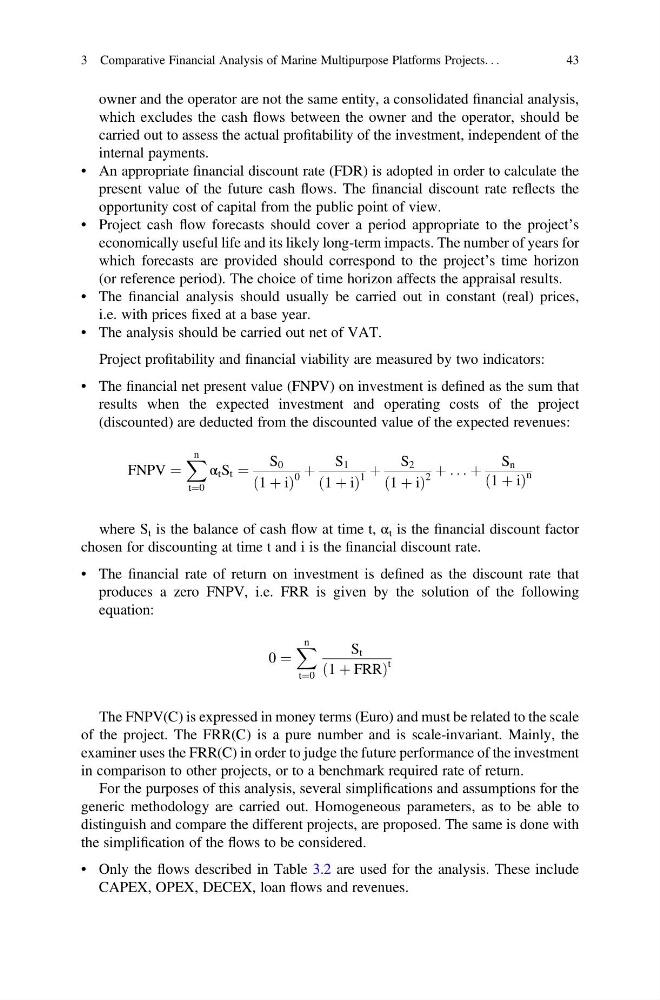
• The financial net present value (FNPV) on investment is defined as the sum that
results when the expected investment and operating costs of the project
(discounted) are deducted from the discounted value of the expected revenues:
FNPV ¼
X n
t¼0
α t S t ¼
S 0
1 þ i
ð
Þ
0
þ
S 1
1 þ i
ð
Þ
1
þ
S 2
1 þ i
ð
Þ
2
þ . . . þ
S n
1 þ i
ð
Þ
n
where S t is the balance of cash flow at time t, α t is the financial discount factor
chosen for discounting at time t and i is the financial discount rate.
• The financial rate of return on investment is defined as the discount rate that
produces a zero FNPV, i.e. FRR is given by the solution of the following
equation:
0 ¼
X n
t¼0
S t
1 þ FRR
ð
Þ
t
The FNPV(C) is expressed in money terms (Euro) and must be related to the scale
of the project. The FRR(C) is a pure number and is scale-invariant. Mainly, the
examiner uses the FRR(C) in order to judge the future performance of the investment
in comparison to other projects, or to a benchmark required rate of return.
For the purposes of this analysis, several simplifications and assumptions for the
generic methodology are carried out. Homogeneous parameters, as to be able to
distinguish and compare the different projects, are proposed. The same is done with
the simplification of the flows to be considered.
• Only the flows described in Table 3.2 are used for the analysis. These include
CAPEX, OPEX, DECEX, loan flows and revenues.
3 Comparative Financial Analysis of Marine Multipurpose Platforms Projects. . .
43
which excludes the cash flows between the owner and the operator, should be
carried out to assess the actual profitability of the investment, independent of the
internal payments.
• An appropriate financial discount rate (FDR) is adopted in order to calculate the
present value of the future cash flows. The financial discount rate reflects the
opportunity cost of capital from the public point of view.
• Project cash flow forecasts should cover a period appropriate to the project’s
economically useful life and its likely long-term impacts. The number of years for
which forecasts are provided should correspond to the project’s time horizon
(or reference period). The choice of time horizon affects the appraisal results.
• The financial analysis should usually be carried out in constant (real) prices,
i.e. with prices fixed at a base year.
• The analysis should be carried out net of VAT.
Project profitability and financial viability are measured by two indicators:
• The financial net present value (FNPV) on investment is defined as the sum that
results when the expected investment and operating costs of the project
(discounted) are deducted from the discounted value of the expected revenues:
FNPV ¼
X n
t¼0
α t S t ¼
S 0
1 þ i
ð
Þ
0
þ
S 1
1 þ i
ð
Þ
1
þ
S 2
1 þ i
ð
Þ
2
þ . . . þ
S n
1 þ i
ð
Þ
n
where S t is the balance of cash flow at time t, α t is the financial discount factor
chosen for discounting at time t and i is the financial discount rate.
• The financial rate of return on investment is defined as the discount rate that
produces a zero FNPV, i.e. FRR is given by the solution of the following
equation:
0 ¼
X n
t¼0
S t
1 þ FRR
ð
Þ
t
The FNPV(C) is expressed in money terms (Euro) and must be related to the scale
of the project. The FRR(C) is a pure number and is scale-invariant. Mainly, the
examiner uses the FRR(C) in order to judge the future performance of the investment
in comparison to other projects, or to a benchmark required rate of return.
For the purposes of this analysis, several simplifications and assumptions for the
generic methodology are carried out. Homogeneous parameters, as to be able to
distinguish and compare the different projects, are proposed. The same is done with
the simplification of the flows to be considered.
• Only the flows described in Table 3.2 are used for the analysis. These include
CAPEX, OPEX, DECEX, loan flows and revenues.
3 Comparative Financial Analysis of Marine Multipurpose Platforms Projects. . .
43