

3.2.3 Financial Assessment
According to the EC “Guide to Cost-Benefit Analysis (CBA) of Investment Projects” (Sartori et al. 2015), financial assessment has different objectives. These are
identified as follows:
• Assess the project profitability.
• Assess the project profitability for the project owner and some key stakeholders.
• Verify the project financial sustainability.
• Outline the cash flows which underpin the calculation of the socio-economic
costs and benefits.
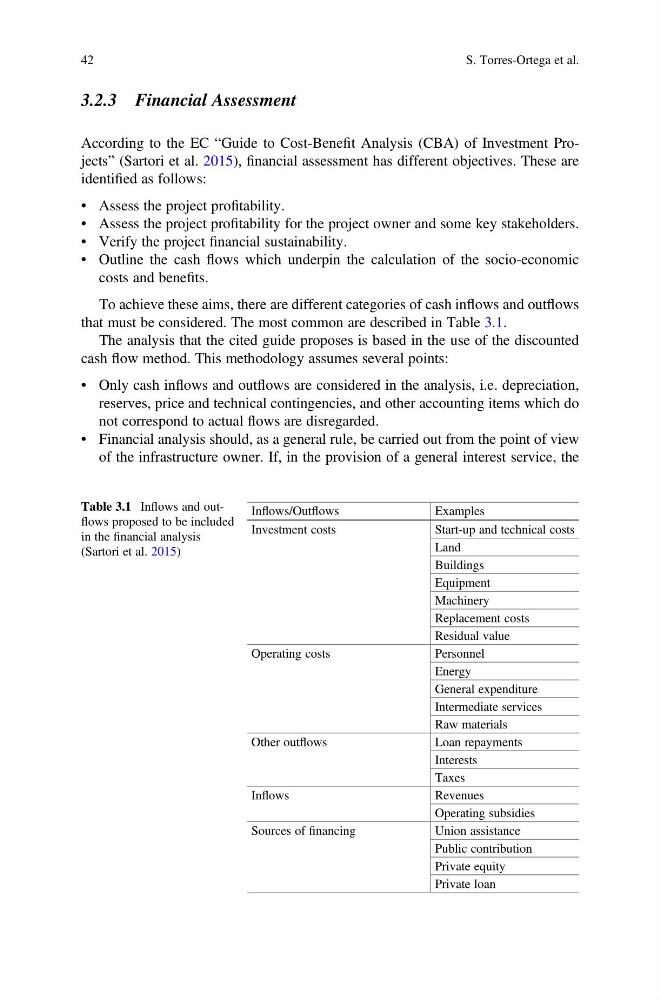
To achieve these aims, there are different categories of cash inflows and outflows
that must be considered. The most common are described in Table 3.1.
The analysis that the cited guide proposes is based in the use of the discounted
cash flow method. This methodology assumes several points:
• Only cash inflows and outflows are considered in the analysis, i.e. depreciation,
reserves, price and technical contingencies, and other accounting items which do
not correspond to actual flows are disregarded.
• Financial analysis should, as a general rule, be carried out from the point of view
of the infrastructure owner. If, in the provision of a general interest service, the
Table 3.1 Inflows and outflows proposed to be included
in the financial analysis
(Sartori et al. 2015)
Inflows/Outflows
Examples
Investment costs
Start-up and technical costs
Land
Buildings
Equipment
Machinery
Replacement costs
Residual value
Operating costs
Personnel
Energy
General expenditure
Intermediate services
Raw materials
Other outflows
Loan repayments
Interests
Taxes
Inflows
Revenues
Operating subsidies
Sources of financing
Union assistance
Public contribution
Private equity
Private loan
42
S. Torres-Ortega et al.
According to the EC “Guide to Cost-Benefit Analysis (CBA) of Investment Projects” (Sartori et al. 2015), financial assessment has different objectives. These are
identified as follows:
• Assess the project profitability.
• Assess the project profitability for the project owner and some key stakeholders.
• Verify the project financial sustainability.
• Outline the cash flows which underpin the calculation of the socio-economic
costs and benefits.
To achieve these aims, there are different categories of cash inflows and outflows
that must be considered. The most common are described in Table 3.1.
The analysis that the cited guide proposes is based in the use of the discounted
cash flow method. This methodology assumes several points:
• Only cash inflows and outflows are considered in the analysis, i.e. depreciation,
reserves, price and technical contingencies, and other accounting items which do
not correspond to actual flows are disregarded.
• Financial analysis should, as a general rule, be carried out from the point of view
of the infrastructure owner. If, in the provision of a general interest service, the
Table 3.1 Inflows and outflows proposed to be included
in the financial analysis
(Sartori et al. 2015)
Inflows/Outflows
Examples
Investment costs
Start-up and technical costs
Land
Buildings
Equipment
Machinery
Replacement costs
Residual value
Operating costs
Personnel
Energy
General expenditure
Intermediate services
Raw materials
Other outflows
Loan repayments
Interests
Taxes
Inflows
Revenues
Operating subsidies
Sources of financing
Union assistance
Public contribution
Private equity
Private loan
42
S. Torres-Ortega et al.