

Appendices
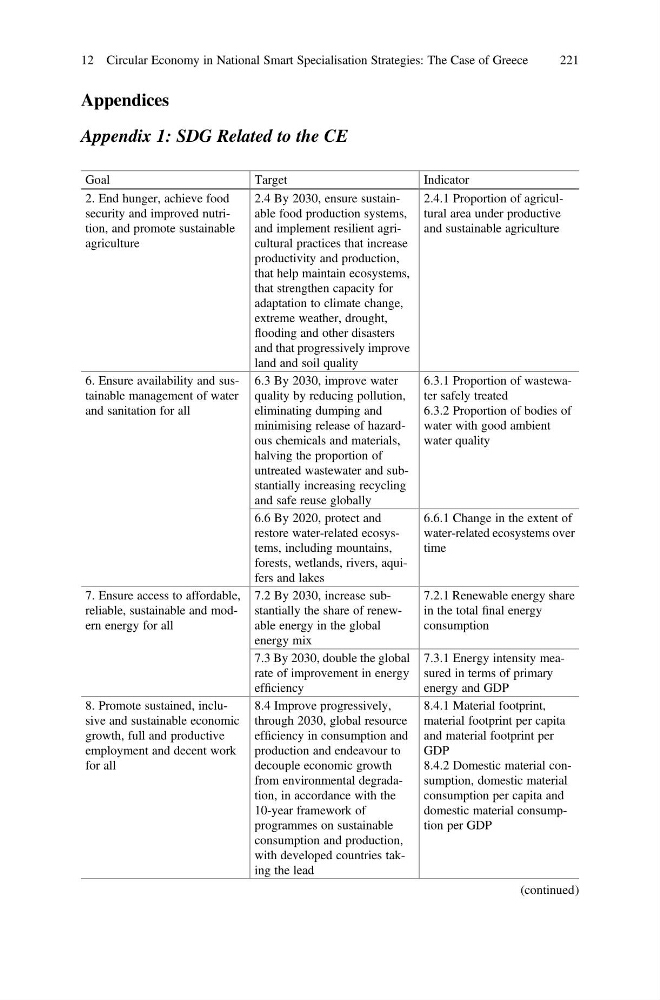
Appendix 1: SDG Related to the CE
Goal
Target
Indicator
2. End hunger, achieve food
security and improved nutrition, and promote sustainable
agriculture
2.4 By 2030, ensure sustainable food production systems,
and implement resilient agricultural practices that increase
productivity and production,
that help maintain ecosystems,
that strengthen capacity for
adaptation to climate change,
extreme weather, drought,
flooding and other disasters
and that progressively improve
land and soil quality
2.4.1 Proportion of agricultural area under productive
and sustainable agriculture
6. Ensure availability and sustainable management of water
and sanitation for all
6.3 By 2030, improve water
quality by reducing pollution,
eliminating dumping and
minimising release of hazardous chemicals and materials,
halving the proportion of
untreated wastewater and substantially increasing recycling
and safe reuse globally
6.3.1 Proportion of wastewater safely treated
6.3.2 Proportion of bodies of
water with good ambient
water quality
6.6 By 2020, protect and
restore water-related ecosystems, including mountains,
forests, wetlands, rivers, aquifers and lakes
6.6.1 Change in the extent of
water-related ecosystems over
time
7. Ensure access to affordable,
reliable, sustainable and modern energy for all
7.2 By 2030, increase substantially the share of renewable energy in the global
energy mix
7.2.1 Renewable energy share
in the total final energy
consumption
7.3 By 2030, double the global
rate of improvement in energy
efficiency
7.3.1 Energy intensity measured in terms of primary
energy and GDP
8. Promote sustained, inclusive and sustainable economic
growth, full and productive
employment and decent work
for all
8.4 Improve progressively,
through 2030, global resource
efficiency in consumption and
production and endeavour to
decouple economic growth
from environmental degradation, in accordance with the
10-year framework of
programmes on sustainable
consumption and production,
with developed countries taking the lead
8.4.1 Material footprint,
material footprint per capita
and material footprint per
GDP
8.4.2 Domestic material consumption, domestic material
consumption per capita and
domestic material consumption per GDP
(continued)
12 Circular Economy in National Smart Specialisation Strategies: The Case of Greece
221
Appendix 1: SDG Related to the CE
Goal
Target
Indicator
2. End hunger, achieve food
security and improved nutrition, and promote sustainable
agriculture
2.4 By 2030, ensure sustainable food production systems,
and implement resilient agricultural practices that increase
productivity and production,
that help maintain ecosystems,
that strengthen capacity for
adaptation to climate change,
extreme weather, drought,
flooding and other disasters
and that progressively improve
land and soil quality
2.4.1 Proportion of agricultural area under productive
and sustainable agriculture
6. Ensure availability and sustainable management of water
and sanitation for all
6.3 By 2030, improve water
quality by reducing pollution,
eliminating dumping and
minimising release of hazardous chemicals and materials,
halving the proportion of
untreated wastewater and substantially increasing recycling
and safe reuse globally
6.3.1 Proportion of wastewater safely treated
6.3.2 Proportion of bodies of
water with good ambient
water quality
6.6 By 2020, protect and
restore water-related ecosystems, including mountains,
forests, wetlands, rivers, aquifers and lakes
6.6.1 Change in the extent of
water-related ecosystems over
time
7. Ensure access to affordable,
reliable, sustainable and modern energy for all
7.2 By 2030, increase substantially the share of renewable energy in the global
energy mix
7.2.1 Renewable energy share
in the total final energy
consumption
7.3 By 2030, double the global
rate of improvement in energy
efficiency
7.3.1 Energy intensity measured in terms of primary
energy and GDP
8. Promote sustained, inclusive and sustainable economic
growth, full and productive
employment and decent work
for all
8.4 Improve progressively,
through 2030, global resource
efficiency in consumption and
production and endeavour to
decouple economic growth
from environmental degradation, in accordance with the
10-year framework of
programmes on sustainable
consumption and production,
with developed countries taking the lead
8.4.1 Material footprint,
material footprint per capita
and material footprint per
GDP
8.4.2 Domestic material consumption, domestic material
consumption per capita and
domestic material consumption per GDP
(continued)
12 Circular Economy in National Smart Specialisation Strategies: The Case of Greece
221