

country-specific recommendations for the next 12–18 months. The green economy is
one of the themes, which includes a variety of environmental issues addressed in this
context, though CE is not directly addressed yet.
12.3 The Greek Context
12.3.1 Snapshot of the Greek CE Performance
Compared to the EU average, Greece scores rather unsatisfactorily in its transition
towards the CE. As demonstrated by Table 12.1, the country generates more
municipal waste per capita or GDP with the exception of generation of waste
excluding major mineral wastes per domestic material consumption, which is the
only case it outperforms the EU average. It has a worse than average performance in
all waste management with recycling rates being between 1/4 (in the case of
biowaste) and close to the EU average (recovery rate of construction and demolition
waste). The performance is at the order of magnitude of 1–10 in all secondary raw
material indicators, while it is also underperforming in competitiveness and innovation (Table 12.2).
In a nutshell Greece is lagging significantly behind the EU average in its
transition to the CE and needs significant acceleration to catch up.
The rather disappointing situation of the country concurs with the most recent
European Semester Country-Specific Recommendations document for Greece (June
2019), where it is stated that “Treatment of solid waste and urban and industrial
wastewater is the main area needing additional investment in order to align the
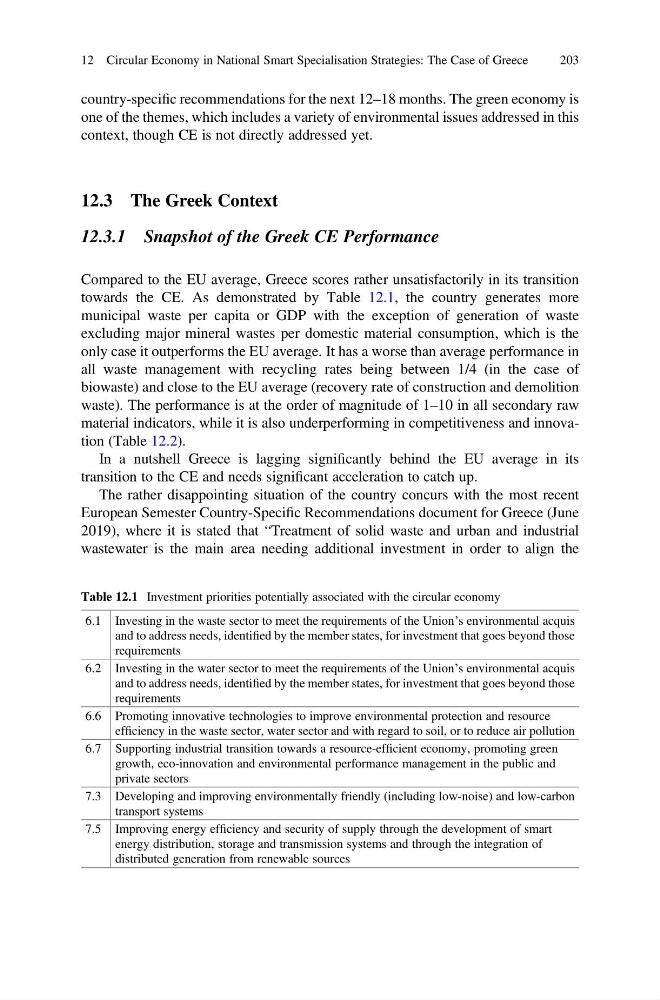
Table 12.1 Investment priorities potentially associated with the circular economy
6.1 Investing in the waste sector to meet the requirements of the Union’s environmental acquis
and to address needs, identified by the member states, for investment that goes beyond those
requirements
6.2 Investing in the water sector to meet the requirements of the Union’s environmental acquis
and to address needs, identified by the member states, for investment that goes beyond those
requirements
6.6 Promoting innovative technologies to improve environmental protection and resource
efficiency in the waste sector, water sector and with regard to soil, or to reduce air pollution
6.7 Supporting industrial transition towards a resource-efficient economy, promoting green
growth, eco-innovation and environmental performance management in the public and
private sectors
7.3 Developing and improving environmentally friendly (including low-noise) and low-carbon
transport systems
7.5 Improving energy efficiency and security of supply through the development of smart
energy distribution, storage and transmission systems and through the integration of
distributed generation from renewable sources
12 Circular Economy in National Smart Specialisation Strategies: The Case of Greece
203
one of the themes, which includes a variety of environmental issues addressed in this
context, though CE is not directly addressed yet.
12.3 The Greek Context
12.3.1 Snapshot of the Greek CE Performance
Compared to the EU average, Greece scores rather unsatisfactorily in its transition
towards the CE. As demonstrated by Table 12.1, the country generates more
municipal waste per capita or GDP with the exception of generation of waste
excluding major mineral wastes per domestic material consumption, which is the
only case it outperforms the EU average. It has a worse than average performance in
all waste management with recycling rates being between 1/4 (in the case of
biowaste) and close to the EU average (recovery rate of construction and demolition
waste). The performance is at the order of magnitude of 1–10 in all secondary raw
material indicators, while it is also underperforming in competitiveness and innovation (Table 12.2).
In a nutshell Greece is lagging significantly behind the EU average in its
transition to the CE and needs significant acceleration to catch up.
The rather disappointing situation of the country concurs with the most recent
European Semester Country-Specific Recommendations document for Greece (June
2019), where it is stated that “Treatment of solid waste and urban and industrial
wastewater is the main area needing additional investment in order to align the
Table 12.1 Investment priorities potentially associated with the circular economy
6.1 Investing in the waste sector to meet the requirements of the Union’s environmental acquis
and to address needs, identified by the member states, for investment that goes beyond those
requirements
6.2 Investing in the water sector to meet the requirements of the Union’s environmental acquis
and to address needs, identified by the member states, for investment that goes beyond those
requirements
6.6 Promoting innovative technologies to improve environmental protection and resource
efficiency in the waste sector, water sector and with regard to soil, or to reduce air pollution
6.7 Supporting industrial transition towards a resource-efficient economy, promoting green
growth, eco-innovation and environmental performance management in the public and
private sectors
7.3 Developing and improving environmentally friendly (including low-noise) and low-carbon
transport systems
7.5 Improving energy efficiency and security of supply through the development of smart
energy distribution, storage and transmission systems and through the integration of
distributed generation from renewable sources
12 Circular Economy in National Smart Specialisation Strategies: The Case of Greece
203