

investment for a particular location site by comparing different net present value
rates.
5.2.2 Workflow
The MERMAID project defines four sites, Mediterranean, North, Baltic, and Atlantic, which comprise the four case studies of the assessment tool. Each site is modeled
differently in the tool due to variability in area characteristics that lead to different
ecological, engineering, socio-economic, and financial concerns. The MERMAID
assessment tool consists of the following five parts:
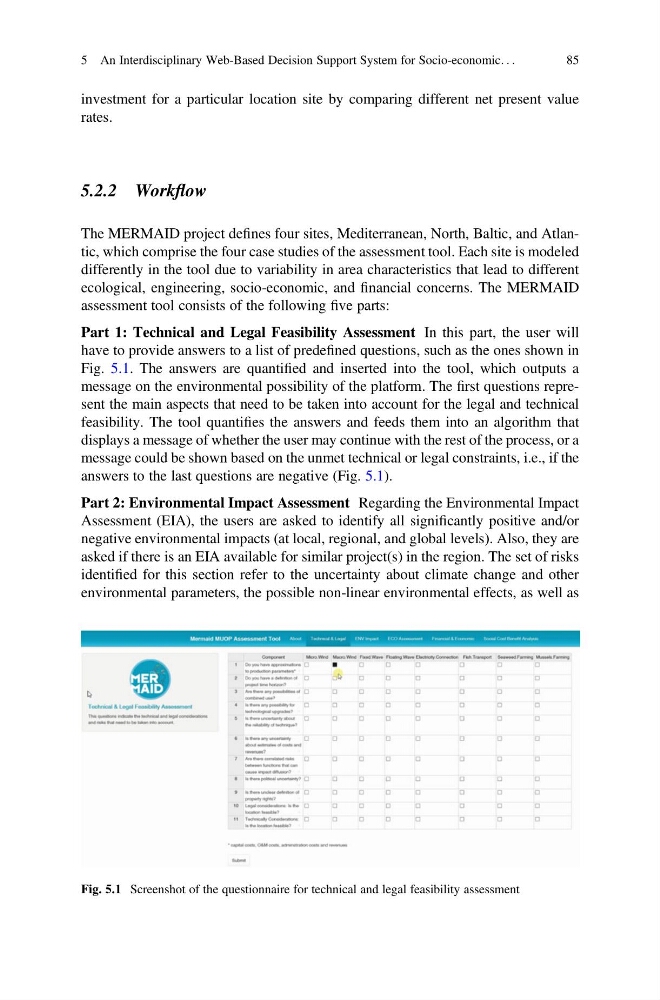
Part 1: Technical and Legal Feasibility Assessment In this part, the user will
have to provide answers to a list of predefined questions, such as the ones shown in
Fig. 5.1. The answers are quantified and inserted into the tool, which outputs a
message on the environmental possibility of the platform. The first questions represent the main aspects that need to be taken into account for the legal and technical
feasibility. The tool quantifies the answers and feeds them into an algorithm that
displays a message of whether the user may continue with the rest of the process, or a
message could be shown based on the unmet technical or legal constraints, i.e., if the
answers to the last questions are negative (Fig. 5.1).
Part 2: Environmental Impact Assessment Regarding the Environmental Impact
Assessment (EIA), the users are asked to identify all significantly positive and/or
negative environmental impacts (at local, regional, and global levels). Also, they are
asked if there is an EIA available for similar project(s) in the region. The set of risks
identified for this section refer to the uncertainty about climate change and other
environmental parameters, the possible non-linear environmental effects, as well as
Fig. 5.1 Screenshot of the questionnaire for technical and legal feasibility assessment
5 An Interdisciplinary Web-Based Decision Support System for Socio-economic. . .
85
rates.
5.2.2 Workflow
The MERMAID project defines four sites, Mediterranean, North, Baltic, and Atlantic, which comprise the four case studies of the assessment tool. Each site is modeled
differently in the tool due to variability in area characteristics that lead to different
ecological, engineering, socio-economic, and financial concerns. The MERMAID
assessment tool consists of the following five parts:
Part 1: Technical and Legal Feasibility Assessment In this part, the user will
have to provide answers to a list of predefined questions, such as the ones shown in
Fig. 5.1. The answers are quantified and inserted into the tool, which outputs a
message on the environmental possibility of the platform. The first questions represent the main aspects that need to be taken into account for the legal and technical
feasibility. The tool quantifies the answers and feeds them into an algorithm that
displays a message of whether the user may continue with the rest of the process, or a
message could be shown based on the unmet technical or legal constraints, i.e., if the
answers to the last questions are negative (Fig. 5.1).
Part 2: Environmental Impact Assessment Regarding the Environmental Impact
Assessment (EIA), the users are asked to identify all significantly positive and/or
negative environmental impacts (at local, regional, and global levels). Also, they are
asked if there is an EIA available for similar project(s) in the region. The set of risks
identified for this section refer to the uncertainty about climate change and other
environmental parameters, the possible non-linear environmental effects, as well as
Fig. 5.1 Screenshot of the questionnaire for technical and legal feasibility assessment
5 An Interdisciplinary Web-Based Decision Support System for Socio-economic. . .
85