

varying results about the experience as a moderator. The
results of various researchers show that experience moderates the relationship of most constructs to behavioral intentions (BI). Experience also moderates the relationship of
habit (H) facilitating conditions (FC) and behavioral intention (BI) as a direct determinant of use behavior (UB). Age,
gender, and experience also have a combined effect on the
correlation between facilitating conditions (FC) and behavioral intention BI. Hall and Mansfield (1975) discovered that
gender, age, and experience are the moderates of technology
acceptance. Furthermore, according to Venkatesh et al.
(2012), with the joint impact of gender and age, experience
further moderates the association between behavioral intention (BI) and facilitating conditions (FC). The relationship
between BI and FC is moderated by experience (Venkatesh
et al., 2012). Hence, having more experience with technology results in more familiarity, confidence, and understanding with the technology, therefore reducing the
dependency on facilitating conditions (Alba & Hutchinson,
1987).
5.8.3 Gender (As a Moderating Variable)
Gender is a moderator that affects all constructs of behavioral intentions (BI). Venkatesh et al. (2003) claimed that
gender moderates the association between a) EE and BI,
(b) PE and BI, and (c) SI and BI. Venkatesh et al. (2003)
found that gender possesses a moderating effect on the social
norm (Venkatesh et al., 2003). Women are found to be more
conscious of SI than men and hence the impact of SI on
intentions was greater for women, especially for older
women. Venkatesh and Morris (2000) reported that the
technology adoption decision is strongly influenced by PE
for men and by EE and SI for women. The gender is not
considered for this study because the population of this study
in the HEIs of Saudi Arabia is male.
5.8.4 Technology Awareness (As a Moderating
Variable)
The literature shows a significant relationship between
awareness and behavioral intension (Faruq & Ahmad, 2013)
to adopt new technology. Bardram and Hansen (2010) found
a strong relationship between technological awareness and
its use. Charbaji and Mikdashi (2003) used awareness in his
study and found that awareness strongly influences the BI to
use e-government. The new technology may be adopted by
the people if the people are aware of the technology to an
adequate level (Lee & Wu, 2011). Similarly, Rehman, Esichaikul and Kamal (2012) argue that the adoption of technological services requires that individuals should be aware
of services. The adoption of new technology by end-users is
influenced by their personal beliefs and attitudes that have
been highlighted in many theories and models such as TRA,
TPB, and TAM. The personal belief and attitudes of the
individual are more likely to be established if the individuals
are aware of new technology when initially launched. The
‘awareness’, according to Sun and Fang (2016) is, “The
degree to which a person thinks about how the technology
fits the individual’s local specifics and his/her own needs”.
The technology is designed for specific tasks that work
under specific technical environments such as learning
ability and availability of technical support (Burton-Jones &
Grange, 2013). To achieve a better benefit of technology, the
users of the technology need to be aware of the issues
associated with the technology (Burton-Jones & Grange,
2013; Porter & Graham, 2016; Sun & Fang, 2016). Adoption of technology with a less mindful adoption decision
may lead to the wastage of resources and investment due to
lack of alignments between the context and the technology.
The meaning of the technology contexts is that technology
users are aware of the advantages and disadvantages of the
technology (Sun & Fang, 2016). The awareness of the
advantages and disadvantages of technology builds confidence in using it (Ahmed et al., 2016), although the real
challenge is the effective adoption of educational technology
(Ismail, 2016). The lack of technology awareness has been
cited as the ‘first barrier’ to the adoption of innovative
technologies (Riedel et al., 2007) and a ‘basic pre-requisite’
for growth and adoption of new technology (Reffat, 2003). It
is considered a key challenge for the implementation of
technology (Shannak, 2013). Assessing awareness is in
agreement with Hall and Hord (2011) who presented the
seven stages of concern in the adoption of new technology
and argued that stage-0 is the awareness stage. This implies
that when an individual intends to adopt a technology,
he/she must be aware of the advantages and disadvantages of
the technology (Rehman et al., 2012). In the light of the
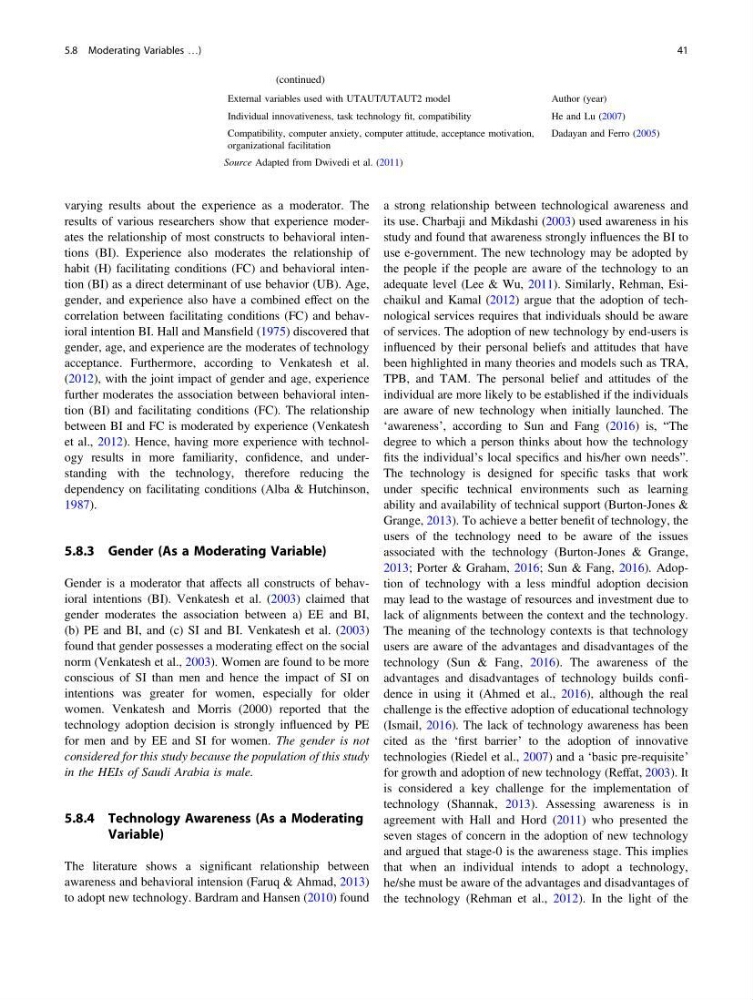
Table 5.2 (continued)
External variables used with UTAUT/UTAUT2 model
Author (year)
Individual innovativeness, task technology fit, compatibility
He and Lu (2007)
Compatibility, computer anxiety, computer attitude, acceptance motivation,
organizational facilitation
Dadayan and Ferro (2005)
Source Adapted from Dwivedi et al. (2011)
5.8 Moderating Variables …)
41
results of various researchers show that experience moderates the relationship of most constructs to behavioral intentions (BI). Experience also moderates the relationship of
habit (H) facilitating conditions (FC) and behavioral intention (BI) as a direct determinant of use behavior (UB). Age,
gender, and experience also have a combined effect on the
correlation between facilitating conditions (FC) and behavioral intention BI. Hall and Mansfield (1975) discovered that
gender, age, and experience are the moderates of technology
acceptance. Furthermore, according to Venkatesh et al.
(2012), with the joint impact of gender and age, experience
further moderates the association between behavioral intention (BI) and facilitating conditions (FC). The relationship
between BI and FC is moderated by experience (Venkatesh
et al., 2012). Hence, having more experience with technology results in more familiarity, confidence, and understanding with the technology, therefore reducing the
dependency on facilitating conditions (Alba & Hutchinson,
1987).
5.8.3 Gender (As a Moderating Variable)
Gender is a moderator that affects all constructs of behavioral intentions (BI). Venkatesh et al. (2003) claimed that
gender moderates the association between a) EE and BI,
(b) PE and BI, and (c) SI and BI. Venkatesh et al. (2003)
found that gender possesses a moderating effect on the social
norm (Venkatesh et al., 2003). Women are found to be more
conscious of SI than men and hence the impact of SI on
intentions was greater for women, especially for older
women. Venkatesh and Morris (2000) reported that the
technology adoption decision is strongly influenced by PE
for men and by EE and SI for women. The gender is not
considered for this study because the population of this study
in the HEIs of Saudi Arabia is male.
5.8.4 Technology Awareness (As a Moderating
Variable)
The literature shows a significant relationship between
awareness and behavioral intension (Faruq & Ahmad, 2013)
to adopt new technology. Bardram and Hansen (2010) found
a strong relationship between technological awareness and
its use. Charbaji and Mikdashi (2003) used awareness in his
study and found that awareness strongly influences the BI to
use e-government. The new technology may be adopted by
the people if the people are aware of the technology to an
adequate level (Lee & Wu, 2011). Similarly, Rehman, Esichaikul and Kamal (2012) argue that the adoption of technological services requires that individuals should be aware
of services. The adoption of new technology by end-users is
influenced by their personal beliefs and attitudes that have
been highlighted in many theories and models such as TRA,
TPB, and TAM. The personal belief and attitudes of the
individual are more likely to be established if the individuals
are aware of new technology when initially launched. The
‘awareness’, according to Sun and Fang (2016) is, “The
degree to which a person thinks about how the technology
fits the individual’s local specifics and his/her own needs”.
The technology is designed for specific tasks that work
under specific technical environments such as learning
ability and availability of technical support (Burton-Jones &
Grange, 2013). To achieve a better benefit of technology, the
users of the technology need to be aware of the issues
associated with the technology (Burton-Jones & Grange,
2013; Porter & Graham, 2016; Sun & Fang, 2016). Adoption of technology with a less mindful adoption decision
may lead to the wastage of resources and investment due to
lack of alignments between the context and the technology.
The meaning of the technology contexts is that technology
users are aware of the advantages and disadvantages of the
technology (Sun & Fang, 2016). The awareness of the
advantages and disadvantages of technology builds confidence in using it (Ahmed et al., 2016), although the real
challenge is the effective adoption of educational technology
(Ismail, 2016). The lack of technology awareness has been
cited as the ‘first barrier’ to the adoption of innovative
technologies (Riedel et al., 2007) and a ‘basic pre-requisite’
for growth and adoption of new technology (Reffat, 2003). It
is considered a key challenge for the implementation of
technology (Shannak, 2013). Assessing awareness is in
agreement with Hall and Hord (2011) who presented the
seven stages of concern in the adoption of new technology
and argued that stage-0 is the awareness stage. This implies
that when an individual intends to adopt a technology,
he/she must be aware of the advantages and disadvantages of
the technology (Rehman et al., 2012). In the light of the
Table 5.2 (continued)
External variables used with UTAUT/UTAUT2 model
Author (year)
Individual innovativeness, task technology fit, compatibility
He and Lu (2007)
Compatibility, computer anxiety, computer attitude, acceptance motivation,
organizational facilitation
Dadayan and Ferro (2005)
Source Adapted from Dwivedi et al. (2011)
5.8 Moderating Variables …)
41