

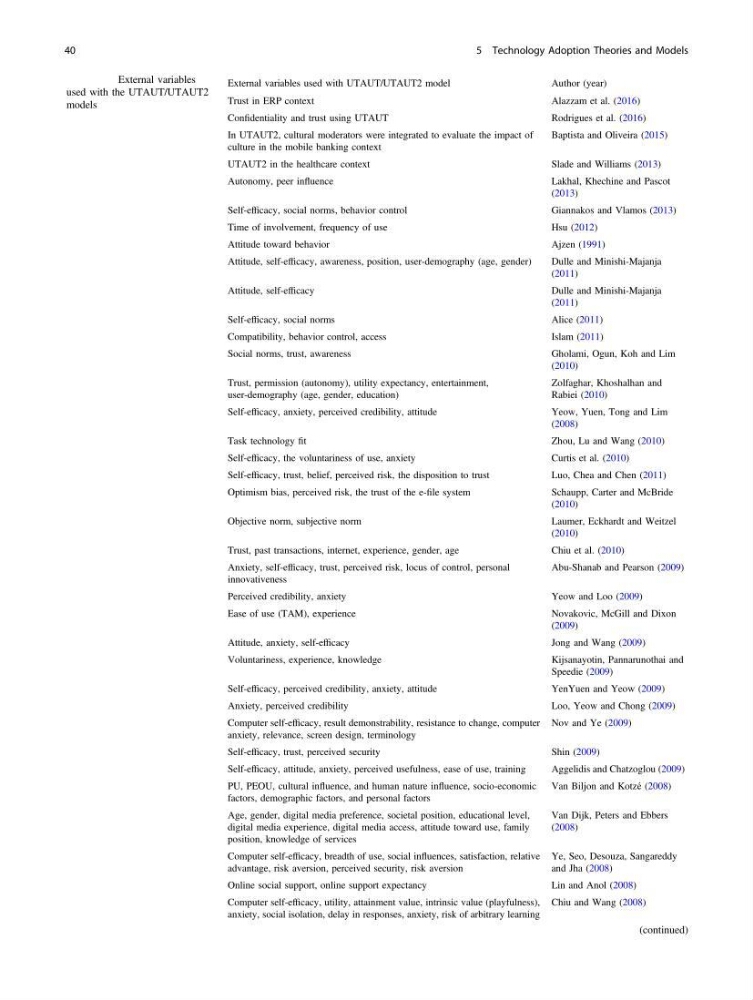
Table 5.2 External variables
used with the UTAUT/UTAUT2
models
External variables used with UTAUT/UTAUT2 model
Author (year)
Trust in ERP context
Alazzam et al. (2016)
Confidentiality and trust using UTAUT
Rodrigues et al. (2016)
In UTAUT2, cultural moderators were integrated to evaluate the impact of
culture in the mobile banking context
Baptista and Oliveira (2015)
UTAUT2 in the healthcare context
Slade and Williams (2013)
Autonomy, peer influence
Lakhal, Khechine and Pascot
(2013)
Self-efficacy, social norms, behavior control
Giannakos and Vlamos (2013)
Time of involvement, frequency of use
Hsu (2012)
Attitude toward behavior
Ajzen (1991)
Attitude, self-efficacy, awareness, position, user-demography (age, gender)
Dulle and Minishi-Majanja
(2011)
Attitude, self-efficacy
Dulle and Minishi-Majanja
(2011)
Self-efficacy, social norms
Alice (2011)
Compatibility, behavior control, access
Islam (2011)
Social norms, trust, awareness
Gholami, Ogun, Koh and Lim
(2010)
Trust, permission (autonomy), utility expectancy, entertainment,
user-demography (age, gender, education)
Zolfaghar, Khoshalhan and
Rabiei (2010)
Self-efficacy, anxiety, perceived credibility, attitude
Yeow, Yuen, Tong and Lim
(2008)
Task technology fit
Zhou, Lu and Wang (2010)
Self-efficacy, the voluntariness of use, anxiety
Curtis et al. (2010)
Self-efficacy, trust, belief, perceived risk, the disposition to trust
Luo, Chea and Chen (2011)
Optimism bias, perceived risk, the trust of the e-file system
Schaupp, Carter and McBride
(2010)
Objective norm, subjective norm
Laumer, Eckhardt and Weitzel
(2010)
Trust, past transactions, internet, experience, gender, age
Chiu et al. (2010)
Anxiety, self-efficacy, trust, perceived risk, locus of control, personal
innovativeness
Abu-Shanab and Pearson (2009)
Perceived credibility, anxiety
Yeow and Loo (2009)
Ease of use (TAM), experience
Novakovic, McGill and Dixon
(2009)
Attitude, anxiety, self-efficacy
Jong and Wang (2009)
Voluntariness, experience, knowledge
Kijsanayotin, Pannarunothai and
Speedie (2009)
Self-efficacy, perceived credibility, anxiety, attitude
YenYuen and Yeow (2009)
Anxiety, perceived credibility
Loo, Yeow and Chong (2009)
Computer self-efficacy, result demonstrability, resistance to change, computer
anxiety, relevance, screen design, terminology
Nov and Ye (2009)
Self-efficacy, trust, perceived security
Shin (2009)
Self-efficacy, attitude, anxiety, perceived usefulness, ease of use, training
Aggelidis and Chatzoglou (2009)
PU, PEOU, cultural influence, and human nature influence, socio-economic
factors, demographic factors, and personal factors
Van Biljon and Kotzé (2008)
Age, gender, digital media preference, societal position, educational level,
digital media experience, digital media access, attitude toward use, family
position, knowledge of services
Van Dijk, Peters and Ebbers
(2008)
Computer self-efficacy, breadth of use, social influences, satisfaction, relative
advantage, risk aversion, perceived security, risk aversion
Ye, Seo, Desouza, Sangareddy
and Jha (2008)
Online social support, online support expectancy
Lin and Anol (2008)
Computer self-efficacy, utility, attainment value, intrinsic value (playfulness),
anxiety, social isolation, delay in responses, anxiety, risk of arbitrary learning
Chiu and Wang (2008)
(continued)
40
5 Technology Adoption Theories and Models
used with the UTAUT/UTAUT2
models
External variables used with UTAUT/UTAUT2 model
Author (year)
Trust in ERP context
Alazzam et al. (2016)
Confidentiality and trust using UTAUT
Rodrigues et al. (2016)
In UTAUT2, cultural moderators were integrated to evaluate the impact of
culture in the mobile banking context
Baptista and Oliveira (2015)
UTAUT2 in the healthcare context
Slade and Williams (2013)
Autonomy, peer influence
Lakhal, Khechine and Pascot
(2013)
Self-efficacy, social norms, behavior control
Giannakos and Vlamos (2013)
Time of involvement, frequency of use
Hsu (2012)
Attitude toward behavior
Ajzen (1991)
Attitude, self-efficacy, awareness, position, user-demography (age, gender)
Dulle and Minishi-Majanja
(2011)
Attitude, self-efficacy
Dulle and Minishi-Majanja
(2011)
Self-efficacy, social norms
Alice (2011)
Compatibility, behavior control, access
Islam (2011)
Social norms, trust, awareness
Gholami, Ogun, Koh and Lim
(2010)
Trust, permission (autonomy), utility expectancy, entertainment,
user-demography (age, gender, education)
Zolfaghar, Khoshalhan and
Rabiei (2010)
Self-efficacy, anxiety, perceived credibility, attitude
Yeow, Yuen, Tong and Lim
(2008)
Task technology fit
Zhou, Lu and Wang (2010)
Self-efficacy, the voluntariness of use, anxiety
Curtis et al. (2010)
Self-efficacy, trust, belief, perceived risk, the disposition to trust
Luo, Chea and Chen (2011)
Optimism bias, perceived risk, the trust of the e-file system
Schaupp, Carter and McBride
(2010)
Objective norm, subjective norm
Laumer, Eckhardt and Weitzel
(2010)
Trust, past transactions, internet, experience, gender, age
Chiu et al. (2010)
Anxiety, self-efficacy, trust, perceived risk, locus of control, personal
innovativeness
Abu-Shanab and Pearson (2009)
Perceived credibility, anxiety
Yeow and Loo (2009)
Ease of use (TAM), experience
Novakovic, McGill and Dixon
(2009)
Attitude, anxiety, self-efficacy
Jong and Wang (2009)
Voluntariness, experience, knowledge
Kijsanayotin, Pannarunothai and
Speedie (2009)
Self-efficacy, perceived credibility, anxiety, attitude
YenYuen and Yeow (2009)
Anxiety, perceived credibility
Loo, Yeow and Chong (2009)
Computer self-efficacy, result demonstrability, resistance to change, computer
anxiety, relevance, screen design, terminology
Nov and Ye (2009)
Self-efficacy, trust, perceived security
Shin (2009)
Self-efficacy, attitude, anxiety, perceived usefulness, ease of use, training
Aggelidis and Chatzoglou (2009)
PU, PEOU, cultural influence, and human nature influence, socio-economic
factors, demographic factors, and personal factors
Van Biljon and Kotzé (2008)
Age, gender, digital media preference, societal position, educational level,
digital media experience, digital media access, attitude toward use, family
position, knowledge of services
Van Dijk, Peters and Ebbers
(2008)
Computer self-efficacy, breadth of use, social influences, satisfaction, relative
advantage, risk aversion, perceived security, risk aversion
Ye, Seo, Desouza, Sangareddy
and Jha (2008)
Online social support, online support expectancy
Lin and Anol (2008)
Computer self-efficacy, utility, attainment value, intrinsic value (playfulness),
anxiety, social isolation, delay in responses, anxiety, risk of arbitrary learning
Chiu and Wang (2008)
(continued)
40
5 Technology Adoption Theories and Models