

142 P. NAEF ET AL.
Netherlands also have an intermediate category. The oECD proposes
a standardised typology based on three categories: (1) predominantly
urban; (2) intermediate; (3) predominantly rural (oECD 2019). With
the exception of Slovenia, where more than half of all people live in
rural areas, the countries represented in the previous chapters are mostly
composed of urban or intermediate populations, with the Netherlands,
the United Kingdom and Switzerland associated with the smallest rural
populations. These urban–rural divisions can influence household energy
demand and related policies.
Dwelling tenure will also determine households’ opportunities to
reduce energy demand. Previous research highlights the extensive literature on the tenant–landlord relations associated to energy use problematics, pointing out dilemmas such as ‘the fact that landlords lack
incentives to invest in energy renovations for buildings where the benefits would accrue to tenants or, from the perspective of the tenant, the
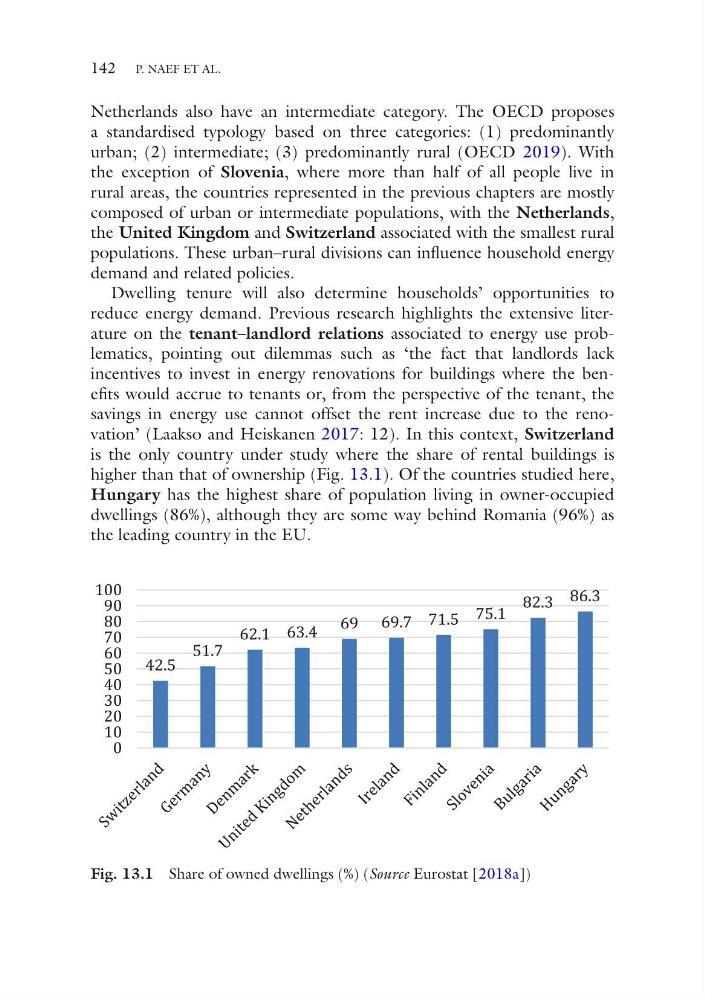
savings in energy use cannot offset the rent increase due to the renovation’ (Laakso and Heiskanen 2017: 12). In this context, Switzerland
is the only country under study where the share of rental buildings is
higher than that of ownership (Fig. 13.1). of the countries studied here,
Hungary has the highest share of population living in owner-occupied
dwellings (86%), although they are some way behind Romania (96%) as
the leading country in the EU.
Fig. 13.1 Share of owned dwellings (%) (Source Eurostat [2018a])
Netherlands also have an intermediate category. The oECD proposes
a standardised typology based on three categories: (1) predominantly
urban; (2) intermediate; (3) predominantly rural (oECD 2019). With
the exception of Slovenia, where more than half of all people live in
rural areas, the countries represented in the previous chapters are mostly
composed of urban or intermediate populations, with the Netherlands,
the United Kingdom and Switzerland associated with the smallest rural
populations. These urban–rural divisions can influence household energy
demand and related policies.
Dwelling tenure will also determine households’ opportunities to
reduce energy demand. Previous research highlights the extensive literature on the tenant–landlord relations associated to energy use problematics, pointing out dilemmas such as ‘the fact that landlords lack
incentives to invest in energy renovations for buildings where the benefits would accrue to tenants or, from the perspective of the tenant, the
savings in energy use cannot offset the rent increase due to the renovation’ (Laakso and Heiskanen 2017: 12). In this context, Switzerland
is the only country under study where the share of rental buildings is
higher than that of ownership (Fig. 13.1). of the countries studied here,
Hungary has the highest share of population living in owner-occupied
dwellings (86%), although they are some way behind Romania (96%) as
the leading country in the EU.
Fig. 13.1 Share of owned dwellings (%) (Source Eurostat [2018a])