

acquisitions internally. It also created divisions
with a customer focus and increased divisional
autonomy, while demonstrating organisational
flexibility to maximise synergies across its
increasingly broad areas of business.
• Motive: EU directives led to Germany passing new laws to promote greater competition
in its domestic postal market in 1997, making
Germany the leader in postal market liberalisation in Europe. At the time, domestic post
accounted for more than 75% of Deutsche
Post’s revenues. Hence, Deutsche Post was
motivated to expand into new value areas,
both geographically and within logistic services, to preserve profits as domestic competition inevitably increased.
• Context: Deutsche Post benefited from favourable timing. Its transition was motivated by legislation, rather than by declining letter volumes.
Consequently, it still had the large internal cash
flows needed to undertake large acquisitions. Its
privatisation in 2001 also afforded it the freedom
to undertake radical strategies.
• Strategic response: Deutsche Post made
several large acquisitions that transformed it
into a major global logistics company. It
made smaller acquisitions in the late 1990s
(Danzas and Air Express International) before
acquiring DHL and Excel in 2002 and 2005
respectively for more than €8 billion
following its privatisation in 2001. DHL had
expertise in international express delivery and
a developed postal network across the USA
and Europe, while Excel made Deutsche Post
a major player in supply-side logistics.
However, such an extreme strategy comes
with inherent risks, as evidenced by Deutsche
Post discontinuing its domestic express service in the USA and incurring $3.9 billion in
restructuring costs as a result in 2009.
• Organisational structure: Deutsche Post has
demonstrated flexibility in its organisational
structure as it has sought to increase the
autonomy and customer responsiveness of its
divisions. Similar divisions in new acquisitions were combined to create more efficient
networks, and a shift from a three-tier to a
two-tier management structure allowed for
greater responsiveness to consumer demands.
Deutsche Post also formed cross-cutting service divisions to maximise synergies across its
new business areas, and a global services unit
was introduced in 2006 to provide support
across all divisions (Fig. 13 and Table 2).
(4) Lessons from the case studies—the utilities
sector
(1) RWE
RWE had a large stock of lignite, coal and
nuclear assets in 2004 that were low cost,
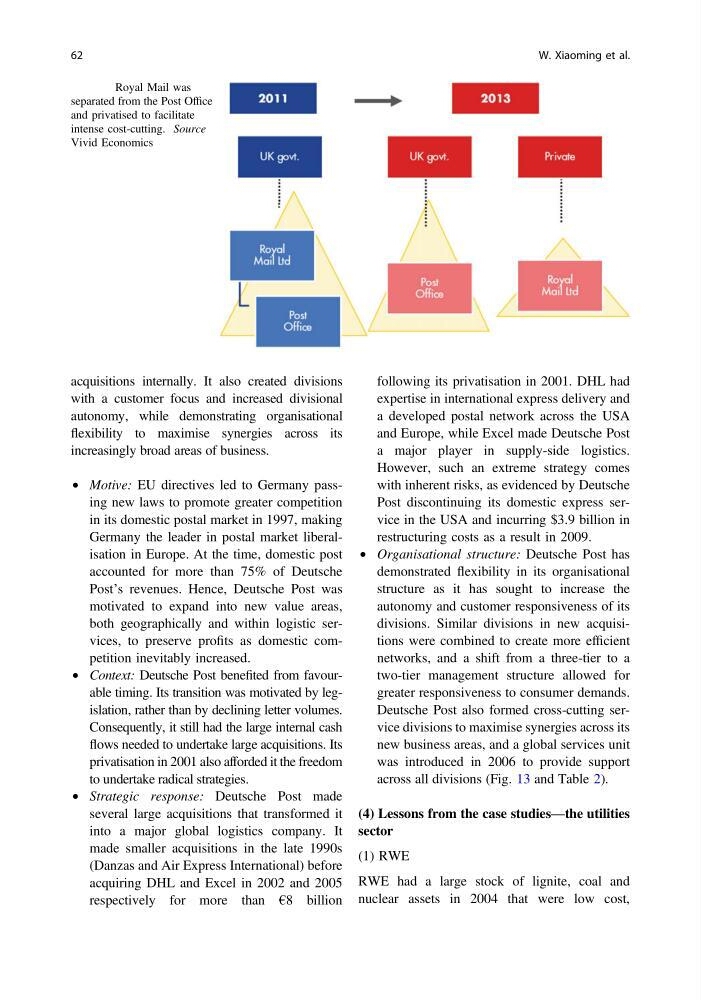
Fig. 12 Royal Mail was
separated from the Post Office
and privatised to facilitate
intense cost-cutting. Source
Vivid Economics
62
W. Xiaoming et al.
with a customer focus and increased divisional
autonomy, while demonstrating organisational
flexibility to maximise synergies across its
increasingly broad areas of business.
• Motive: EU directives led to Germany passing new laws to promote greater competition
in its domestic postal market in 1997, making
Germany the leader in postal market liberalisation in Europe. At the time, domestic post
accounted for more than 75% of Deutsche
Post’s revenues. Hence, Deutsche Post was
motivated to expand into new value areas,
both geographically and within logistic services, to preserve profits as domestic competition inevitably increased.
• Context: Deutsche Post benefited from favourable timing. Its transition was motivated by legislation, rather than by declining letter volumes.
Consequently, it still had the large internal cash
flows needed to undertake large acquisitions. Its
privatisation in 2001 also afforded it the freedom
to undertake radical strategies.
• Strategic response: Deutsche Post made
several large acquisitions that transformed it
into a major global logistics company. It
made smaller acquisitions in the late 1990s
(Danzas and Air Express International) before
acquiring DHL and Excel in 2002 and 2005
respectively for more than €8 billion
following its privatisation in 2001. DHL had
expertise in international express delivery and
a developed postal network across the USA
and Europe, while Excel made Deutsche Post
a major player in supply-side logistics.
However, such an extreme strategy comes
with inherent risks, as evidenced by Deutsche
Post discontinuing its domestic express service in the USA and incurring $3.9 billion in
restructuring costs as a result in 2009.
• Organisational structure: Deutsche Post has
demonstrated flexibility in its organisational
structure as it has sought to increase the
autonomy and customer responsiveness of its
divisions. Similar divisions in new acquisitions were combined to create more efficient
networks, and a shift from a three-tier to a
two-tier management structure allowed for
greater responsiveness to consumer demands.
Deutsche Post also formed cross-cutting service divisions to maximise synergies across its
new business areas, and a global services unit
was introduced in 2006 to provide support
across all divisions (Fig. 13 and Table 2).
(4) Lessons from the case studies—the utilities
sector
(1) RWE
RWE had a large stock of lignite, coal and
nuclear assets in 2004 that were low cost,
Fig. 12 Royal Mail was
separated from the Post Office
and privatised to facilitate
intense cost-cutting. Source
Vivid Economics
62
W. Xiaoming et al.