

other development actors towards both fossil
fuels and clean energy technologies, with a clear
and common roadmap for transition (the Asian
Infrastructure Investment Bank could play a
leading role in this). Committing to eliminate
support for unabated coal projects could be a first
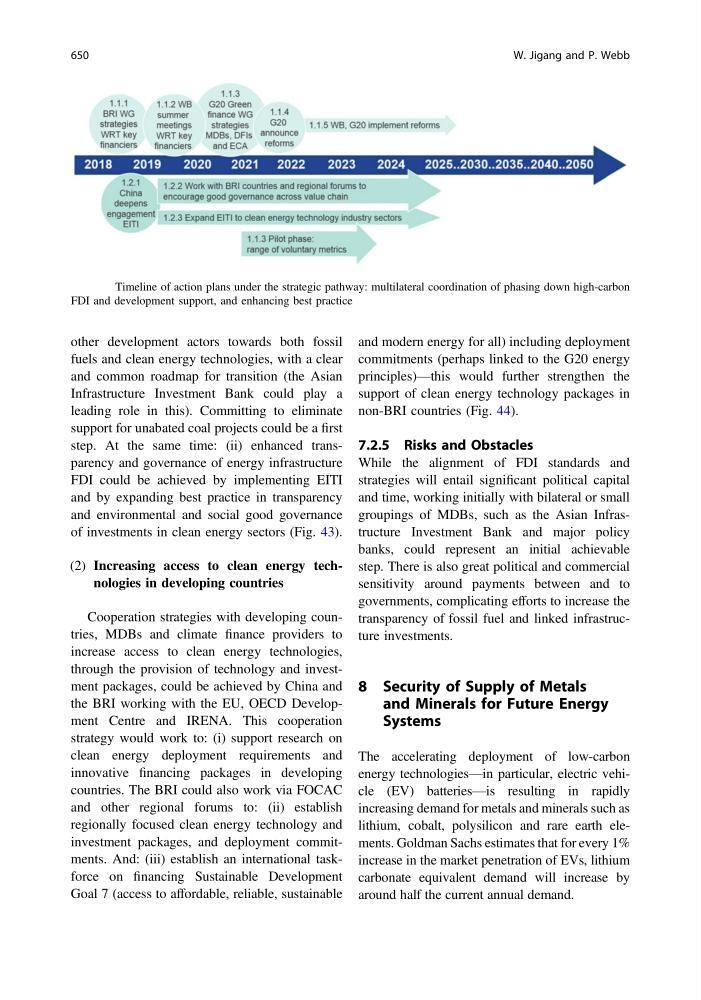
step. At the same time: (ii) enhanced transparency and governance of energy infrastructure
FDI could be achieved by implementing EITI
and by expanding best practice in transparency
and environmental and social good governance
of investments in clean energy sectors (Fig. 43).
(2) Increasing access to clean energy technologies in developing countries
Cooperation strategies with developing countries, MDBs and climate finance providers to
increase access to clean energy technologies,
through the provision of technology and investment packages, could be achieved by China and
the BRI working with the EU, OECD Development Centre and IRENA. This cooperation
strategy would work to: (i) support research on
clean energy deployment requirements and
innovative financing packages in developing
countries. The BRI could also work via FOCAC
and other regional forums to: (ii) establish
regionally focused clean energy technology and
investment packages, and deployment commitments. And: (iii) establish an international taskforce on financing Sustainable Development
Goal 7 (access to affordable, reliable, sustainable
and modern energy for all) including deployment
commitments (perhaps linked to the G20 energy
principles)—this would further strengthen the
support of clean energy technology packages in
non-BRI countries (Fig. 44).
7.2.5 Risks and Obstacles
While the alignment of FDI standards and
strategies will entail significant political capital
and time, working initially with bilateral or small
groupings of MDBs, such as the Asian Infrastructure Investment Bank and major policy
banks, could represent an initial achievable
step. There is also great political and commercial
sensitivity around payments between and to
governments, complicating efforts to increase the
transparency of fossil fuel and linked infrastructure investments.
8 Security of Supply of Metals
and Minerals for Future Energy
Systems
The accelerating deployment of low-carbon
energy technologies—in particular, electric vehicle (EV) batteries—is resulting in rapidly
increasing demand for metals and minerals such as
lithium, cobalt, polysilicon and rare earth elements. Goldman Sachs estimates that for every 1%
increase in the market penetration of EVs, lithium
carbonate equivalent demand will increase by
around half the current annual demand.
Fig. 43 Timeline of action plans under the strategic pathway: multilateral coordination of phasing down high-carbon
FDI and development support, and enhancing best practice
650
W. Jigang and P. Webb