

34% in 2016, offshore spending is expected to
decline by an additional 20–25% in 2017 and
floating rigs to fall from 133 in 2016 to 120 in
2017.
In line with the trend of switching from coal
to gas (see Box 7) and the electrification of
transport, IOCs are increasingly switching their
focus to natural gas. Gas production in the second quarter of 2016 by Shell, BP and ExxonMobil, as a share of total production, stood at
50%, 47% and 41% respectively (Fig. 27). Natural gas could deliver lower emissions relative to
coal; however, the climate impact will depend on
managing methane leakage. Methane (CH4)
accelerates climate change and has a greater
global warming potential than CO 2 over a short
time horizon. Leakage rates of 1.5% from the
production of natural gas increase the climate
impact of natural gas by 50%. One recent study
shows leakage rates at gas power stations and
refineries are much higher than previously
thought, up to 120 and 90 times greater
respectively.
For producer countries, lower oil prices have
led to a reassessment of the role of hydrocarbons
in their economies, as budgetary pressures
increase in line with indebtedness and macroeconomic volatility. As the 2016 analysis by the
International Monetary Fund shows in Fig. 28,
government revenues of the countries in the
Cooperation Council for the Arab States of the
Gulf have rapidly declined with the oil price.
Saudi Arabia’s revenues fell by more than $100
billion and it borrowed $17.5 billion to finance
its budget. Saudi Arabia has ramped up its efforts
to diversify its domestic energy mix, issuing
tenders for solar and wind energy investment
worth between $30 and 50 billion.
At the same time, lower oil prices are giving
fiscal breathing space for countries that provide
consumption subsidies for their citizens or
industries. This in turn may affect the willingness
of these countries to subsidise fossil fuel consumption, should higher prices return. In the
OECD, fossil fuel subsidies stood at $51 billion,
or $784 per person, in 2013. In 2014, global
fossil fuel consumption subsidies stood at $493
billion, a reduction of $39 billion year-on-year,
with oil subsidies representing more than half of
all consumption subsidies. While consumption
subsidies have fallen in recent years, fossil fuel
consumption has been supported over the long
term. Between 2003 and 2015 the consumption
weighted mean net tax on petrol fell by 13.3%
across 157 countries. Of these 157 countries, 84
either reduced consumption subsidies or
increased petrol taxes. But as consumption has
shifted towards nations that have maintained
subsidies or lowered petrol taxes, subsidy
reforms have been undermined at a global level.
Following the agreement by the G20 in
September 2009 to phase out inefficient fossil
fuel subsidies, as of mid-2015 the unweighted
mean net tax was unchanged across the 20 states.
However, this commitment has not been reaffirmed at the latest G20 meetings (Fig. 29).
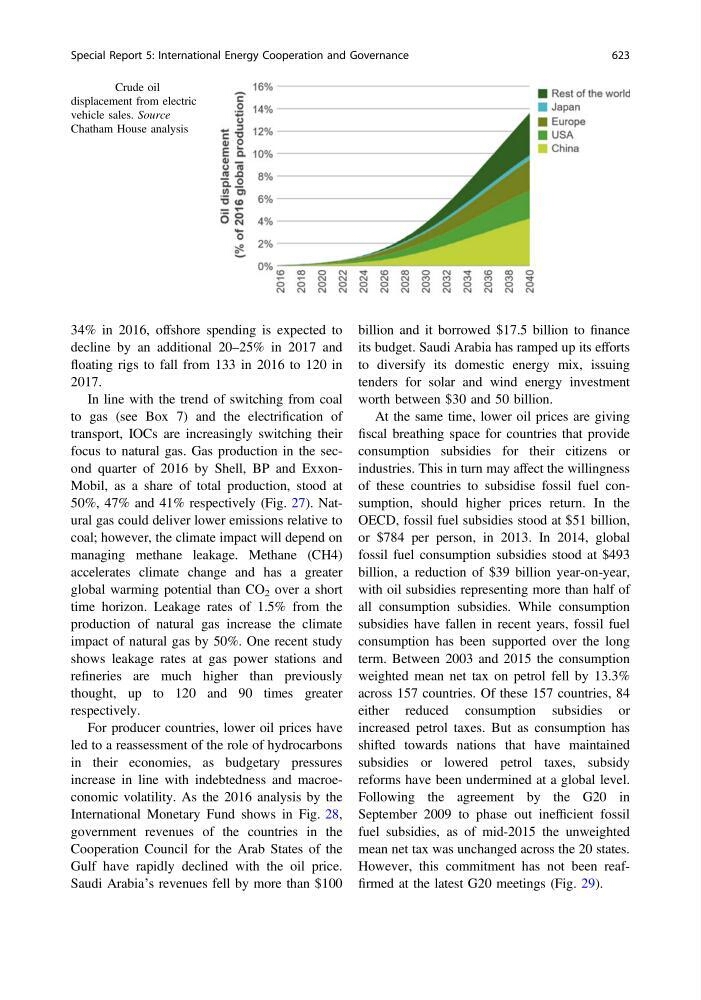
Fig. 26 Crude oil
displacement from electric
vehicle sales. Source
Chatham House analysis
Special Report 5: International Energy Cooperation and Governance
623