

and trade, alongside the mapping of in-use stocks
of materials to enhance recycling collection rates,
is surely a win-win.
Box 7: The circular economy and
resource efficiency
China is, and will continue to be, a
resource-reliant economy: as the pace of
economic growth slows, demand for
materials is set to continue growing.
Globally, resource consumption is expected to more than double by 2050, while
resource efficiency could save the global
economy $2.9 trillion per year by 2030.
It is possible to determine the per capita
income level at which per capita demand
for a particular material saturates. Across
the UK, USA, Germany and Japan,
apparent domestic consumption of steel
saturates around 0.5–0.8 tonnes per capita,
once an income threshold of $1,200
GDP/capita is reached.
As saturation effects kick in and
economies establish a stock of primary
materials in physical infrastructure and
consumer goods, the circular economy can
provide a means to further decouple
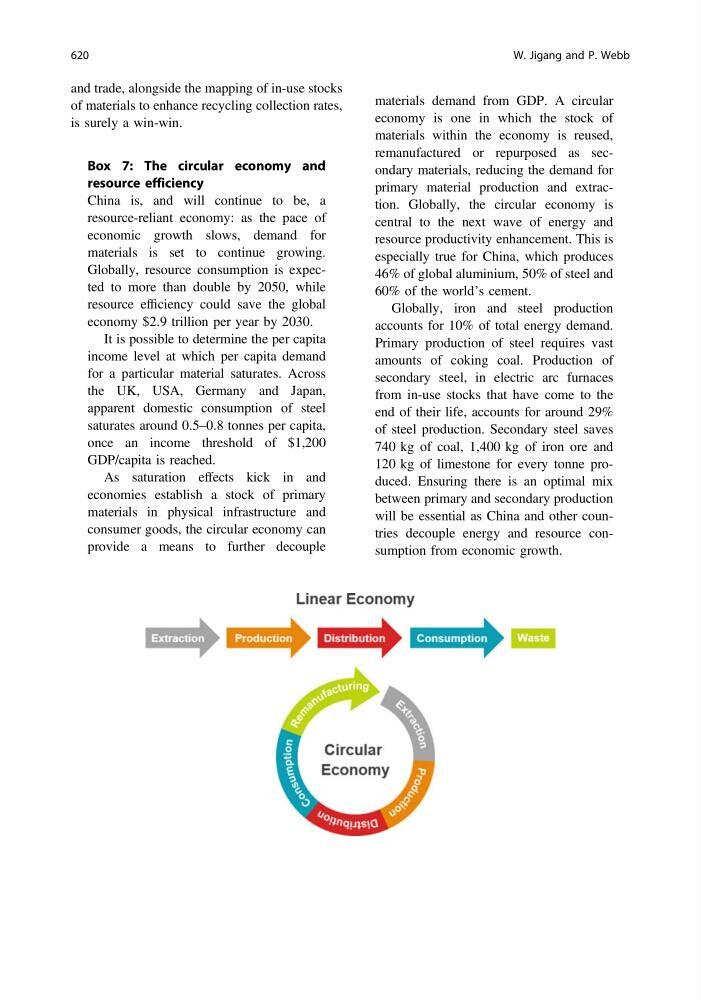
materials demand from GDP. A circular
economy is one in which the stock of
materials within the economy is reused,
remanufactured or repurposed as secondary materials, reducing the demand for
primary material production and extraction. Globally, the circular economy is
central to the next wave of energy and
resource productivity enhancement. This is
especially true for China, which produces
46% of global aluminium, 50% of steel and
60% of the world’s cement.
Globally, iron and steel production
accounts for 10% of total energy demand.
Primary production of steel requires vast
amounts of coking coal. Production of
secondary steel, in electric arc furnaces
from in-use stocks that have come to the
end of their life, accounts for around 29%
of steel production. Secondary steel saves
740 kg of coal, 1,400 kg of iron ore and
120 kg of limestone for every tonne produced. Ensuring there is an optimal mix
between primary and secondary production
will be essential as China and other countries decouple energy and resource consumption from economic growth.
620
W. Jigang and P. Webb