

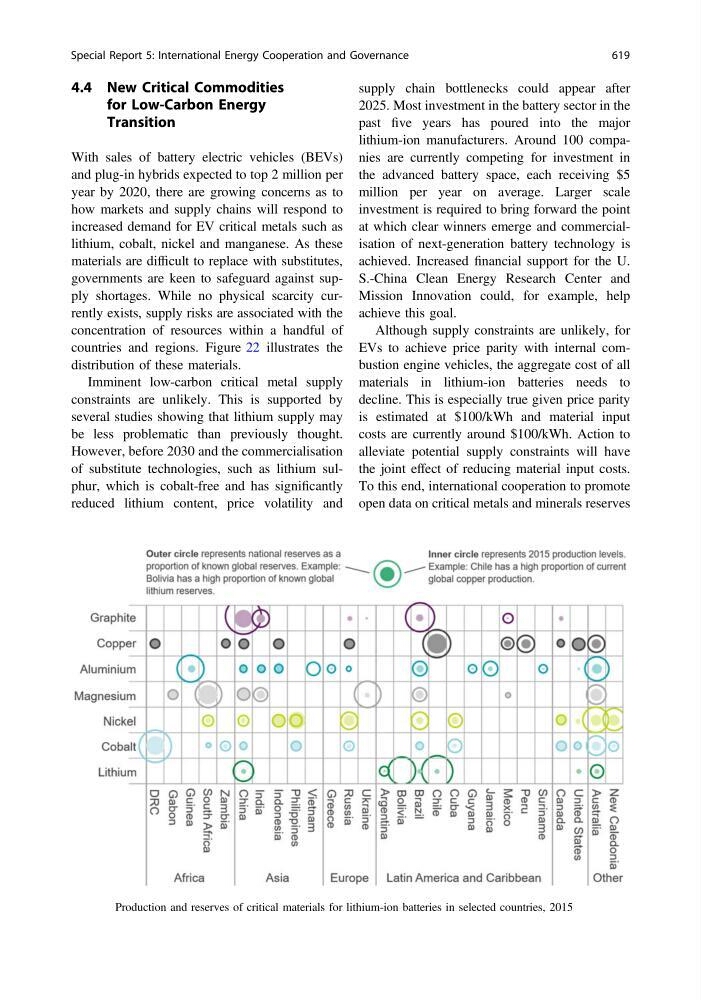
Fig. 22 Production and reserves of critical materials for lithium-ion batteries in selected countries, 2015
4.4 New Critical Commodities
for Low-Carbon Energy
Transition
With sales of battery electric vehicles (BEVs)
and plug-in hybrids expected to top 2 million per
year by 2020, there are growing concerns as to
how markets and supply chains will respond to
increased demand for EV critical metals such as
lithium, cobalt, nickel and manganese. As these
materials are difficult to replace with substitutes,
governments are keen to safeguard against supply shortages. While no physical scarcity currently exists, supply risks are associated with the
concentration of resources within a handful of
countries and regions. Figure 22 illustrates the
distribution of these materials.
Imminent low-carbon critical metal supply
constraints are unlikely. This is supported by
several studies showing that lithium supply may
be less problematic than previously thought.
However, before 2030 and the commercialisation
of substitute technologies, such as lithium sulphur, which is cobalt-free and has significantly
reduced lithium content, price volatility and
supply chain bottlenecks could appear after
2025. Most investment in the battery sector in the
past five years has poured into the major
lithium-ion manufacturers. Around 100 companies are currently competing for investment in
the advanced battery space, each receiving $5
million per year on average. Larger scale
investment is required to bring forward the point
at which clear winners emerge and commercialisation of next-generation battery technology is
achieved. Increased financial support for the U.
S.-China Clean Energy Research Center and
Mission Innovation could, for example, help
achieve this goal.
Although supply constraints are unlikely, for
EVs to achieve price parity with internal combustion engine vehicles, the aggregate cost of all
materials in lithium-ion batteries needs to
decline. This is especially true given price parity
is estimated at $100/kWh and material input
costs are currently around $100/kWh. Action to
alleviate potential supply constraints will have
the joint effect of reducing material input costs.
To this end, international cooperation to promote
open data on critical metals and minerals reserves
Special Report 5: International Energy Cooperation and Governance
619