

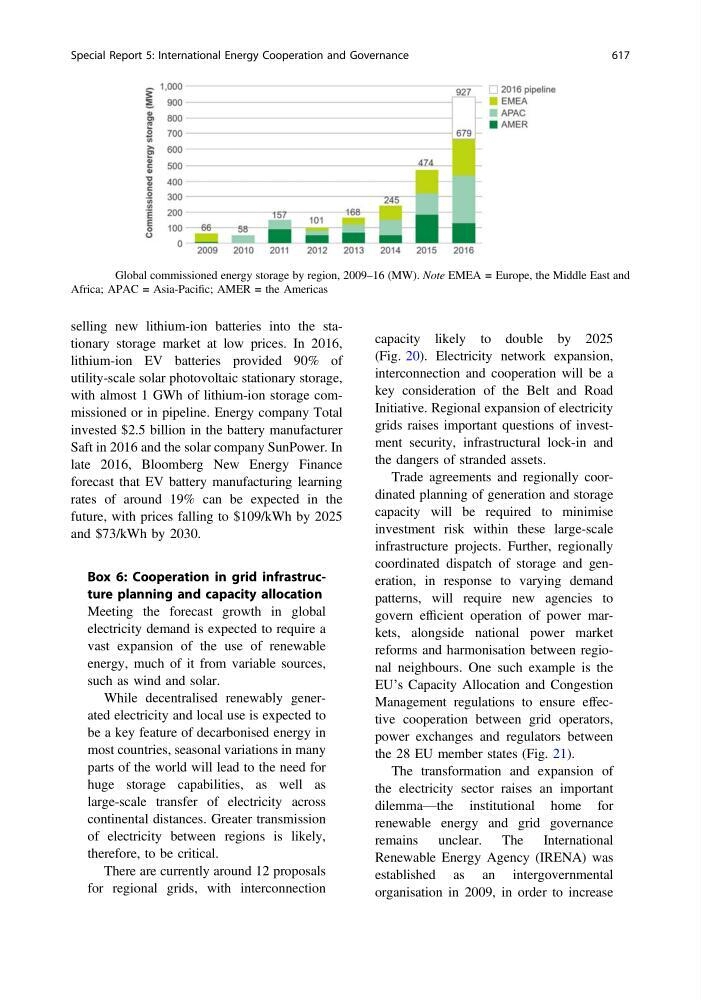
selling new lithium-ion batteries into the stationary storage market at low prices. In 2016,
lithium-ion EV batteries provided 90% of
utility-scale solar photovoltaic stationary storage,
with almost 1 GWh of lithium-ion storage commissioned or in pipeline. Energy company Total
invested $2.5 billion in the battery manufacturer
Saft in 2016 and the solar company SunPower. In
late 2016, Bloomberg New Energy Finance
forecast that EV battery manufacturing learning
rates of around 19% can be expected in the
future, with prices falling to $109/kWh by 2025
and $73/kWh by 2030.
Box 6: Cooperation in grid infrastructure planning and capacity allocation
Meeting the forecast growth in global
electricity demand is expected to require a
vast expansion of the use of renewable
energy, much of it from variable sources,
such as wind and solar.
While decentralised renewably generated electricity and local use is expected to
be a key feature of decarbonised energy in
most countries, seasonal variations in many
parts of the world will lead to the need for
huge storage capabilities, as well as
large-scale transfer of electricity across
continental distances. Greater transmission
of electricity between regions is likely,
therefore, to be critical.
There are currently around 12 proposals
for regional grids, with interconnection
capacity likely to double by 2025
(Fig. 20). Electricity network expansion,
interconnection and cooperation will be a
key consideration of the Belt and Road
Initiative. Regional expansion of electricity
grids raises important questions of investment security, infrastructural lock-in and
the dangers of stranded assets.
Trade agreements and regionally coordinated planning of generation and storage
capacity will be required to minimise
investment risk within these large-scale
infrastructure projects. Further, regionally
coordinated dispatch of storage and generation, in response to varying demand
patterns, will require new agencies to
govern efficient operation of power markets, alongside national power market
reforms and harmonisation between regional neighbours. One such example is the
EU’s Capacity Allocation and Congestion
Management regulations to ensure effective cooperation between grid operators,
power exchanges and regulators between
the 28 EU member states (Fig. 21).
The transformation and expansion of
the electricity sector raises an important
dilemma—the institutional home for
renewable energy and grid governance
remains unclear. The International
Renewable Energy Agency (IRENA) was
established as an intergovernmental
organisation in 2009, in order to increase
Fig. 19 Global commissioned energy storage by region, 2009–16 (MW). Note EMEA = Europe, the Middle East and
Africa; APAC = Asia-Pacific; AMER = the Americas
Special Report 5: International Energy Cooperation and Governance
617