

Box 5: From quantity to quality: Digitalisation and the Internet of things
Electrification, digitalisation and the Internet of things are increasingly central to
high-added value economic activity. In
many countries, the growing importance of
electricity as an energy carrier has occurred
alongside a shift from industrial- and
infrastructure-driven growth to an economy driven by services.
Decoupling electricity-based services
from emissions will only be possible with
enhanced system flexibility, enabling a
range of intermittent and dispatchable
low-carbon power to replace traditional
fossil fuel base load generation, without
compromising security of supply. Battery
storage—whether stationary or in vehicles
—will clearly be an important component
in enabling such flexibility.
But there is hope that the digitalisation
of the energy sector and the Internet of
things will unlock huge efficiency opportunities, while simultaneously enhancing
the quality of energy services. DeepMind
has already proven the capacity for
machine learning to find unforeseen efficiency gains in a Google data centre and is
now working with National Grid in the UK
on a pilot project.
Within the smart energy household the
idea is that devices and appliances connect
to the Internet via smart meters. These
appliances and devices can provide more
services to the consumer while also
responding to signals to reduce demand,
providing balancing and flexibility on the
demand side. An example is the Nest
self-learning thermostat, which optimises
heating and cooling of homes and businesses to conserve energy.
In the UK the Electricity Networks
Strategy Group foresees the smart, digital
grid becoming the “enabler for a radical
departure from the operation of the current
power system, with extensive balancing on
the demand side”. By 2020, nearly 800
million smart meters are expected to be
installed globally. In China in 2015, 447
million smart meters had been installed.
Commercial application of demand
management is already bearing fruit in
some countries. But in all likelihood the
scale of the opportunity will only be
revealed with advances in machine learning and innovations in the devices and the
systems that integrate them in the home or
office.
Cheaper electricity storage will facilitate new
energy choices and reshape energy governance.
The declining cost of EV batteries is enabling
cheaper stationary battery storage, creating a
virtuous circle of electrified transport supplied by
renewables and storage. Excess EV battery production capacity is resulting in manufacturers
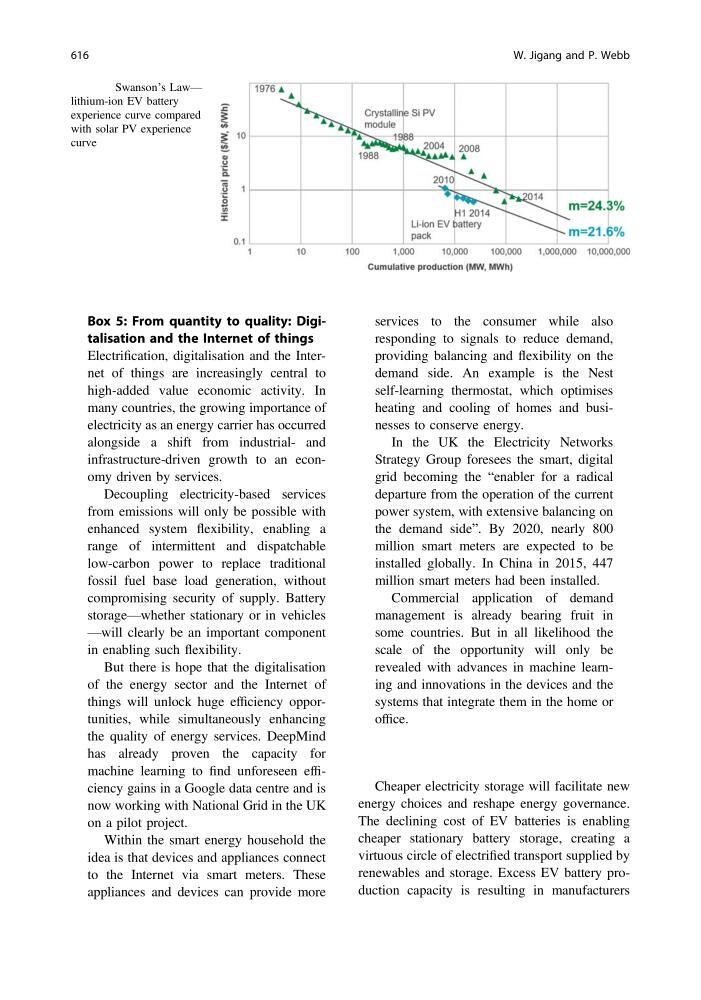
Fig. 18 Swanson’s Law—
lithium-ion EV battery
experience curve compared
with solar PV experience
curve
616
W. Jigang and P. Webb