

greater adequacy of investment than a
single-owner network.
(1) An institutional model to align incentives
with public policy objectives
An institutional model is needed that mitigates
monopolistic behaviour and provides networks
with incentives to invest in appropriate network
infrastructure and to operate infrastructure efficiently. Two institutional models that can create
an efficient regime are the TSO model, with
performance-based regulation, and the ISO
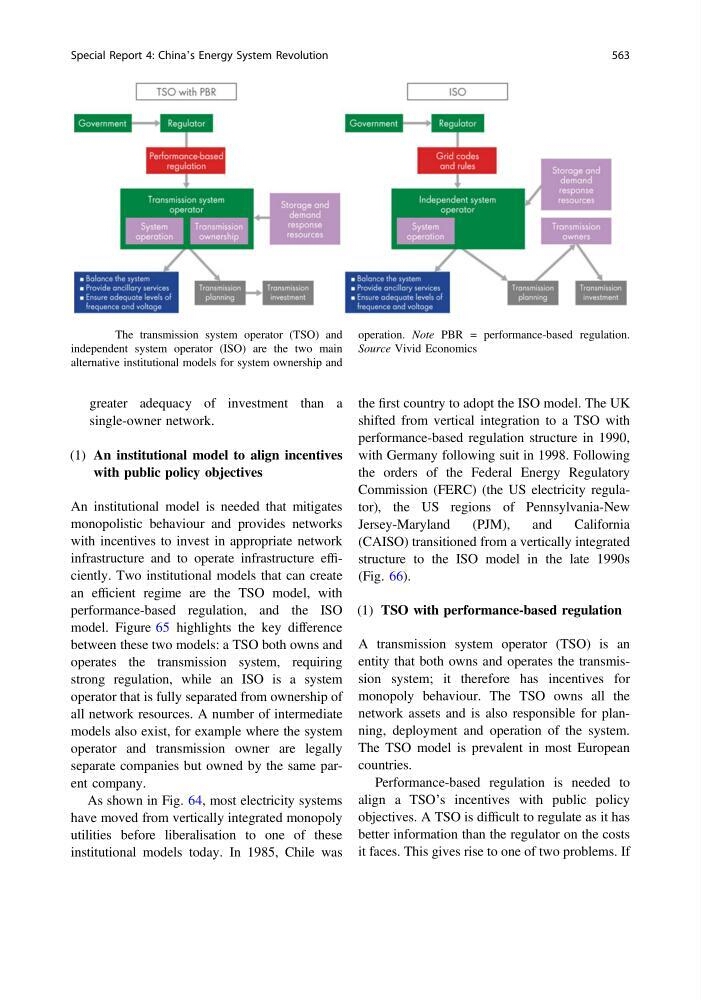
model. Figure 65 highlights the key difference
between these two models: a TSO both owns and
operates the transmission system, requiring
strong regulation, while an ISO is a system
operator that is fully separated from ownership of
all network resources. A number of intermediate
models also exist, for example where the system
operator and transmission owner are legally
separate companies but owned by the same parent company.
As shown in Fig. 64, most electricity systems
have moved from vertically integrated monopoly
utilities before liberalisation to one of these
institutional models today. In 1985, Chile was
the first country to adopt the ISO model. The UK
shifted from vertical integration to a TSO with
performance-based regulation structure in 1990,
with Germany following suit in 1998. Following
the orders of the Federal Energy Regulatory
Commission (FERC) (the US electricity regulator), the US regions of Pennsylvania-New
Jersey-Maryland
(PJM),
and
California
(CAISO) transitioned from a vertically integrated
structure to the ISO model in the late 1990s
(Fig. 66).
(1) TSO with performance-based regulation
A transmission system operator (TSO) is an
entity that both owns and operates the transmission system; it therefore has incentives for
monopoly behaviour. The TSO owns all the
network assets and is also responsible for planning, deployment and operation of the system.
The TSO model is prevalent in most European
countries.
Performance-based regulation is needed to
align a TSO’s incentives with public policy
objectives. A TSO is difficult to regulate as it has
better information than the regulator on the costs
it faces. This gives rise to one of two problems. If
Fig. 65 The transmission system operator (TSO) and
independent system operator (ISO) are the two main
alternative institutional models for system ownership and
operation. Note PBR = performance-based regulation.
Source Vivid Economics
Special Report 4: China’s Energy System Revolution
563
single-owner network.
(1) An institutional model to align incentives
with public policy objectives
An institutional model is needed that mitigates
monopolistic behaviour and provides networks
with incentives to invest in appropriate network
infrastructure and to operate infrastructure efficiently. Two institutional models that can create
an efficient regime are the TSO model, with
performance-based regulation, and the ISO
model. Figure 65 highlights the key difference
between these two models: a TSO both owns and
operates the transmission system, requiring
strong regulation, while an ISO is a system
operator that is fully separated from ownership of
all network resources. A number of intermediate
models also exist, for example where the system
operator and transmission owner are legally
separate companies but owned by the same parent company.
As shown in Fig. 64, most electricity systems
have moved from vertically integrated monopoly
utilities before liberalisation to one of these
institutional models today. In 1985, Chile was
the first country to adopt the ISO model. The UK
shifted from vertical integration to a TSO with
performance-based regulation structure in 1990,
with Germany following suit in 1998. Following
the orders of the Federal Energy Regulatory
Commission (FERC) (the US electricity regulator), the US regions of Pennsylvania-New
Jersey-Maryland
(PJM),
and
California
(CAISO) transitioned from a vertically integrated
structure to the ISO model in the late 1990s
(Fig. 66).
(1) TSO with performance-based regulation
A transmission system operator (TSO) is an
entity that both owns and operates the transmission system; it therefore has incentives for
monopoly behaviour. The TSO owns all the
network assets and is also responsible for planning, deployment and operation of the system.
The TSO model is prevalent in most European
countries.
Performance-based regulation is needed to
align a TSO’s incentives with public policy
objectives. A TSO is difficult to regulate as it has
better information than the regulator on the costs
it faces. This gives rise to one of two problems. If
Fig. 65 The transmission system operator (TSO) and
independent system operator (ISO) are the two main
alternative institutional models for system ownership and
operation. Note PBR = performance-based regulation.
Source Vivid Economics
Special Report 4: China’s Energy System Revolution
563