

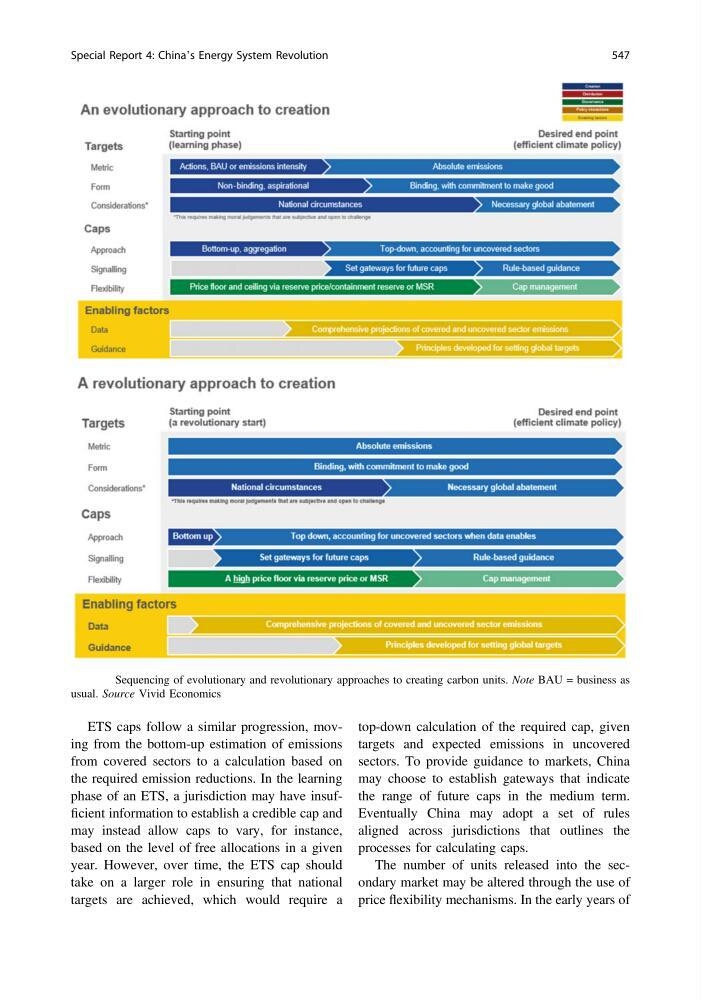
ETS caps follow a similar progression, moving from the bottom-up estimation of emissions
from covered sectors to a calculation based on
the required emission reductions. In the learning
phase of an ETS, a jurisdiction may have insufficient information to establish a credible cap and
may instead allow caps to vary, for instance,
based on the level of free allocations in a given
year. However, over time, the ETS cap should
take on a larger role in ensuring that national
targets are achieved, which would require a
top-down calculation of the required cap, given
targets and expected emissions in uncovered
sectors. To provide guidance to markets, China
may choose to establish gateways that indicate
the range of future caps in the medium term.
Eventually China may adopt a set of rules
aligned across jurisdictions that outlines the
processes for calculating caps.
The number of units released into the secondary market may be altered through the use of
price flexibility mechanisms. In the early years of
Fig. 60 Sequencing of evolutionary and revolutionary approaches to creating carbon units. Note BAU = business as
usual. Source Vivid Economics
Special Report 4: China’s Energy System Revolution
547
from covered sectors to a calculation based on
the required emission reductions. In the learning
phase of an ETS, a jurisdiction may have insufficient information to establish a credible cap and
may instead allow caps to vary, for instance,
based on the level of free allocations in a given
year. However, over time, the ETS cap should
take on a larger role in ensuring that national
targets are achieved, which would require a
top-down calculation of the required cap, given
targets and expected emissions in uncovered
sectors. To provide guidance to markets, China
may choose to establish gateways that indicate
the range of future caps in the medium term.
Eventually China may adopt a set of rules
aligned across jurisdictions that outlines the
processes for calculating caps.
The number of units released into the secondary market may be altered through the use of
price flexibility mechanisms. In the early years of
Fig. 60 Sequencing of evolutionary and revolutionary approaches to creating carbon units. Note BAU = business as
usual. Source Vivid Economics
Special Report 4: China’s Energy System Revolution
547