

will often purchase appliances that are inefficient
and high cost to operate. This can occur for a
variety of reasons. For instance, consumers may
seek to reduce the time costs associated with
researching the relative performance of different
appliances and not consider the environmental or
energy impacts of their choices. Alternatively,
landlords may purchase cheap but inefficient
appliances, which are higher cost because their
tenants pay for high rates of energy use. Because
of these and other market failures, the introduction of energy efficiency standards has reduced
emissions cost-effectively in many countries.
These standards improve the quality of the stock
of appliances sold, while in many cases having
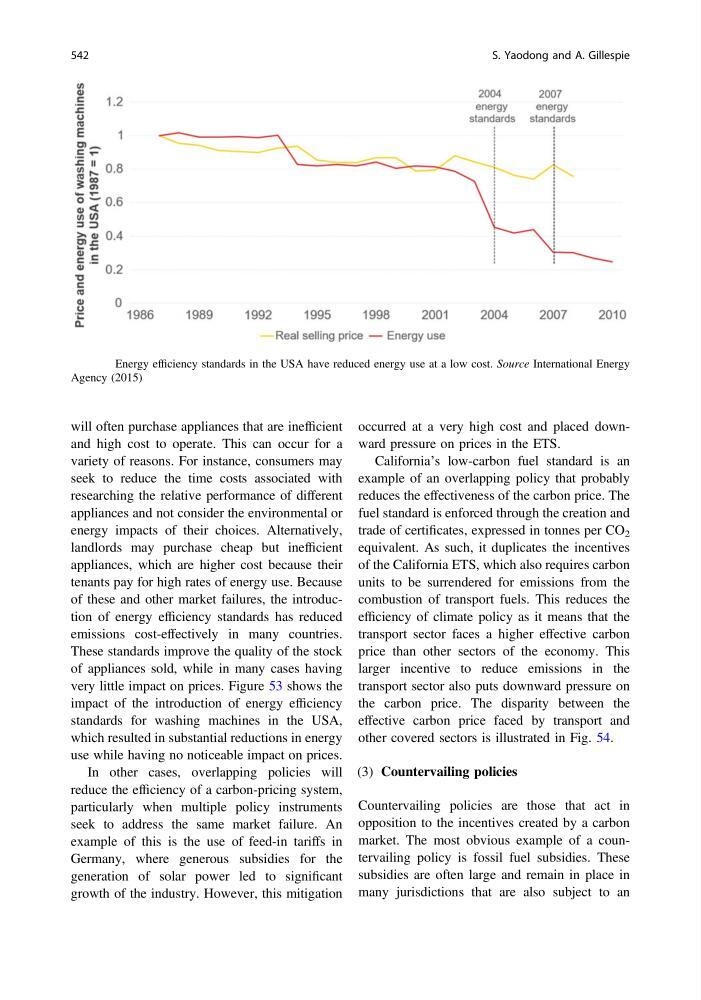
very little impact on prices. Figure 53 shows the
impact of the introduction of energy efficiency
standards for washing machines in the USA,
which resulted in substantial reductions in energy
use while having no noticeable impact on prices.
In other cases, overlapping policies will
reduce the efficiency of a carbon-pricing system,
particularly when multiple policy instruments
seek to address the same market failure. An
example of this is the use of feed-in tariffs in
Germany, where generous subsidies for the
generation of solar power led to significant
growth of the industry. However, this mitigation
occurred at a very high cost and placed downward pressure on prices in the ETS.
California’s low-carbon fuel standard is an
example of an overlapping policy that probably
reduces the effectiveness of the carbon price. The
fuel standard is enforced through the creation and
trade of certificates, expressed in tonnes per CO 2
equivalent. As such, it duplicates the incentives
of the California ETS, which also requires carbon
units to be surrendered for emissions from the
combustion of transport fuels. This reduces the
efficiency of climate policy as it means that the
transport sector faces a higher effective carbon
price than other sectors of the economy. This
larger incentive to reduce emissions in the
transport sector also puts downward pressure on
the carbon price. The disparity between the
effective carbon price faced by transport and
other covered sectors is illustrated in Fig. 54.
(3) Countervailing policies
Countervailing policies are those that act in
opposition to the incentives created by a carbon
market. The most obvious example of a countervailing policy is fossil fuel subsidies. These
subsidies are often large and remain in place in
many jurisdictions that are also subject to an
Fig. 53 Energy efficiency standards in the USA have reduced energy use at a low cost. Source International Energy
Agency (2015)
542
S. Yaodong and A. Gillespie
and high cost to operate. This can occur for a
variety of reasons. For instance, consumers may
seek to reduce the time costs associated with
researching the relative performance of different
appliances and not consider the environmental or
energy impacts of their choices. Alternatively,
landlords may purchase cheap but inefficient
appliances, which are higher cost because their
tenants pay for high rates of energy use. Because
of these and other market failures, the introduction of energy efficiency standards has reduced
emissions cost-effectively in many countries.
These standards improve the quality of the stock
of appliances sold, while in many cases having
very little impact on prices. Figure 53 shows the
impact of the introduction of energy efficiency
standards for washing machines in the USA,
which resulted in substantial reductions in energy
use while having no noticeable impact on prices.
In other cases, overlapping policies will
reduce the efficiency of a carbon-pricing system,
particularly when multiple policy instruments
seek to address the same market failure. An
example of this is the use of feed-in tariffs in
Germany, where generous subsidies for the
generation of solar power led to significant
growth of the industry. However, this mitigation
occurred at a very high cost and placed downward pressure on prices in the ETS.
California’s low-carbon fuel standard is an
example of an overlapping policy that probably
reduces the effectiveness of the carbon price. The
fuel standard is enforced through the creation and
trade of certificates, expressed in tonnes per CO 2
equivalent. As such, it duplicates the incentives
of the California ETS, which also requires carbon
units to be surrendered for emissions from the
combustion of transport fuels. This reduces the
efficiency of climate policy as it means that the
transport sector faces a higher effective carbon
price than other sectors of the economy. This
larger incentive to reduce emissions in the
transport sector also puts downward pressure on
the carbon price. The disparity between the
effective carbon price faced by transport and
other covered sectors is illustrated in Fig. 54.
(3) Countervailing policies
Countervailing policies are those that act in
opposition to the incentives created by a carbon
market. The most obvious example of a countervailing policy is fossil fuel subsidies. These
subsidies are often large and remain in place in
many jurisdictions that are also subject to an
Fig. 53 Energy efficiency standards in the USA have reduced energy use at a low cost. Source International Energy
Agency (2015)
542
S. Yaodong and A. Gillespie