

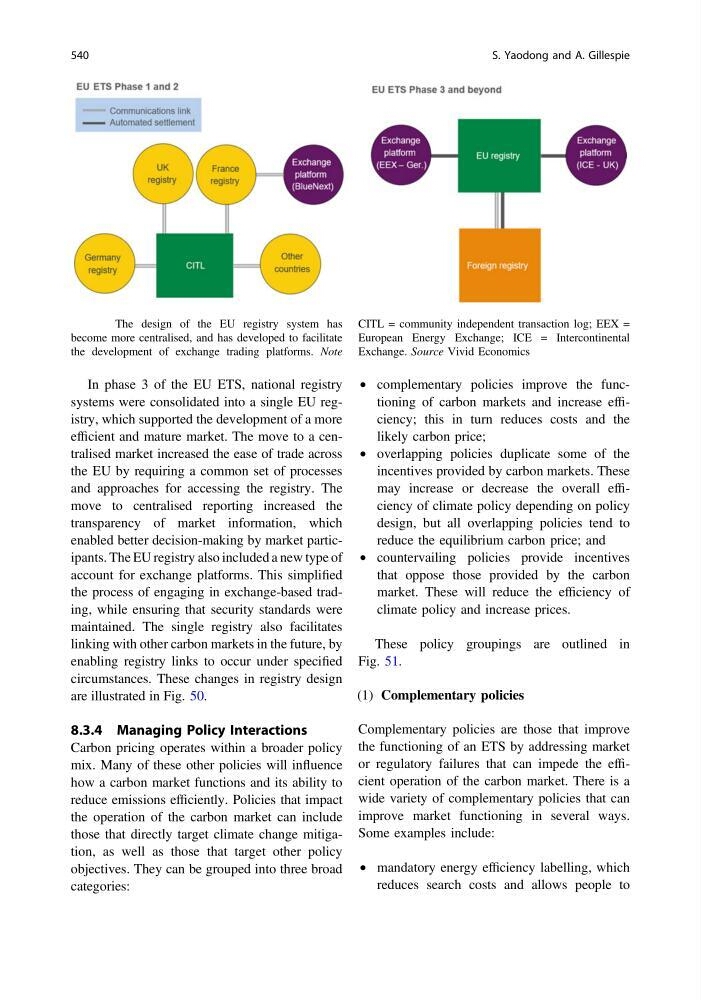
In phase 3 of the EU ETS, national registry
systems were consolidated into a single EU registry, which supported the development of a more
efficient and mature market. The move to a centralised market increased the ease of trade across
the EU by requiring a common set of processes
and approaches for accessing the registry. The
move to centralised reporting increased the
transparency of market information, which
enabled better decision-making by market participants. The EU registry also included a new type of
account for exchange platforms. This simplified
the process of engaging in exchange-based trading, while ensuring that security standards were
maintained. The single registry also facilitates
linking with other carbon markets in the future, by
enabling registry links to occur under specified
circumstances. These changes in registry design
are illustrated in Fig. 50.
8.3.4 Managing Policy Interactions
Carbon pricing operates within a broader policy
mix. Many of these other policies will influence
how a carbon market functions and its ability to
reduce emissions efficiently. Policies that impact
the operation of the carbon market can include
those that directly target climate change mitigation, as well as those that target other policy
objectives. They can be grouped into three broad
categories:
• complementary policies improve the functioning of carbon markets and increase efficiency; this in turn reduces costs and the
likely carbon price;
• overlapping policies duplicate some of the
incentives provided by carbon markets. These
may increase or decrease the overall efficiency of climate policy depending on policy
design, but all overlapping policies tend to
reduce the equilibrium carbon price; and
• countervailing policies provide incentives
that oppose those provided by the carbon
market. These will reduce the efficiency of
climate policy and increase prices.
These policy groupings are outlined in
Fig. 51.
(1) Complementary policies
Complementary policies are those that improve
the functioning of an ETS by addressing market
or regulatory failures that can impede the efficient operation of the carbon market. There is a
wide variety of complementary policies that can
improve market functioning in several ways.
Some examples include:
• mandatory energy efficiency labelling, which
reduces search costs and allows people to
Fig. 50 The design of the EU registry system has
become more centralised, and has developed to facilitate
the development of exchange trading platforms. Note
CITL = community independent transaction log; EEX =
European Energy Exchange; ICE = Intercontinental
Exchange. Source Vivid Economics
540
S. Yaodong and A. Gillespie
systems were consolidated into a single EU registry, which supported the development of a more
efficient and mature market. The move to a centralised market increased the ease of trade across
the EU by requiring a common set of processes
and approaches for accessing the registry. The
move to centralised reporting increased the
transparency of market information, which
enabled better decision-making by market participants. The EU registry also included a new type of
account for exchange platforms. This simplified
the process of engaging in exchange-based trading, while ensuring that security standards were
maintained. The single registry also facilitates
linking with other carbon markets in the future, by
enabling registry links to occur under specified
circumstances. These changes in registry design
are illustrated in Fig. 50.
8.3.4 Managing Policy Interactions
Carbon pricing operates within a broader policy
mix. Many of these other policies will influence
how a carbon market functions and its ability to
reduce emissions efficiently. Policies that impact
the operation of the carbon market can include
those that directly target climate change mitigation, as well as those that target other policy
objectives. They can be grouped into three broad
categories:
• complementary policies improve the functioning of carbon markets and increase efficiency; this in turn reduces costs and the
likely carbon price;
• overlapping policies duplicate some of the
incentives provided by carbon markets. These
may increase or decrease the overall efficiency of climate policy depending on policy
design, but all overlapping policies tend to
reduce the equilibrium carbon price; and
• countervailing policies provide incentives
that oppose those provided by the carbon
market. These will reduce the efficiency of
climate policy and increase prices.
These policy groupings are outlined in
Fig. 51.
(1) Complementary policies
Complementary policies are those that improve
the functioning of an ETS by addressing market
or regulatory failures that can impede the efficient operation of the carbon market. There is a
wide variety of complementary policies that can
improve market functioning in several ways.
Some examples include:
• mandatory energy efficiency labelling, which
reduces search costs and allows people to
Fig. 50 The design of the EU registry system has
become more centralised, and has developed to facilitate
the development of exchange trading platforms. Note
CITL = community independent transaction log; EEX =
European Energy Exchange; ICE = Intercontinental
Exchange. Source Vivid Economics
540
S. Yaodong and A. Gillespie