

of energy use and decarbonisation of electricity
supply.
Progress towards efficient net zero emissions
power markets will depend on a country’s circumstances, such as its level of economic
development and its domestic energy resource
endowments. Looking at a range of seven
countries across this spectrum (Australia, Brazil,
China, Germany, India, England and the USA),
most are making progress. For example,
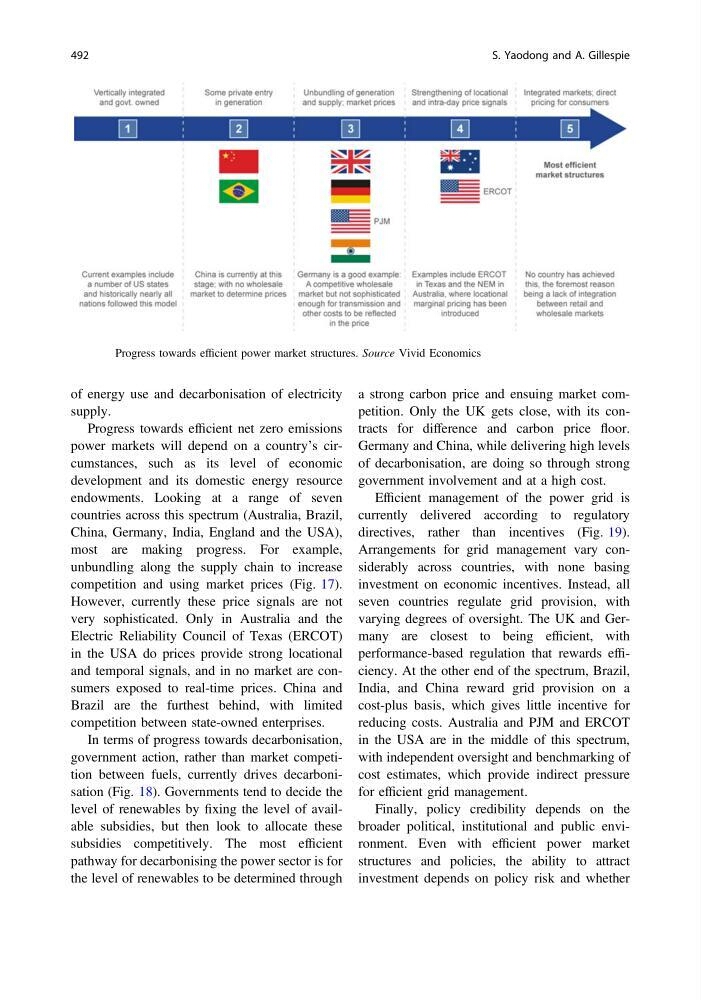
unbundling along the supply chain to increase
competition and using market prices (Fig. 17).
However, currently these price signals are not
very sophisticated. Only in Australia and the
Electric Reliability Council of Texas (ERCOT)
in the USA do prices provide strong locational
and temporal signals, and in no market are consumers exposed to real-time prices. China and
Brazil are the furthest behind, with limited
competition between state-owned enterprises.
In terms of progress towards decarbonisation,
government action, rather than market competition between fuels, currently drives decarbonisation (Fig. 18). Governments tend to decide the
level of renewables by fixing the level of available subsidies, but then look to allocate these
subsidies competitively. The most efficient
pathway for decarbonising the power sector is for
the level of renewables to be determined through
a strong carbon price and ensuing market competition. Only the UK gets close, with its contracts for difference and carbon price floor.
Germany and China, while delivering high levels
of decarbonisation, are doing so through strong
government involvement and at a high cost.
Efficient management of the power grid is
currently delivered according to regulatory
directives, rather than incentives (Fig. 19).
Arrangements for grid management vary considerably across countries, with none basing
investment on economic incentives. Instead, all
seven countries regulate grid provision, with
varying degrees of oversight. The UK and Germany are closest to being efficient, with
performance-based regulation that rewards efficiency. At the other end of the spectrum, Brazil,
India, and China reward grid provision on a
cost-plus basis, which gives little incentive for
reducing costs. Australia and PJM and ERCOT
in the USA are in the middle of this spectrum,
with independent oversight and benchmarking of
cost estimates, which provide indirect pressure
for efficient grid management.
Finally, policy credibility depends on the
broader political, institutional and public environment. Even with efficient power market
structures and policies, the ability to attract
investment depends on policy risk and whether
Fig. 17 Progress towards efficient power market structures. Source Vivid Economics
492
S. Yaodong and A. Gillespie
supply.
Progress towards efficient net zero emissions
power markets will depend on a country’s circumstances, such as its level of economic
development and its domestic energy resource
endowments. Looking at a range of seven
countries across this spectrum (Australia, Brazil,
China, Germany, India, England and the USA),
most are making progress. For example,
unbundling along the supply chain to increase
competition and using market prices (Fig. 17).
However, currently these price signals are not
very sophisticated. Only in Australia and the
Electric Reliability Council of Texas (ERCOT)
in the USA do prices provide strong locational
and temporal signals, and in no market are consumers exposed to real-time prices. China and
Brazil are the furthest behind, with limited
competition between state-owned enterprises.
In terms of progress towards decarbonisation,
government action, rather than market competition between fuels, currently drives decarbonisation (Fig. 18). Governments tend to decide the
level of renewables by fixing the level of available subsidies, but then look to allocate these
subsidies competitively. The most efficient
pathway for decarbonising the power sector is for
the level of renewables to be determined through
a strong carbon price and ensuing market competition. Only the UK gets close, with its contracts for difference and carbon price floor.
Germany and China, while delivering high levels
of decarbonisation, are doing so through strong
government involvement and at a high cost.
Efficient management of the power grid is
currently delivered according to regulatory
directives, rather than incentives (Fig. 19).
Arrangements for grid management vary considerably across countries, with none basing
investment on economic incentives. Instead, all
seven countries regulate grid provision, with
varying degrees of oversight. The UK and Germany are closest to being efficient, with
performance-based regulation that rewards efficiency. At the other end of the spectrum, Brazil,
India, and China reward grid provision on a
cost-plus basis, which gives little incentive for
reducing costs. Australia and PJM and ERCOT
in the USA are in the middle of this spectrum,
with independent oversight and benchmarking of
cost estimates, which provide indirect pressure
for efficient grid management.
Finally, policy credibility depends on the
broader political, institutional and public environment. Even with efficient power market
structures and policies, the ability to attract
investment depends on policy risk and whether
Fig. 17 Progress towards efficient power market structures. Source Vivid Economics
492
S. Yaodong and A. Gillespie