

drilling costs tax deduction, tangible drilling
costs tax deduction, rental deduction, allowing a
working interest to be classified as active income,
and extending the depletion allowance to small
producers. These incentives strongly encouraged
drilling and development investment by mediumand small-sized enterprises, and accelerated shale
gas exploration and production.
Third, the open market environment is a
powerful impulse. The shale gas exploration and
development market in the USA is mature and
features diversified participants and sound competition. There are thousands of shale gas companies at present, with more than 2,000 drilling
rigs. 85% of shale gas is produced by small and
medium-sized companies, which take the lead in
making technological and industrial breakthroughs. Large companies enter and participate
in the market by acquiring and merging small
and medium-sized ones. This creates a market
environment characterised by a mix of large.
medium and small companies, an optimal combination of specialisation and collaboration, and
the efficient flow of capital throughout the value
chain.
Fourth, reasonable regulation acts as an
important guarantee for the shale gas industry.
The US government values regulation in shale
gas exploration and production and reasonably
delegates regulatory power to state governments.
The power to regulate interstate energy business
activities is shared by federal and state governments. In case of conflict between federal and
state regulations, the former prevails. Should
federal standards be lower than state standards,
both standards apply. The federal government
intervenes finitely in shale gas through supervision of environmental regulations and interstate
pipeline access. Specific regulatory power covering the time and place to exploit, as well as gas
well standards, is delegated to states.
Fifth, complete infrastructure and third-party
access supports the development of shale gas.
Gas pipeline networks and urban utility gas
facilities in the USA are well developed, greatly
reducing the need for early development investment and market risk. Statistics from the U.S.
Energy Information Administration show that the
lower 48 states now have 490,000 km of
pipelines, of which 349,000 are interstate and
141,000 intrastate. The complete separation of
gas exploitation from transport, the regulation of
pipeline transmission prices and the deregulation
of gas prices powerfully support the commercialisation of shale gas.
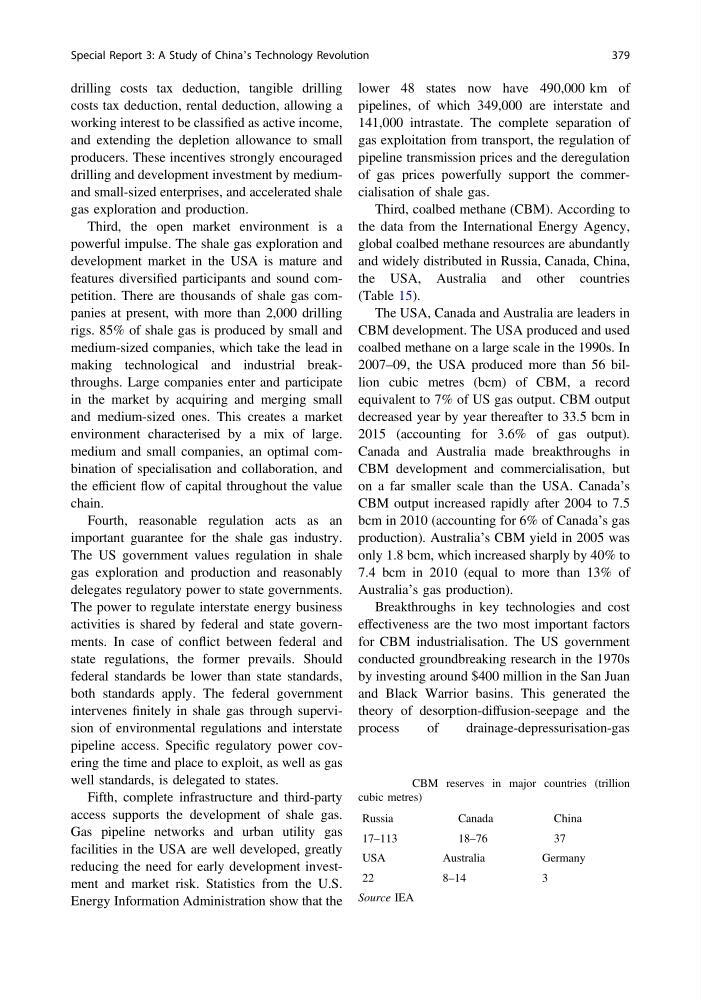
Third, coalbed methane (CBM). According to
the data from the International Energy Agency,
global coalbed methane resources are abundantly
and widely distributed in Russia, Canada, China,
the USA, Australia and other countries
(Table 15).
The USA, Canada and Australia are leaders in
CBM development. The USA produced and used
coalbed methane on a large scale in the 1990s. In
2007–09, the USA produced more than 56 billion cubic metres (bcm) of CBM, a record
equivalent to 7% of US gas output. CBM output
decreased year by year thereafter to 33.5 bcm in
2015 (accounting for 3.6% of gas output).
Canada and Australia made breakthroughs in
CBM development and commercialisation, but
on a far smaller scale than the USA. Canada’s
CBM output increased rapidly after 2004 to 7.5
bcm in 2010 (accounting for 6% of Canada’s gas
production). Australia’s CBM yield in 2005 was
only 1.8 bcm, which increased sharply by 40% to
7.4 bcm in 2010 (equal to more than 13% of
Australia’s gas production).
Breakthroughs in key technologies and cost
effectiveness are the two most important factors
for CBM industrialisation. The US government
conducted groundbreaking research in the 1970s
by investing around $400 million in the San Juan
and Black Warrior basins. This generated the
theory of desorption-diffusion-seepage and the
process
of
drainage-depressurisation-gas
Table 15 CBM reserves in major countries (trillion
cubic metres)
Russia
Canada
China
17–113
18–76
37
USA
Australia
Germany
22
8–14
3
Source IEA
Special Report 3: A Study of China’s Technology Revolution
379
costs tax deduction, rental deduction, allowing a
working interest to be classified as active income,
and extending the depletion allowance to small
producers. These incentives strongly encouraged
drilling and development investment by mediumand small-sized enterprises, and accelerated shale
gas exploration and production.
Third, the open market environment is a
powerful impulse. The shale gas exploration and
development market in the USA is mature and
features diversified participants and sound competition. There are thousands of shale gas companies at present, with more than 2,000 drilling
rigs. 85% of shale gas is produced by small and
medium-sized companies, which take the lead in
making technological and industrial breakthroughs. Large companies enter and participate
in the market by acquiring and merging small
and medium-sized ones. This creates a market
environment characterised by a mix of large.
medium and small companies, an optimal combination of specialisation and collaboration, and
the efficient flow of capital throughout the value
chain.
Fourth, reasonable regulation acts as an
important guarantee for the shale gas industry.
The US government values regulation in shale
gas exploration and production and reasonably
delegates regulatory power to state governments.
The power to regulate interstate energy business
activities is shared by federal and state governments. In case of conflict between federal and
state regulations, the former prevails. Should
federal standards be lower than state standards,
both standards apply. The federal government
intervenes finitely in shale gas through supervision of environmental regulations and interstate
pipeline access. Specific regulatory power covering the time and place to exploit, as well as gas
well standards, is delegated to states.
Fifth, complete infrastructure and third-party
access supports the development of shale gas.
Gas pipeline networks and urban utility gas
facilities in the USA are well developed, greatly
reducing the need for early development investment and market risk. Statistics from the U.S.
Energy Information Administration show that the
lower 48 states now have 490,000 km of
pipelines, of which 349,000 are interstate and
141,000 intrastate. The complete separation of
gas exploitation from transport, the regulation of
pipeline transmission prices and the deregulation
of gas prices powerfully support the commercialisation of shale gas.
Third, coalbed methane (CBM). According to
the data from the International Energy Agency,
global coalbed methane resources are abundantly
and widely distributed in Russia, Canada, China,
the USA, Australia and other countries
(Table 15).
The USA, Canada and Australia are leaders in
CBM development. The USA produced and used
coalbed methane on a large scale in the 1990s. In
2007–09, the USA produced more than 56 billion cubic metres (bcm) of CBM, a record
equivalent to 7% of US gas output. CBM output
decreased year by year thereafter to 33.5 bcm in
2015 (accounting for 3.6% of gas output).
Canada and Australia made breakthroughs in
CBM development and commercialisation, but
on a far smaller scale than the USA. Canada’s
CBM output increased rapidly after 2004 to 7.5
bcm in 2010 (accounting for 6% of Canada’s gas
production). Australia’s CBM yield in 2005 was
only 1.8 bcm, which increased sharply by 40% to
7.4 bcm in 2010 (equal to more than 13% of
Australia’s gas production).
Breakthroughs in key technologies and cost
effectiveness are the two most important factors
for CBM industrialisation. The US government
conducted groundbreaking research in the 1970s
by investing around $400 million in the San Juan
and Black Warrior basins. This generated the
theory of desorption-diffusion-seepage and the
process
of
drainage-depressurisation-gas
Table 15 CBM reserves in major countries (trillion
cubic metres)
Russia
Canada
China
17–113
18–76
37
USA
Australia
Germany
22
8–14
3
Source IEA
Special Report 3: A Study of China’s Technology Revolution
379