

in 1997
69 show there are around 922 trillion
cubic metres of unconventional gas in the world,
nearly half of which is shale gas (456 trillion
cubic metres, mainly in North America, Asia,
Latin America, the Mediterranean and Australia).
Recent data released by the U.S. Energy Information Administration (EIA) show that geological reserves of shale gas in 137 sets of shale
formation in 95 shale gas basins in 42 countries
(including the USA) in 10 geographical regions
of the world are around 1,013 trillion cubic
metres. 220.69 trillion cubic metres of shale gas
are technically recoverable, up 33.67 trillion
cubic metres from the reserves announced in
2011.
Pre-project evaluation and fundamental
research of shale gas resources have been carried
out in more than 30 countries. Large-scale
commercial exploitation has been achieved in
the USA and Canada. China has entered the stage
of massive development. Other countries are still
at the initial stage of shale gas development. As
the earliest pioneer in terms of shale gas exploration and exploitation in the world, the USA
possesses the most mature technologies. The
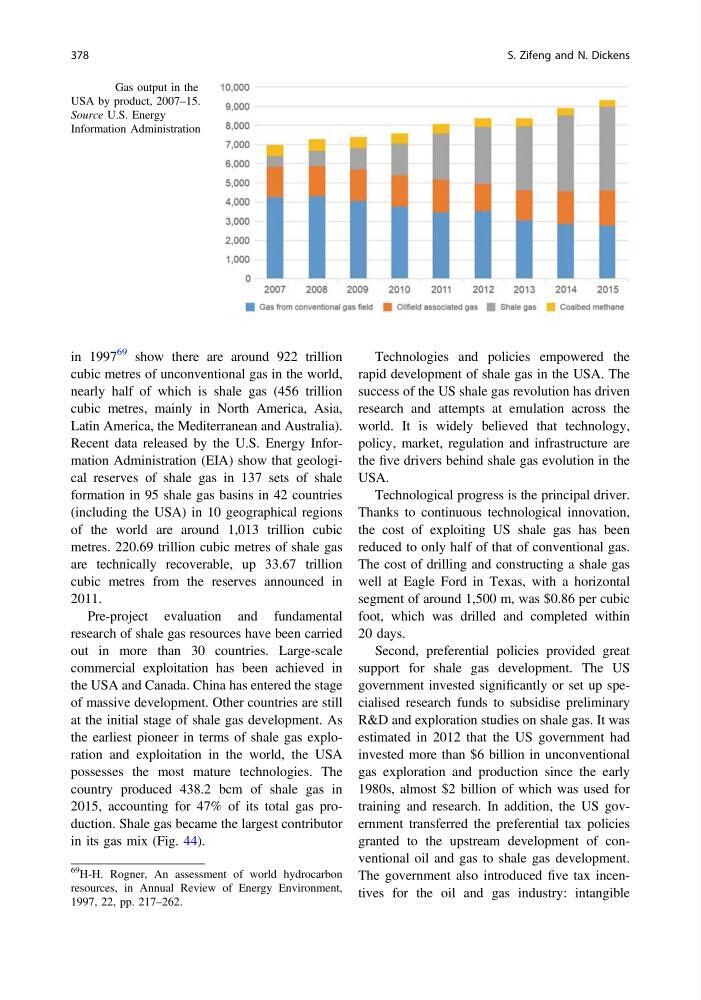
country produced 438.2 bcm of shale gas in
2015, accounting for 47% of its total gas production. Shale gas became the largest contributor
in its gas mix (Fig. 44).
Technologies and policies empowered the
rapid development of shale gas in the USA. The
success of the US shale gas revolution has driven
research and attempts at emulation across the
world. It is widely believed that technology,
policy, market, regulation and infrastructure are
the five drivers behind shale gas evolution in the
USA.
Technological progress is the principal driver.
Thanks to continuous technological innovation,
the cost of exploiting US shale gas has been
reduced to only half of that of conventional gas.
The cost of drilling and constructing a shale gas
well at Eagle Ford in Texas, with a horizontal
segment of around 1,500 m, was $0.86 per cubic
foot, which was drilled and completed within
20 days.
Second, preferential policies provided great
support for shale gas development. The US
government invested significantly or set up specialised research funds to subsidise preliminary
R&D and exploration studies on shale gas. It was
estimated in 2012 that the US government had
invested more than $6 billion in unconventional
gas exploration and production since the early
1980s, almost $2 billion of which was used for
training and research. In addition, the US government transferred the preferential tax policies
granted to the upstream development of conventional oil and gas to shale gas development.
The government also introduced five tax incentives for the oil and gas industry: intangible
Fig. 44 Gas output in the
USA by product, 2007–15.
Source U.S. Energy
Information Administration
69
H-H. Rogner, An assessment of world hydrocarbon
resources, in Annual Review of Energy Environment,
1997, 22, pp. 217–262.
378
S. Zifeng and N. Dickens
69 show there are around 922 trillion
cubic metres of unconventional gas in the world,
nearly half of which is shale gas (456 trillion
cubic metres, mainly in North America, Asia,
Latin America, the Mediterranean and Australia).
Recent data released by the U.S. Energy Information Administration (EIA) show that geological reserves of shale gas in 137 sets of shale
formation in 95 shale gas basins in 42 countries
(including the USA) in 10 geographical regions
of the world are around 1,013 trillion cubic
metres. 220.69 trillion cubic metres of shale gas
are technically recoverable, up 33.67 trillion
cubic metres from the reserves announced in
2011.
Pre-project evaluation and fundamental
research of shale gas resources have been carried
out in more than 30 countries. Large-scale
commercial exploitation has been achieved in
the USA and Canada. China has entered the stage
of massive development. Other countries are still
at the initial stage of shale gas development. As
the earliest pioneer in terms of shale gas exploration and exploitation in the world, the USA
possesses the most mature technologies. The
country produced 438.2 bcm of shale gas in
2015, accounting for 47% of its total gas production. Shale gas became the largest contributor
in its gas mix (Fig. 44).
Technologies and policies empowered the
rapid development of shale gas in the USA. The
success of the US shale gas revolution has driven
research and attempts at emulation across the
world. It is widely believed that technology,
policy, market, regulation and infrastructure are
the five drivers behind shale gas evolution in the
USA.
Technological progress is the principal driver.
Thanks to continuous technological innovation,
the cost of exploiting US shale gas has been
reduced to only half of that of conventional gas.
The cost of drilling and constructing a shale gas
well at Eagle Ford in Texas, with a horizontal
segment of around 1,500 m, was $0.86 per cubic
foot, which was drilled and completed within
20 days.
Second, preferential policies provided great
support for shale gas development. The US
government invested significantly or set up specialised research funds to subsidise preliminary
R&D and exploration studies on shale gas. It was
estimated in 2012 that the US government had
invested more than $6 billion in unconventional
gas exploration and production since the early
1980s, almost $2 billion of which was used for
training and research. In addition, the US government transferred the preferential tax policies
granted to the upstream development of conventional oil and gas to shale gas development.
The government also introduced five tax incentives for the oil and gas industry: intangible
Fig. 44 Gas output in the
USA by product, 2007–15.
Source U.S. Energy
Information Administration
69
H-H. Rogner, An assessment of world hydrocarbon
resources, in Annual Review of Energy Environment,
1997, 22, pp. 217–262.
378
S. Zifeng and N. Dickens