

demands, these economies generally focus more
on energy efficiency, often driven by policy.
Spain and Italy have lower energy use per person
than other developed economies. This is because
they are more service-oriented, with fewer
energy-intensive industries and a Mediterranean
climate that reduces the need for heating and
cooling relative to other countries.
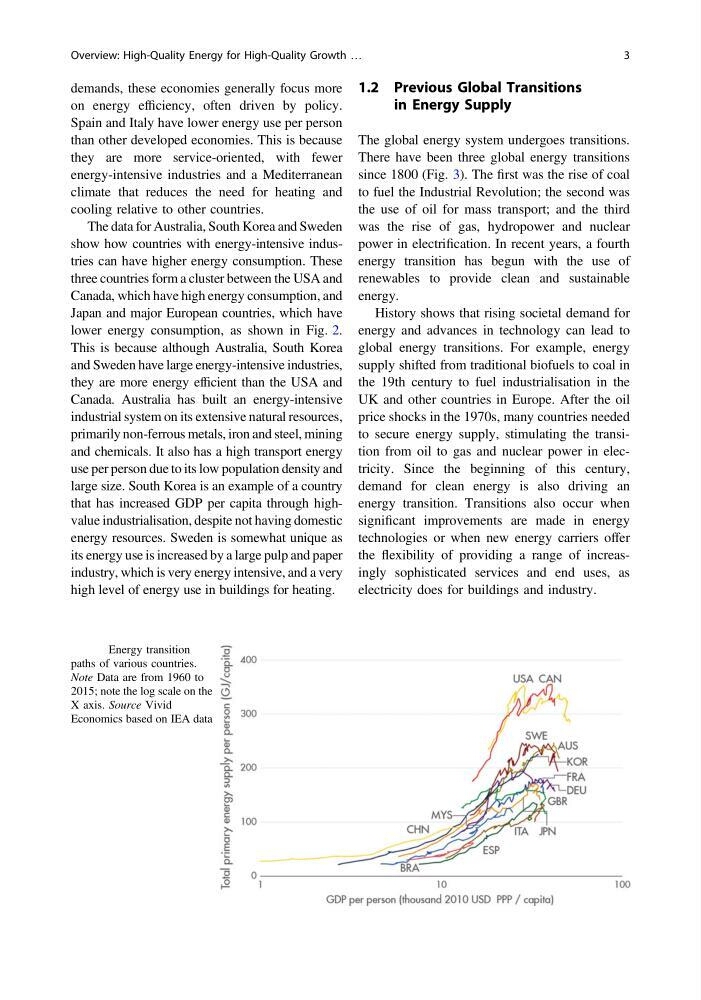
The data for Australia, South Korea and Sweden
show how countries with energy-intensive industries can have higher energy consumption. These
three countries form a cluster between the USA and
Canada, which have high energy consumption, and
Japan and major European countries, which have
lower energy consumption, as shown in Fig. 2.
This is because although Australia, South Korea
and Sweden have large energy-intensive industries,
they are more energy efficient than the USA and
Canada. Australia has built an energy-intensive
industrial system on its extensive natural resources,
primarily non-ferrous metals, iron and steel, mining
and chemicals. It also has a high transport energy
use per person due to its low population density and
large size. South Korea is an example of a country
that has increased GDP per capita through highvalue industrialisation, despite not having domestic
energy resources. Sweden is somewhat unique as
its energy use is increased by a large pulp and paper
industry, which is very energy intensive, and a very
high level of energy use in buildings for heating.
1.2 Previous Global Transitions
in Energy Supply
The global energy system undergoes transitions.
There have been three global energy transitions
since 1800 (Fig. 3). The first was the rise of coal
to fuel the Industrial Revolution; the second was
the use of oil for mass transport; and the third
was the rise of gas, hydropower and nuclear
power in electrification. In recent years, a fourth
energy transition has begun with the use of
renewables to provide clean and sustainable
energy.
History shows that rising societal demand for
energy and advances in technology can lead to
global energy transitions. For example, energy
supply shifted from traditional biofuels to coal in
the 19th century to fuel industrialisation in the
UK and other countries in Europe. After the oil
price shocks in the 1970s, many countries needed
to secure energy supply, stimulating the transition from oil to gas and nuclear power in electricity. Since the beginning of this century,
demand for clean energy is also driving an
energy transition. Transitions also occur when
significant improvements are made in energy
technologies or when new energy carriers offer
the flexibility of providing a range of increasingly sophisticated services and end uses, as
electricity does for buildings and industry.
Fig. 2 Energy transition
paths of various countries.
Note Data are from 1960 to
2015; note the log scale on the
X axis. Source Vivid
Economics based on IEA data
Overview: High-Quality Energy for High-Quality Growth …
3
on energy efficiency, often driven by policy.
Spain and Italy have lower energy use per person
than other developed economies. This is because
they are more service-oriented, with fewer
energy-intensive industries and a Mediterranean
climate that reduces the need for heating and
cooling relative to other countries.
The data for Australia, South Korea and Sweden
show how countries with energy-intensive industries can have higher energy consumption. These
three countries form a cluster between the USA and
Canada, which have high energy consumption, and
Japan and major European countries, which have
lower energy consumption, as shown in Fig. 2.
This is because although Australia, South Korea
and Sweden have large energy-intensive industries,
they are more energy efficient than the USA and
Canada. Australia has built an energy-intensive
industrial system on its extensive natural resources,
primarily non-ferrous metals, iron and steel, mining
and chemicals. It also has a high transport energy
use per person due to its low population density and
large size. South Korea is an example of a country
that has increased GDP per capita through highvalue industrialisation, despite not having domestic
energy resources. Sweden is somewhat unique as
its energy use is increased by a large pulp and paper
industry, which is very energy intensive, and a very
high level of energy use in buildings for heating.
1.2 Previous Global Transitions
in Energy Supply
The global energy system undergoes transitions.
There have been three global energy transitions
since 1800 (Fig. 3). The first was the rise of coal
to fuel the Industrial Revolution; the second was
the use of oil for mass transport; and the third
was the rise of gas, hydropower and nuclear
power in electrification. In recent years, a fourth
energy transition has begun with the use of
renewables to provide clean and sustainable
energy.
History shows that rising societal demand for
energy and advances in technology can lead to
global energy transitions. For example, energy
supply shifted from traditional biofuels to coal in
the 19th century to fuel industrialisation in the
UK and other countries in Europe. After the oil
price shocks in the 1970s, many countries needed
to secure energy supply, stimulating the transition from oil to gas and nuclear power in electricity. Since the beginning of this century,
demand for clean energy is also driving an
energy transition. Transitions also occur when
significant improvements are made in energy
technologies or when new energy carriers offer
the flexibility of providing a range of increasingly sophisticated services and end uses, as
electricity does for buildings and industry.
Fig. 2 Energy transition
paths of various countries.
Note Data are from 1960 to
2015; note the log scale on the
X axis. Source Vivid
Economics based on IEA data
Overview: High-Quality Energy for High-Quality Growth …
3