

Energy transition is a long-term structural
change to the energy system, where entirely new
components arise or old patterns fundamentally
change. The energy system is in a constant state of
evolution. For example, China’s and India’s energy
systems have been organised to date around
low-cost energy; France’s transition to nuclear
power in the 1970s was driven by the desire for
security after the oil price shocks of that decade;
and Germany’s energy transition in the 2010s was
propelled by the desire for clean energy. Transition
also occurs when new end uses require new forms
of energy. For example, the development of electric
vehicles changes the transport industry’s demand
for oil into the need for electric power.
1.1 Energy Demand Changes
with Economic
Development
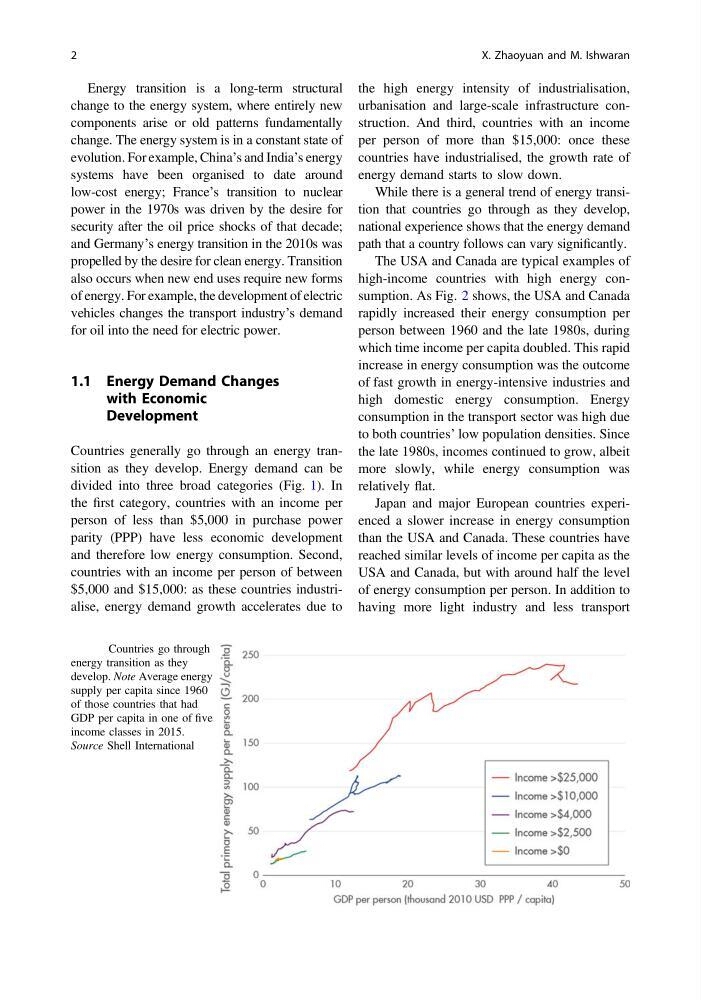
Countries generally go through an energy transition as they develop. Energy demand can be
divided into three broad categories (Fig. 1). In
the first category, countries with an income per
person of less than $5,000 in purchase power
parity (PPP) have less economic development
and therefore low energy consumption. Second,
countries with an income per person of between
$5,000 and $15,000: as these countries industrialise, energy demand growth accelerates due to
the high energy intensity of industrialisation,
urbanisation and large-scale infrastructure construction. And third, countries with an income
per person of more than $15,000: once these
countries have industrialised, the growth rate of
energy demand starts to slow down.
While there is a general trend of energy transition that countries go through as they develop,
national experience shows that the energy demand
path that a country follows can vary significantly.
The USA and Canada are typical examples of
high-income countries with high energy consumption. As Fig. 2 shows, the USA and Canada
rapidly increased their energy consumption per
person between 1960 and the late 1980s, during
which time income per capita doubled. This rapid
increase in energy consumption was the outcome
of fast growth in energy-intensive industries and
high domestic energy consumption. Energy
consumption in the transport sector was high due
to both countries’ low population densities. Since
the late 1980s, incomes continued to grow, albeit
more slowly, while energy consumption was
relatively flat.
Japan and major European countries experienced a slower increase in energy consumption
than the USA and Canada. These countries have
reached similar levels of income per capita as the
USA and Canada, but with around half the level
of energy consumption per person. In addition to
having more light industry and less transport
Fig. 1 Countries go through
energy transition as they
develop. Note Average energy
supply per capita since 1960
of those countries that had
GDP per capita in one of five
income classes in 2015.
Source Shell International
2
X. Zhaoyuan and M. Ishwaran
change to the energy system, where entirely new
components arise or old patterns fundamentally
change. The energy system is in a constant state of
evolution. For example, China’s and India’s energy
systems have been organised to date around
low-cost energy; France’s transition to nuclear
power in the 1970s was driven by the desire for
security after the oil price shocks of that decade;
and Germany’s energy transition in the 2010s was
propelled by the desire for clean energy. Transition
also occurs when new end uses require new forms
of energy. For example, the development of electric
vehicles changes the transport industry’s demand
for oil into the need for electric power.
1.1 Energy Demand Changes
with Economic
Development
Countries generally go through an energy transition as they develop. Energy demand can be
divided into three broad categories (Fig. 1). In
the first category, countries with an income per
person of less than $5,000 in purchase power
parity (PPP) have less economic development
and therefore low energy consumption. Second,
countries with an income per person of between
$5,000 and $15,000: as these countries industrialise, energy demand growth accelerates due to
the high energy intensity of industrialisation,
urbanisation and large-scale infrastructure construction. And third, countries with an income
per person of more than $15,000: once these
countries have industrialised, the growth rate of
energy demand starts to slow down.
While there is a general trend of energy transition that countries go through as they develop,
national experience shows that the energy demand
path that a country follows can vary significantly.
The USA and Canada are typical examples of
high-income countries with high energy consumption. As Fig. 2 shows, the USA and Canada
rapidly increased their energy consumption per
person between 1960 and the late 1980s, during
which time income per capita doubled. This rapid
increase in energy consumption was the outcome
of fast growth in energy-intensive industries and
high domestic energy consumption. Energy
consumption in the transport sector was high due
to both countries’ low population densities. Since
the late 1980s, incomes continued to grow, albeit
more slowly, while energy consumption was
relatively flat.
Japan and major European countries experienced a slower increase in energy consumption
than the USA and Canada. These countries have
reached similar levels of income per capita as the
USA and Canada, but with around half the level
of energy consumption per person. In addition to
having more light industry and less transport
Fig. 1 Countries go through
energy transition as they
develop. Note Average energy
supply per capita since 1960
of those countries that had
GDP per capita in one of five
income classes in 2015.
Source Shell International
2
X. Zhaoyuan and M. Ishwaran