

technologies and constructed several pilot projects, such as Continuon’s (now Liander) facility
in the Netherlands, EDP’s microgeneration
facility in Portugal, the Mad River Park microgrid in Vermont, USA, and the Aichi microgrid
in Japan. China also has several pilot microgrid
projects, including those at Sino-Singapore
Tianjin Eco-City; Henan University of Economics and Law; the Guangdong Foshan combined cooling, heat and power (CCHP) microgrid
system; and the integrated solar, wind, diesel,
energy storage and seawater desalination system
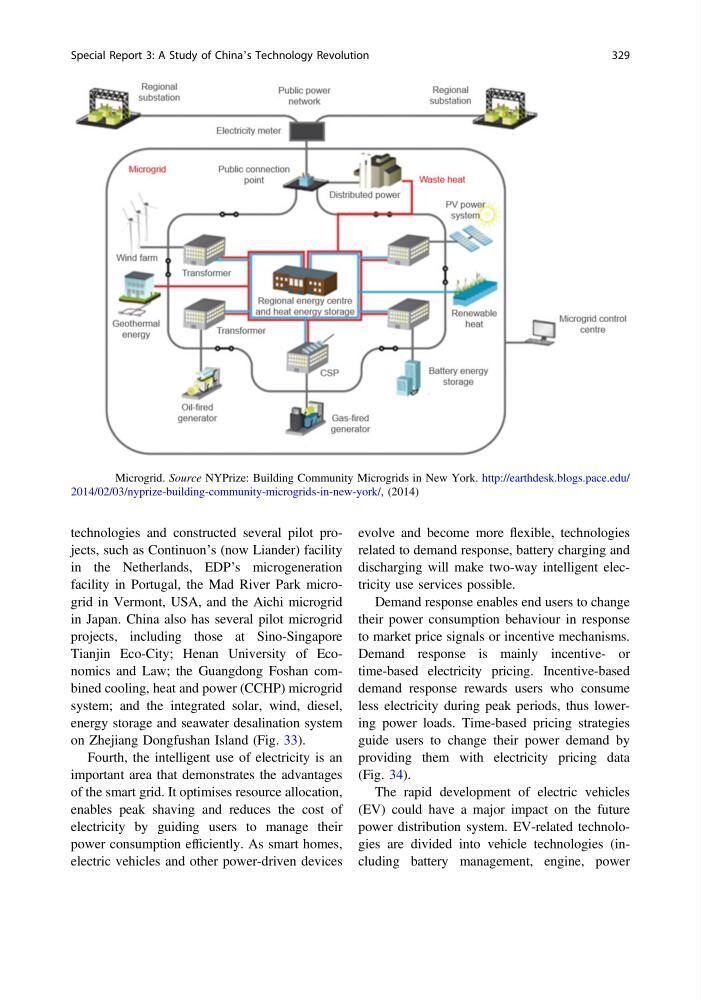
on Zhejiang Dongfushan Island (Fig. 33).
Fourth, the intelligent use of electricity is an
important area that demonstrates the advantages
of the smart grid. It optimises resource allocation,
enables peak shaving and reduces the cost of
electricity by guiding users to manage their
power consumption efficiently. As smart homes,
electric vehicles and other power-driven devices
evolve and become more flexible, technologies
related to demand response, battery charging and
discharging will make two-way intelligent electricity use services possible.
Demand response enables end users to change
their power consumption behaviour in response
to market price signals or incentive mechanisms.
Demand response is mainly incentive- or
time-based electricity pricing. Incentive-based
demand response rewards users who consume
less electricity during peak periods, thus lowering power loads. Time-based pricing strategies
guide users to change their power demand by
providing them with electricity pricing data
(Fig. 34).
The rapid development of electric vehicles
(EV) could have a major impact on the future
power distribution system. EV-related technologies are divided into vehicle technologies (including battery management, engine, power
Fig. 33 Microgrid. Source NYPrize: Building Community Microgrids in New York. http://earthdesk.blogs.pace.edu/
2014/02/03/nyprize-building-community-microgrids-in-new-york/, (2014)
Special Report 3: A Study of China’s Technology Revolution
329
in the Netherlands, EDP’s microgeneration
facility in Portugal, the Mad River Park microgrid in Vermont, USA, and the Aichi microgrid
in Japan. China also has several pilot microgrid
projects, including those at Sino-Singapore
Tianjin Eco-City; Henan University of Economics and Law; the Guangdong Foshan combined cooling, heat and power (CCHP) microgrid
system; and the integrated solar, wind, diesel,
energy storage and seawater desalination system
on Zhejiang Dongfushan Island (Fig. 33).
Fourth, the intelligent use of electricity is an
important area that demonstrates the advantages
of the smart grid. It optimises resource allocation,
enables peak shaving and reduces the cost of
electricity by guiding users to manage their
power consumption efficiently. As smart homes,
electric vehicles and other power-driven devices
evolve and become more flexible, technologies
related to demand response, battery charging and
discharging will make two-way intelligent electricity use services possible.
Demand response enables end users to change
their power consumption behaviour in response
to market price signals or incentive mechanisms.
Demand response is mainly incentive- or
time-based electricity pricing. Incentive-based
demand response rewards users who consume
less electricity during peak periods, thus lowering power loads. Time-based pricing strategies
guide users to change their power demand by
providing them with electricity pricing data
(Fig. 34).
The rapid development of electric vehicles
(EV) could have a major impact on the future
power distribution system. EV-related technologies are divided into vehicle technologies (including battery management, engine, power
Fig. 33 Microgrid. Source NYPrize: Building Community Microgrids in New York. http://earthdesk.blogs.pace.edu/
2014/02/03/nyprize-building-community-microgrids-in-new-york/, (2014)
Special Report 3: A Study of China’s Technology Revolution
329