

revolutionised US and, to an extent, global gas
markets. This occurred with apparent speed: the
first large-scale application of hydraulic fracturing technology was in 2000, with production
increasing rapidly from 2006. However, this
rapid revolution was supported by factors that
had long been in place. The supply of tight gas
below ground has been present for millions of
years, while above ground the exploration and
production industry was mature, and the demand
for gas in the USA had been established for
decades, with an extensive pipeline network
serving the widest possible set of consumers.
The USA also has a mature liberalised gas market that provides incentives to any technology
that can supply demand. It can be argued that it is
this market factor that triggered the shale gas
revolution, because it is when gas prices
increased due to the prospect of a shortage that
hydraulic fracturing technology was applied at a
large enough scale to change the energy system.
The change metric shows that the fuel mix of US
energy production has changed significantly in
the 1970s–1980s. It was only when gas prices
increased that the change metric rose above historic highs (Figs. 21 and 22).
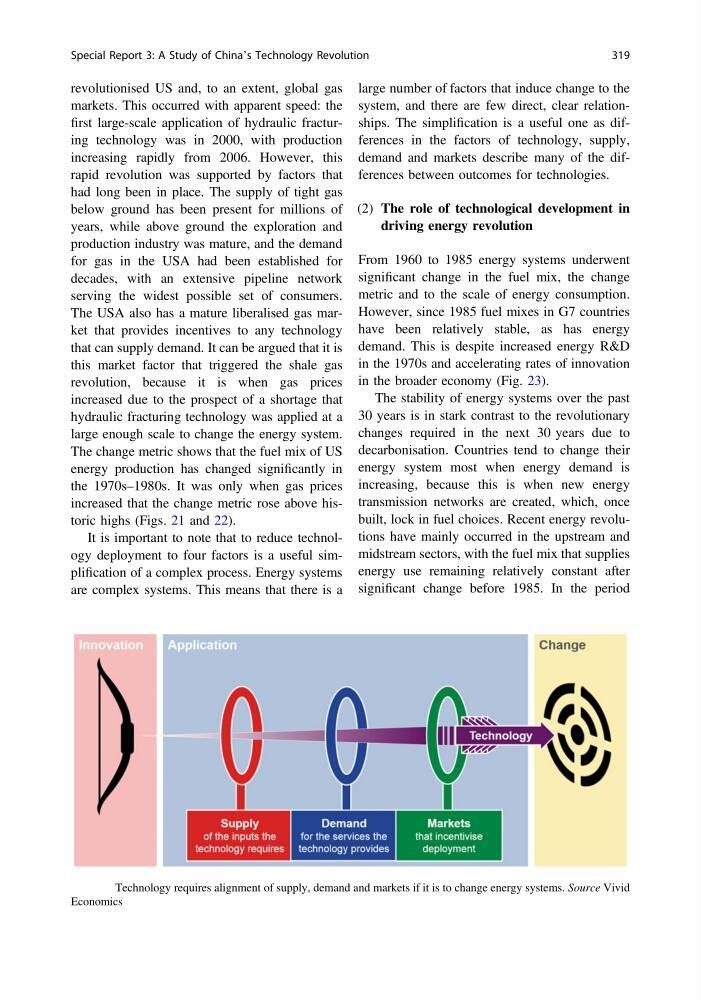
It is important to note that to reduce technology deployment to four factors is a useful simplification of a complex process. Energy systems
are complex systems. This means that there is a
large number of factors that induce change to the
system, and there are few direct, clear relationships. The simplification is a useful one as differences in the factors of technology, supply,
demand and markets describe many of the differences between outcomes for technologies.
(2) The role of technological development in
driving energy revolution
From 1960 to 1985 energy systems underwent
significant change in the fuel mix, the change
metric and to the scale of energy consumption.
However, since 1985 fuel mixes in G7 countries
have been relatively stable, as has energy
demand. This is despite increased energy R&D
in the 1970s and accelerating rates of innovation
in the broader economy (Fig. 23).
The stability of energy systems over the past
30 years is in stark contrast to the revolutionary
changes required in the next 30 years due to
decarbonisation. Countries tend to change their
energy system most when energy demand is
increasing, because this is when new energy
transmission networks are created, which, once
built, lock in fuel choices. Recent energy revolutions have mainly occurred in the upstream and
midstream sectors, with the fuel mix that supplies
energy use remaining relatively constant after
significant change before 1985. In the period
Fig. 21 Technology requires alignment of supply, demand and markets if it is to change energy systems. Source Vivid
Economics
Special Report 3: A Study of China’s Technology Revolution
319
markets. This occurred with apparent speed: the
first large-scale application of hydraulic fracturing technology was in 2000, with production
increasing rapidly from 2006. However, this
rapid revolution was supported by factors that
had long been in place. The supply of tight gas
below ground has been present for millions of
years, while above ground the exploration and
production industry was mature, and the demand
for gas in the USA had been established for
decades, with an extensive pipeline network
serving the widest possible set of consumers.
The USA also has a mature liberalised gas market that provides incentives to any technology
that can supply demand. It can be argued that it is
this market factor that triggered the shale gas
revolution, because it is when gas prices
increased due to the prospect of a shortage that
hydraulic fracturing technology was applied at a
large enough scale to change the energy system.
The change metric shows that the fuel mix of US
energy production has changed significantly in
the 1970s–1980s. It was only when gas prices
increased that the change metric rose above historic highs (Figs. 21 and 22).
It is important to note that to reduce technology deployment to four factors is a useful simplification of a complex process. Energy systems
are complex systems. This means that there is a
large number of factors that induce change to the
system, and there are few direct, clear relationships. The simplification is a useful one as differences in the factors of technology, supply,
demand and markets describe many of the differences between outcomes for technologies.
(2) The role of technological development in
driving energy revolution
From 1960 to 1985 energy systems underwent
significant change in the fuel mix, the change
metric and to the scale of energy consumption.
However, since 1985 fuel mixes in G7 countries
have been relatively stable, as has energy
demand. This is despite increased energy R&D
in the 1970s and accelerating rates of innovation
in the broader economy (Fig. 23).
The stability of energy systems over the past
30 years is in stark contrast to the revolutionary
changes required in the next 30 years due to
decarbonisation. Countries tend to change their
energy system most when energy demand is
increasing, because this is when new energy
transmission networks are created, which, once
built, lock in fuel choices. Recent energy revolutions have mainly occurred in the upstream and
midstream sectors, with the fuel mix that supplies
energy use remaining relatively constant after
significant change before 1985. In the period
Fig. 21 Technology requires alignment of supply, demand and markets if it is to change energy systems. Source Vivid
Economics
Special Report 3: A Study of China’s Technology Revolution
319