

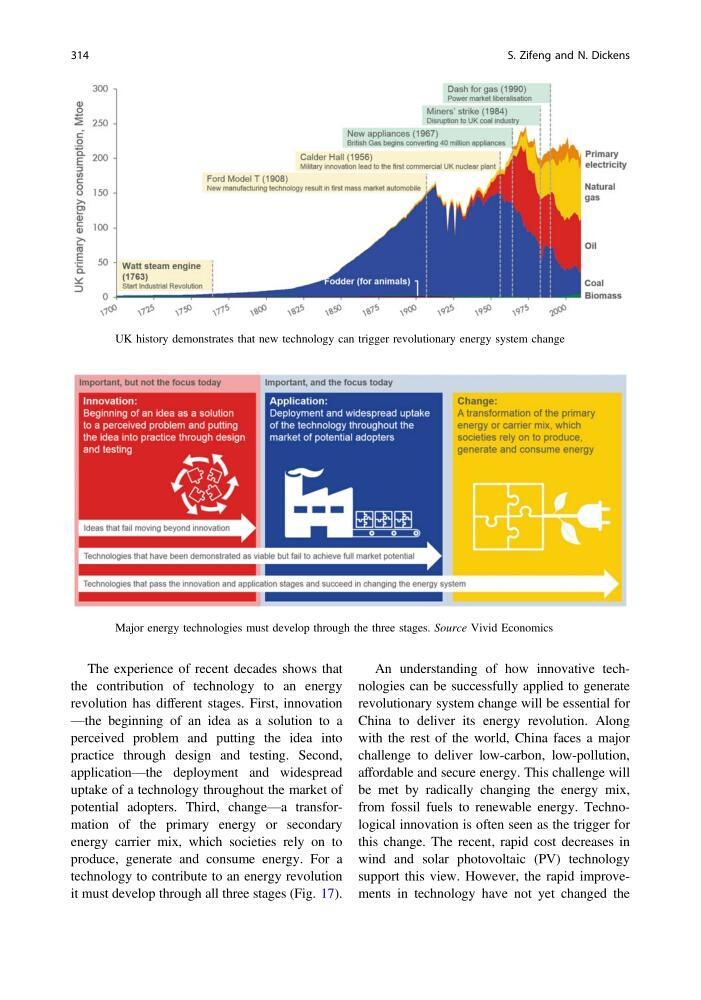
The experience of recent decades shows that
the contribution of technology to an energy
revolution has different stages. First, innovation
—the beginning of an idea as a solution to a
perceived problem and putting the idea into
practice through design and testing. Second,
application—the deployment and widespread
uptake of a technology throughout the market of
potential adopters. Third, change—a transformation of the primary energy or secondary
energy carrier mix, which societies rely on to
produce, generate and consume energy. For a
technology to contribute to an energy revolution
it must develop through all three stages (Fig. 17).
An understanding of how innovative technologies can be successfully applied to generate
revolutionary system change will be essential for
China to deliver its energy revolution. Along
with the rest of the world, China faces a major
challenge to deliver low-carbon, low-pollution,
affordable and secure energy. This challenge will
be met by radically changing the energy mix,
from fossil fuels to renewable energy. Technological innovation is often seen as the trigger for
this change. The recent, rapid cost decreases in
wind and solar photovoltaic (PV) technology
support this view. However, the rapid improvements in technology have not yet changed the
Fig. 16 UK history demonstrates that new technology can trigger revolutionary energy system change
Fig. 17 Major energy technologies must develop through the three stages. Source Vivid Economics
314
S. Zifeng and N. Dickens
the contribution of technology to an energy
revolution has different stages. First, innovation
—the beginning of an idea as a solution to a
perceived problem and putting the idea into
practice through design and testing. Second,
application—the deployment and widespread
uptake of a technology throughout the market of
potential adopters. Third, change—a transformation of the primary energy or secondary
energy carrier mix, which societies rely on to
produce, generate and consume energy. For a
technology to contribute to an energy revolution
it must develop through all three stages (Fig. 17).
An understanding of how innovative technologies can be successfully applied to generate
revolutionary system change will be essential for
China to deliver its energy revolution. Along
with the rest of the world, China faces a major
challenge to deliver low-carbon, low-pollution,
affordable and secure energy. This challenge will
be met by radically changing the energy mix,
from fossil fuels to renewable energy. Technological innovation is often seen as the trigger for
this change. The recent, rapid cost decreases in
wind and solar photovoltaic (PV) technology
support this view. However, the rapid improvements in technology have not yet changed the
Fig. 16 UK history demonstrates that new technology can trigger revolutionary energy system change
Fig. 17 Major energy technologies must develop through the three stages. Source Vivid Economics
314
S. Zifeng and N. Dickens