

alternative to petrol when the project first started
in 1975, but predictions of future high oil prices
led to sustained generous subsidies and a belief
that ethanol would become competitive over time.
After economic difficulties in 1985 and the oil
price crash in 1986 guaranteed prices for ethanol
were reduced, causing ethanol production to fall
for the first time since the programme began. It
was only following this reduction in guaranteed
prices that ethanol production efficiency began to
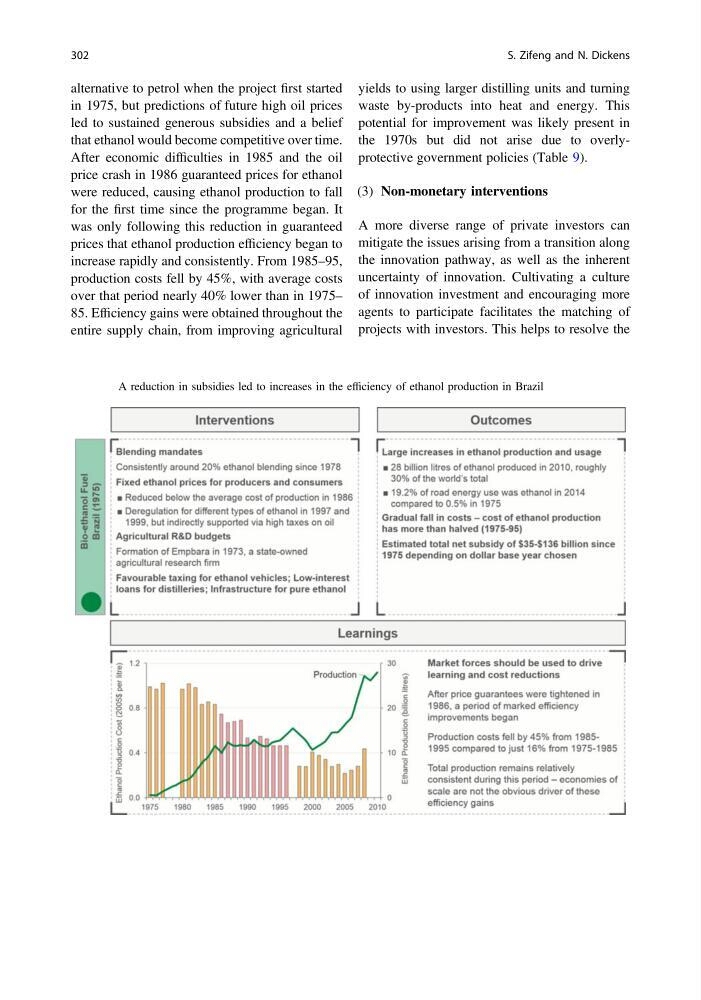
increase rapidly and consistently. From 1985–95,
production costs fell by 45%, with average costs
over that period nearly 40% lower than in 1975–
85. Efficiency gains were obtained throughout the
entire supply chain, from improving agricultural
yields to using larger distilling units and turning
waste by-products into heat and energy. This
potential for improvement was likely present in
the 1970s but did not arise due to overlyprotective government policies (Table 9).
(3) Non-monetary interventions
A more diverse range of private investors can
mitigate the issues arising from a transition along
the innovation pathway, as well as the inherent
uncertainty of innovation. Cultivating a culture
of innovation investment and encouraging more
agents to participate facilitates the matching of
projects with investors. This helps to resolve the
Table 9 A reduction in subsidies led to increases in the efficiency of ethanol production in Brazil
302
S. Zifeng and N. Dickens
in 1975, but predictions of future high oil prices
led to sustained generous subsidies and a belief
that ethanol would become competitive over time.
After economic difficulties in 1985 and the oil
price crash in 1986 guaranteed prices for ethanol
were reduced, causing ethanol production to fall
for the first time since the programme began. It
was only following this reduction in guaranteed
prices that ethanol production efficiency began to
increase rapidly and consistently. From 1985–95,
production costs fell by 45%, with average costs
over that period nearly 40% lower than in 1975–
85. Efficiency gains were obtained throughout the
entire supply chain, from improving agricultural
yields to using larger distilling units and turning
waste by-products into heat and energy. This
potential for improvement was likely present in
the 1970s but did not arise due to overlyprotective government policies (Table 9).
(3) Non-monetary interventions
A more diverse range of private investors can
mitigate the issues arising from a transition along
the innovation pathway, as well as the inherent
uncertainty of innovation. Cultivating a culture
of innovation investment and encouraging more
agents to participate facilitates the matching of
projects with investors. This helps to resolve the
Table 9 A reduction in subsidies led to increases in the efficiency of ethanol production in Brazil
302
S. Zifeng and N. Dickens