

generally create a new or improved service or
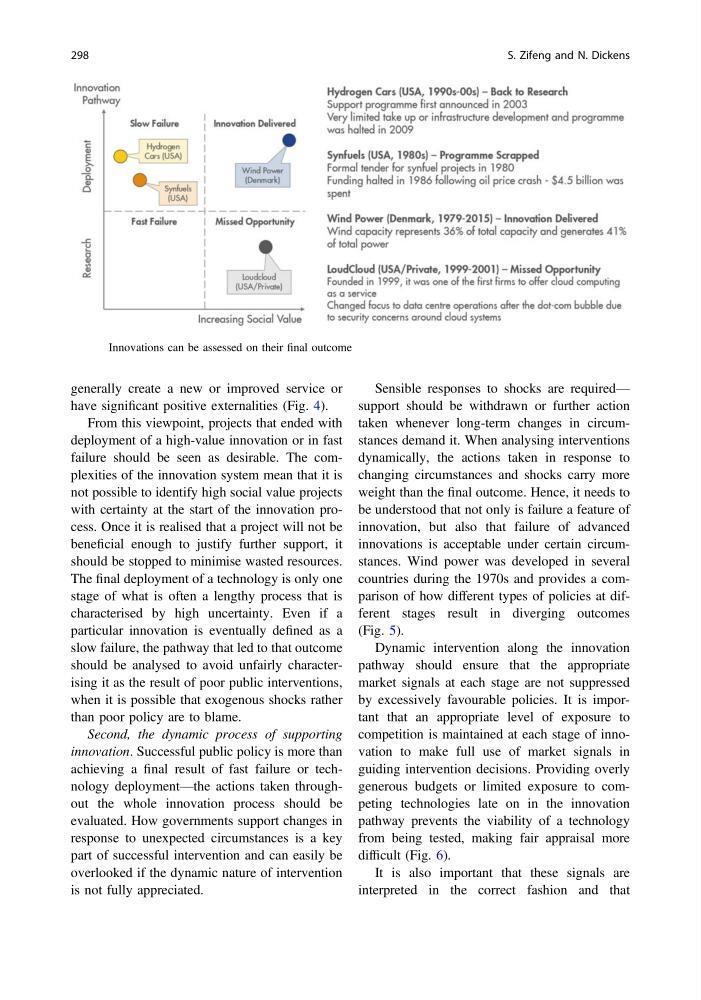
have significant positive externalities (Fig. 4).
From this viewpoint, projects that ended with
deployment of a high-value innovation or in fast
failure should be seen as desirable. The complexities of the innovation system mean that it is
not possible to identify high social value projects
with certainty at the start of the innovation process. Once it is realised that a project will not be
beneficial enough to justify further support, it
should be stopped to minimise wasted resources.
The final deployment of a technology is only one
stage of what is often a lengthy process that is
characterised by high uncertainty. Even if a
particular innovation is eventually defined as a
slow failure, the pathway that led to that outcome
should be analysed to avoid unfairly characterising it as the result of poor public interventions,
when it is possible that exogenous shocks rather
than poor policy are to blame.
Second, the dynamic process of supporting
innovation. Successful public policy is more than
achieving a final result of fast failure or technology deployment—the actions taken throughout the whole innovation process should be
evaluated. How governments support changes in
response to unexpected circumstances is a key
part of successful intervention and can easily be
overlooked if the dynamic nature of intervention
is not fully appreciated.
Sensible responses to shocks are required—
support should be withdrawn or further action
taken whenever long-term changes in circumstances demand it. When analysing interventions
dynamically, the actions taken in response to
changing circumstances and shocks carry more
weight than the final outcome. Hence, it needs to
be understood that not only is failure a feature of
innovation, but also that failure of advanced
innovations is acceptable under certain circumstances. Wind power was developed in several
countries during the 1970s and provides a comparison of how different types of policies at different stages result in diverging outcomes
(Fig. 5).
Dynamic intervention along the innovation
pathway should ensure that the appropriate
market signals at each stage are not suppressed
by excessively favourable policies. It is important that an appropriate level of exposure to
competition is maintained at each stage of innovation to make full use of market signals in
guiding intervention decisions. Providing overly
generous budgets or limited exposure to competing technologies late on in the innovation
pathway prevents the viability of a technology
from being tested, making fair appraisal more
difficult (Fig. 6).
It is also important that these signals are
interpreted in the correct fashion and that
Fig. 4 Innovations can be assessed on their final outcome
298
S. Zifeng and N. Dickens
have significant positive externalities (Fig. 4).
From this viewpoint, projects that ended with
deployment of a high-value innovation or in fast
failure should be seen as desirable. The complexities of the innovation system mean that it is
not possible to identify high social value projects
with certainty at the start of the innovation process. Once it is realised that a project will not be
beneficial enough to justify further support, it
should be stopped to minimise wasted resources.
The final deployment of a technology is only one
stage of what is often a lengthy process that is
characterised by high uncertainty. Even if a
particular innovation is eventually defined as a
slow failure, the pathway that led to that outcome
should be analysed to avoid unfairly characterising it as the result of poor public interventions,
when it is possible that exogenous shocks rather
than poor policy are to blame.
Second, the dynamic process of supporting
innovation. Successful public policy is more than
achieving a final result of fast failure or technology deployment—the actions taken throughout the whole innovation process should be
evaluated. How governments support changes in
response to unexpected circumstances is a key
part of successful intervention and can easily be
overlooked if the dynamic nature of intervention
is not fully appreciated.
Sensible responses to shocks are required—
support should be withdrawn or further action
taken whenever long-term changes in circumstances demand it. When analysing interventions
dynamically, the actions taken in response to
changing circumstances and shocks carry more
weight than the final outcome. Hence, it needs to
be understood that not only is failure a feature of
innovation, but also that failure of advanced
innovations is acceptable under certain circumstances. Wind power was developed in several
countries during the 1970s and provides a comparison of how different types of policies at different stages result in diverging outcomes
(Fig. 5).
Dynamic intervention along the innovation
pathway should ensure that the appropriate
market signals at each stage are not suppressed
by excessively favourable policies. It is important that an appropriate level of exposure to
competition is maintained at each stage of innovation to make full use of market signals in
guiding intervention decisions. Providing overly
generous budgets or limited exposure to competing technologies late on in the innovation
pathway prevents the viability of a technology
from being tested, making fair appraisal more
difficult (Fig. 6).
It is also important that these signals are
interpreted in the correct fashion and that
Fig. 4 Innovations can be assessed on their final outcome
298
S. Zifeng and N. Dickens