

which rose to $290 million in 1992. In the final
two years of the project (2002–03), average
yearly funding stood at $550 million, 10 times
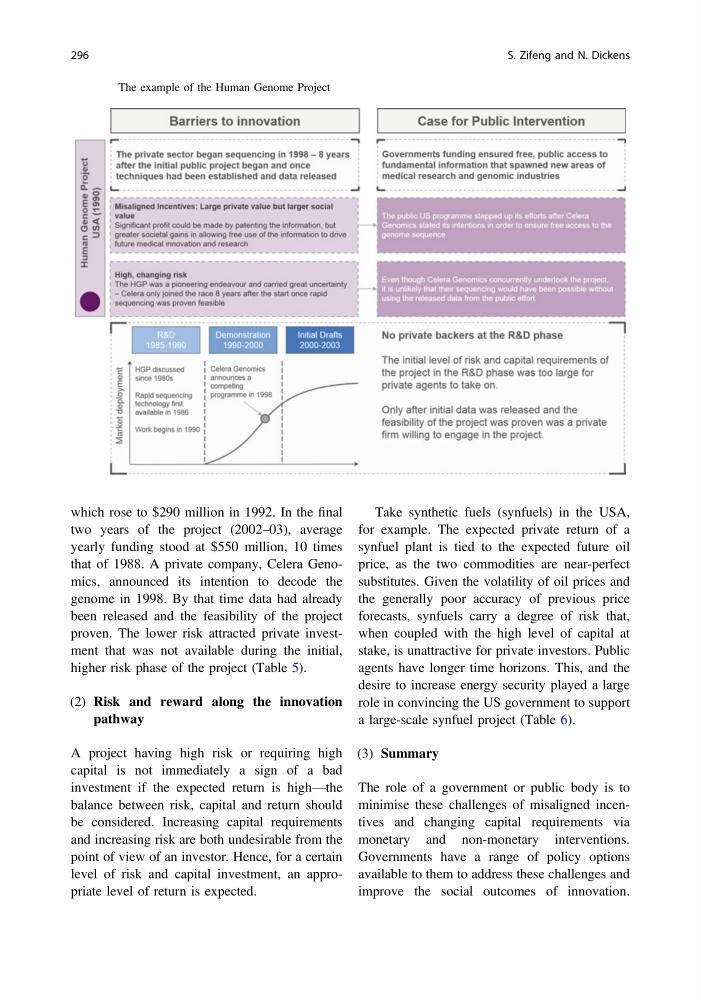
that of 1988. A private company, Celera Genomics, announced its intention to decode the
genome in 1998. By that time data had already
been released and the feasibility of the project
proven. The lower risk attracted private investment that was not available during the initial,
higher risk phase of the project (Table 5).
(2) Risk and reward along the innovation
pathway
A project having high risk or requiring high
capital is not immediately a sign of a bad
investment if the expected return is high—the
balance between risk, capital and return should
be considered. Increasing capital requirements
and increasing risk are both undesirable from the
point of view of an investor. Hence, for a certain
level of risk and capital investment, an appropriate level of return is expected.
Take synthetic fuels (synfuels) in the USA,
for example. The expected private return of a
synfuel plant is tied to the expected future oil
price, as the two commodities are near-perfect
substitutes. Given the volatility of oil prices and
the generally poor accuracy of previous price
forecasts, synfuels carry a degree of risk that,
when coupled with the high level of capital at
stake, is unattractive for private investors. Public
agents have longer time horizons. This, and the
desire to increase energy security played a large
role in convincing the US government to support
a large-scale synfuel project (Table 6).
(3) Summary
The role of a government or public body is to
minimise these challenges of misaligned incentives and changing capital requirements via
monetary and non-monetary interventions.
Governments have a range of policy options
available to them to address these challenges and
improve the social outcomes of innovation.
Table 5 The example of the Human Genome Project
296
S. Zifeng and N. Dickens
two years of the project (2002–03), average
yearly funding stood at $550 million, 10 times
that of 1988. A private company, Celera Genomics, announced its intention to decode the
genome in 1998. By that time data had already
been released and the feasibility of the project
proven. The lower risk attracted private investment that was not available during the initial,
higher risk phase of the project (Table 5).
(2) Risk and reward along the innovation
pathway
A project having high risk or requiring high
capital is not immediately a sign of a bad
investment if the expected return is high—the
balance between risk, capital and return should
be considered. Increasing capital requirements
and increasing risk are both undesirable from the
point of view of an investor. Hence, for a certain
level of risk and capital investment, an appropriate level of return is expected.
Take synthetic fuels (synfuels) in the USA,
for example. The expected private return of a
synfuel plant is tied to the expected future oil
price, as the two commodities are near-perfect
substitutes. Given the volatility of oil prices and
the generally poor accuracy of previous price
forecasts, synfuels carry a degree of risk that,
when coupled with the high level of capital at
stake, is unattractive for private investors. Public
agents have longer time horizons. This, and the
desire to increase energy security played a large
role in convincing the US government to support
a large-scale synfuel project (Table 6).
(3) Summary
The role of a government or public body is to
minimise these challenges of misaligned incentives and changing capital requirements via
monetary and non-monetary interventions.
Governments have a range of policy options
available to them to address these challenges and
improve the social outcomes of innovation.
Table 5 The example of the Human Genome Project
296
S. Zifeng and N. Dickens