

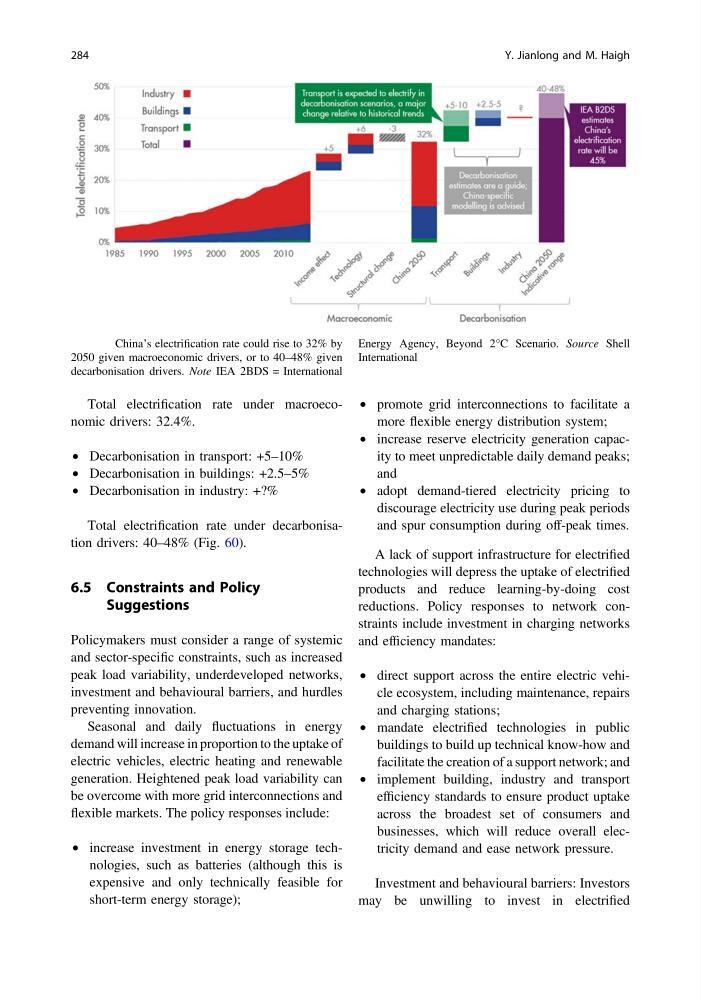
Total electrification rate under macroeconomic drivers: 32.4%.
• Decarbonisation in transport: +5–10%
• Decarbonisation in buildings: +2.5–5%
• Decarbonisation in industry: +?%
Total electrification rate under decarbonisation drivers: 40–48% (Fig. 60).
6.5 Constraints and Policy
Suggestions
Policymakers must consider a range of systemic
and sector-specific constraints, such as increased
peak load variability, underdeveloped networks,
investment and behavioural barriers, and hurdles
preventing innovation.
Seasonal and daily fluctuations in energy
demand will increase in proportion to the uptake of
electric vehicles, electric heating and renewable
generation. Heightened peak load variability can
be overcome with more grid interconnections and
flexible markets. The policy responses include:
• increase investment in energy storage technologies, such as batteries (although this is
expensive and only technically feasible for
short-term energy storage);
• promote grid interconnections to facilitate a
more flexible energy distribution system;
• increase reserve electricity generation capacity to meet unpredictable daily demand peaks;
and
• adopt demand-tiered electricity pricing to
discourage electricity use during peak periods
and spur consumption during off-peak times.
A lack of support infrastructure for electrified
technologies will depress the uptake of electrified
products and reduce learning-by-doing cost
reductions. Policy responses to network constraints include investment in charging networks
and efficiency mandates:
• direct support across the entire electric vehicle ecosystem, including maintenance, repairs
and charging stations;
• mandate electrified technologies in public
buildings to build up technical know-how and
facilitate the creation of a support network; and
• implement building, industry and transport
efficiency standards to ensure product uptake
across the broadest set of consumers and
businesses, which will reduce overall electricity demand and ease network pressure.
Investment and behavioural barriers: Investors
may be unwilling to invest in electrified
Fig. 60 China’s electrification rate could rise to 32% by
2050 given macroeconomic drivers, or to 40–48% given
decarbonisation drivers. Note IEA 2BDS = International
Energy Agency, Beyond 2°C Scenario. Source Shell
International
284
Y. Jianlong and M. Haigh
• Decarbonisation in transport: +5–10%
• Decarbonisation in buildings: +2.5–5%
• Decarbonisation in industry: +?%
Total electrification rate under decarbonisation drivers: 40–48% (Fig. 60).
6.5 Constraints and Policy
Suggestions
Policymakers must consider a range of systemic
and sector-specific constraints, such as increased
peak load variability, underdeveloped networks,
investment and behavioural barriers, and hurdles
preventing innovation.
Seasonal and daily fluctuations in energy
demand will increase in proportion to the uptake of
electric vehicles, electric heating and renewable
generation. Heightened peak load variability can
be overcome with more grid interconnections and
flexible markets. The policy responses include:
• increase investment in energy storage technologies, such as batteries (although this is
expensive and only technically feasible for
short-term energy storage);
• promote grid interconnections to facilitate a
more flexible energy distribution system;
• increase reserve electricity generation capacity to meet unpredictable daily demand peaks;
and
• adopt demand-tiered electricity pricing to
discourage electricity use during peak periods
and spur consumption during off-peak times.
A lack of support infrastructure for electrified
technologies will depress the uptake of electrified
products and reduce learning-by-doing cost
reductions. Policy responses to network constraints include investment in charging networks
and efficiency mandates:
• direct support across the entire electric vehicle ecosystem, including maintenance, repairs
and charging stations;
• mandate electrified technologies in public
buildings to build up technical know-how and
facilitate the creation of a support network; and
• implement building, industry and transport
efficiency standards to ensure product uptake
across the broadest set of consumers and
businesses, which will reduce overall electricity demand and ease network pressure.
Investment and behavioural barriers: Investors
may be unwilling to invest in electrified
Fig. 60 China’s electrification rate could rise to 32% by
2050 given macroeconomic drivers, or to 40–48% given
decarbonisation drivers. Note IEA 2BDS = International
Energy Agency, Beyond 2°C Scenario. Source Shell
International
284
Y. Jianlong and M. Haigh